Key Takeaways
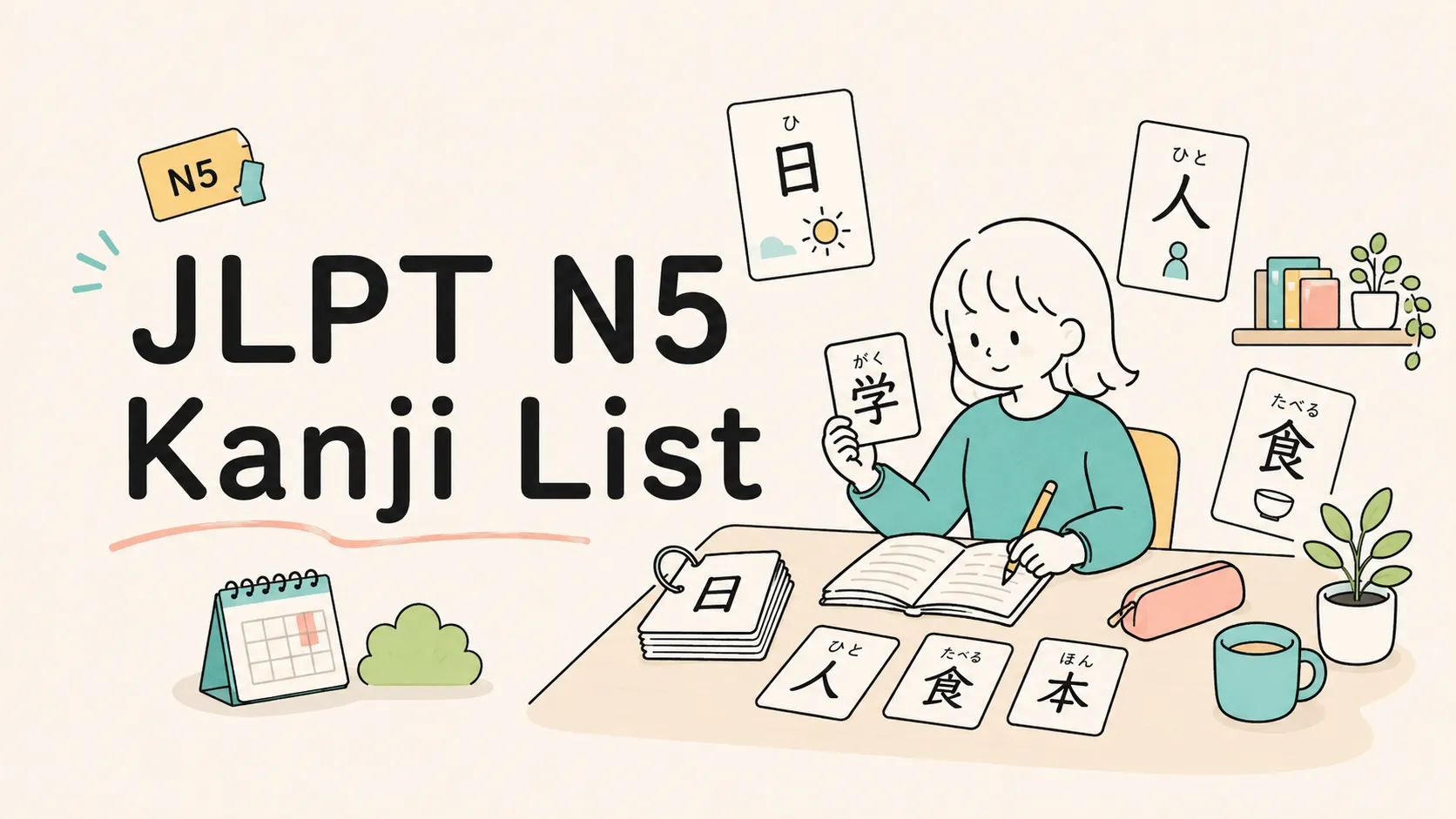
- This guide includes 112 common beginner kanji for practical JLPT N5 study.
- Each kanji includes up to two beginner-relevant readings, paired with real words whenever useful.
- You do not need to memorize every possible reading at once. Start with the reading inside the word you are actually learning, then use the AI prompts below to practice it in new sentences and quizzes.
Looking for a complete N5 kanji list? Start here.
Below are 112 common beginner kanji for JLPT N5 study, grouped by theme with simple meanings and real words that show you how each kanji is actually read.
I made this list for the kind of question I had as a self-taught beginner: if 日 can be read as にち, ひ, or something else depending on the word, what am I actually supposed to learn?
So instead of giving you a long list of isolated readings, I pair the most beginner-relevant readings with real words:
にち → 毎日(まいにち) · every day
ひ → 日(ひ) · day · sun
Some kanji have many more possible readings than the ones shown here. This is not meant to be a complete dictionary of every possible pronunciation. The goal is to give you a practical N5 reference without overwhelming you on day one.
You can also download a more detailed self-study PDF with additional vocabulary, kana, romaji, short conversations, and review pages, use the printable kanji chart for quick review, or copy one of the AI prompts further down to turn any kanji here into fresh practice sentences and quizzes.
Why Does One Kanji Have Different Readings?
Many kanji have more than one reading.
The two main types are on’yomi(音読み), which are historically Chinese-derived readings, and kun’yomi(訓読み), which come from native Japanese words.
As a rough pattern, you will often see on’yomi in words made from two or more kanji, while kun’yomi often appears when a kanji stands alone or has a hiragana ending. But this is not a perfect rule, and Japanese has plenty of exceptions.
Here are three examples:
| Kanji | One Reading in a Real Word | Another Reading in a Real Word |
|---|---|---|
| 日 | にち → 毎日(まいにち) · every day | ひ → 日(ひ) · day · sun |
| 食 | しょく → 食事(しょくじ) · meal | た → 食べる(たべる) · to eat |
| 行 | こう → 旅行(りょこう) · travel | い → 行く(いく) · to go |
You do not need to memorize every reading at once. Start by learning how the kanji is read inside a real word.
Complete N5 Kanji List by Theme
This complete n5 kanji list is grouped into seven themes.
For each kanji, I show a simple English meaning and up to two useful beginner readings in real words. If only one reading is especially useful at this level, I do not force a second one to fill the table.
Numbers and Counting
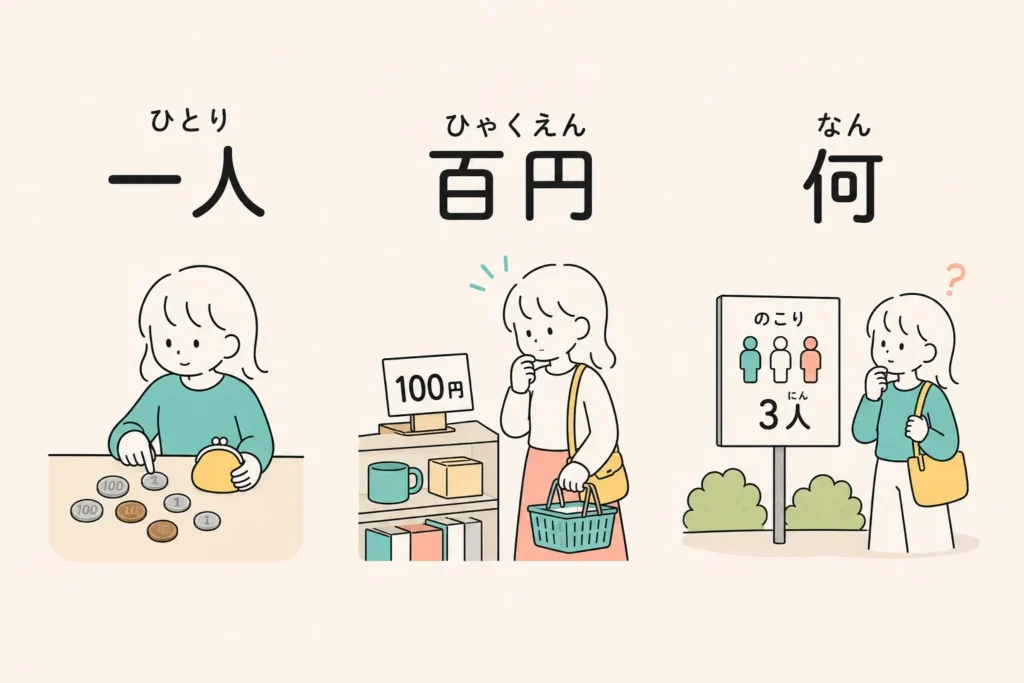
You will see these kanji in prices, dates, ages, counters, money, and everyday numbers.
| Kanji | Meaning | Reading & Example |
|---|---|---|
| 一 | one |
いち →
一月 · January
ひと → 一つ · one thing |
| 二 | two |
に →
二月 · February
ふた → 二つ · two things |
| 三 | three |
さん →
三人 · three people
みっ → 三つ · three things |
| 四 | four |
し →
四月 · April
よ → 四人 · four people |
| 五 | five |
ご →
五分 · five minutes
いつ → 五つ · five things |
| 六 | six |
ろく →
六時 · six o’clock
むっ → 六つ · six things |
| 七 | seven |
しち →
七月 · July
なな → 七つ · seven things |
| 八 | eight |
はち →
八時 · eight o’clock
やっ → 八つ · eight things |
| 九 | nine |
く →
九月 · September
ここの → 九つ · nine things |
| 十 | ten |
じゅう →
十分 · ten minutes
とお → 十 · ten |
| 百 | hundred | ひゃく → 百円 · 100 yen |
| 千 | thousand | せん → 千円 · 1,000 yen |
| 万 | ten thousand | まん → 一万円 · 10,000 yen |
| 億 | hundred million | おく → 一億 · one hundred million |
| 円 | yen | えん → 百円 · 100 yen |
| 半 | half | はん → 一時半 · 1:30 |
Time and Calendar
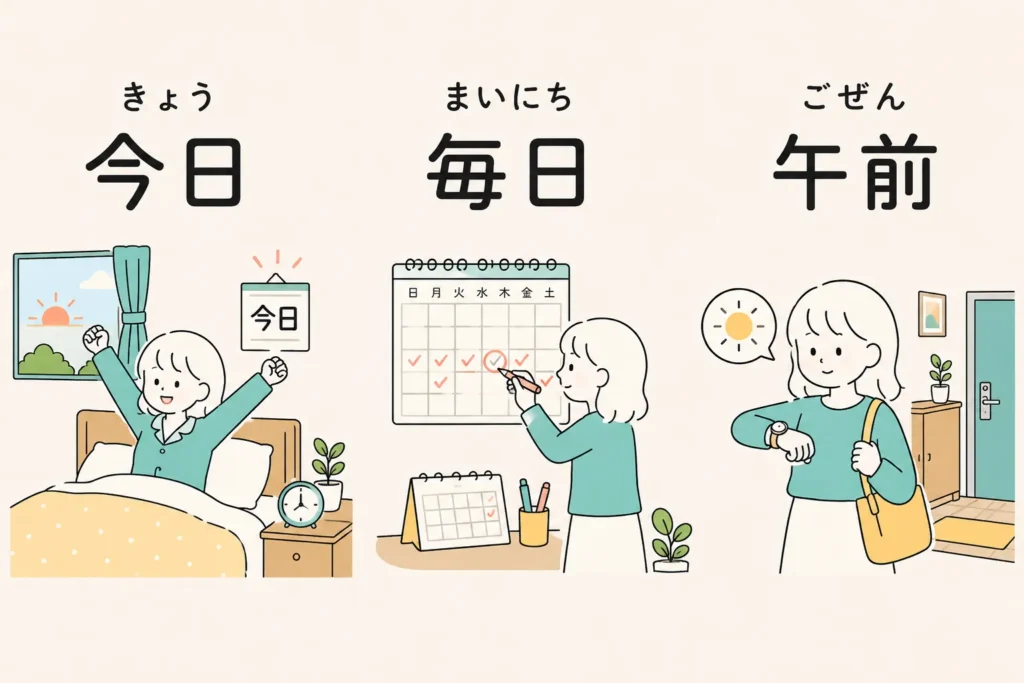
You will see these kanji in dates, schedules, opening hours, train timetables, and everyday conversations.
| Kanji | Meaning | Reading & Example |
|---|---|---|
| 日 | day · sun |
にち →
毎日 · every day
ひ → 日 · day · sun |
| 週 | week | しゅう → 毎週 · every week |
| 月 | month · moon |
げつ →
月曜日 · Monday
がつ → 一月 · January |
| 年 | year |
ねん →
来年 · next year
とし → 年 · year |
| 時 | time · hour |
じ →
八時 · eight o’clock
とき → 時 · time |
| 間 | interval · period |
かん →
一時間 · one hour
あいだ → 間 · between |
| 分 | minute · part |
ふん →
五分 · five minutes
ぶん → 半分 · half |
| 午 | noon | ご → 午後 · p.m. · afternoon |
| 前 | before · front |
ぜん →
午前 · a.m.
まえ → 前 · front · before |
| 後 | after · behind |
ご →
午後 · p.m. · afternoon
あと → 後 · after |
| 今 | now |
こん →
今月 · this month
いま → 今 · now |
| 先 | ahead · previous |
せん →
先生 · teacher
さき → 先 · ahead |
| 来 | come · next |
らい →
来年 · next year
く → 来る · to come |
| 毎 | every | まい → 毎日 · every day |
People and Family
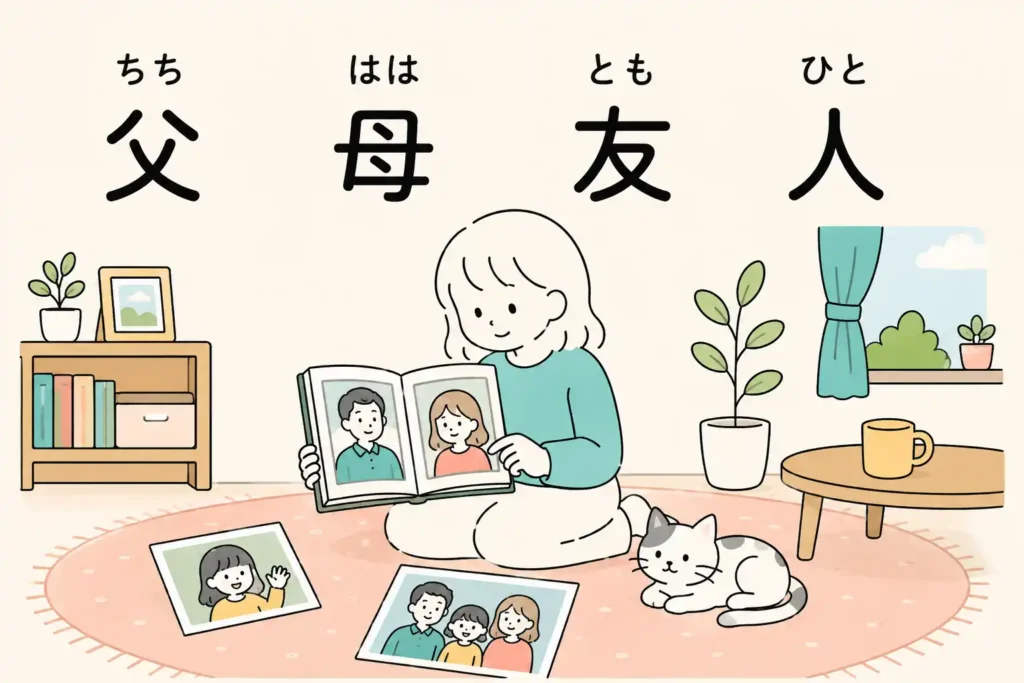
These kanji appear when talking about people, family, friends, and relationships.
| Kanji | Meaning | Reading & Example |
|---|---|---|
| 人 | person |
じん →
日本人 · Japanese person
ひと → 人 · person |
| 男 | man · male |
だん →
男子 · boy · male
おとこ → 男 · man |
| 女 | woman · female |
じょ →
女子 · girl · female
おんな → 女 · woman |
| 子 | child |
し →
女子 · girl · female
こ → 子ども · child |
| 母 | mother |
はは →
母 · my mother
かあ → お母さん · mother |
| 父 | father |
ちち →
父 · my father
とう → お父さん · father |
| 友 | friend |
ゆう →
友人 · friend
とも → 友だち · friend |
School, Language and Daily Words
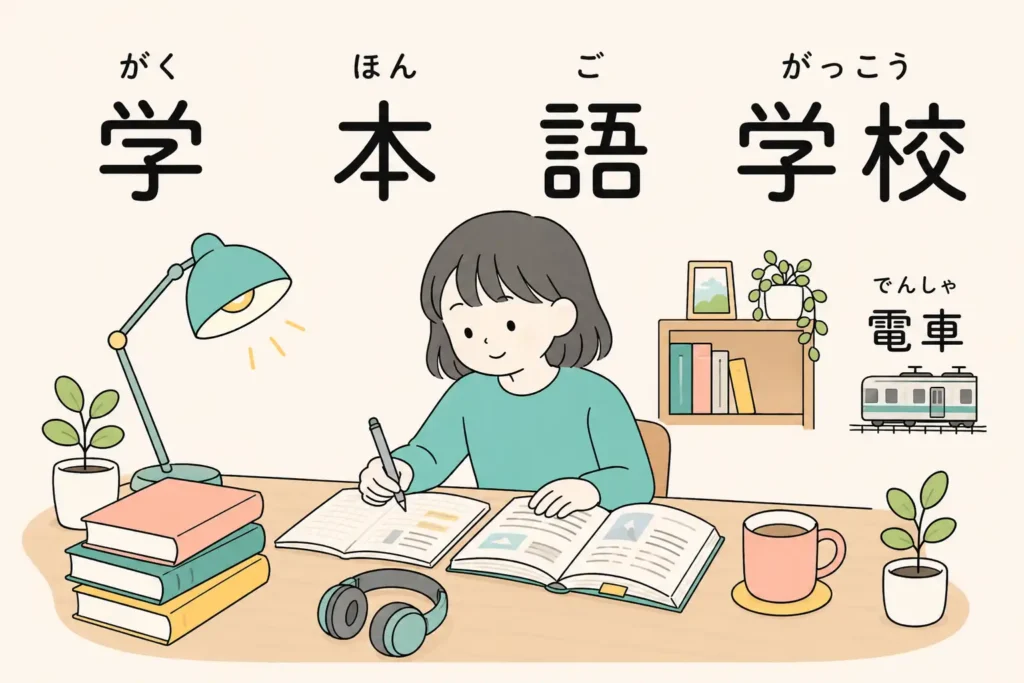
You will meet these kanji in schools, textbooks, language study, transport, shops, and everyday vocabulary.
Places and Directions
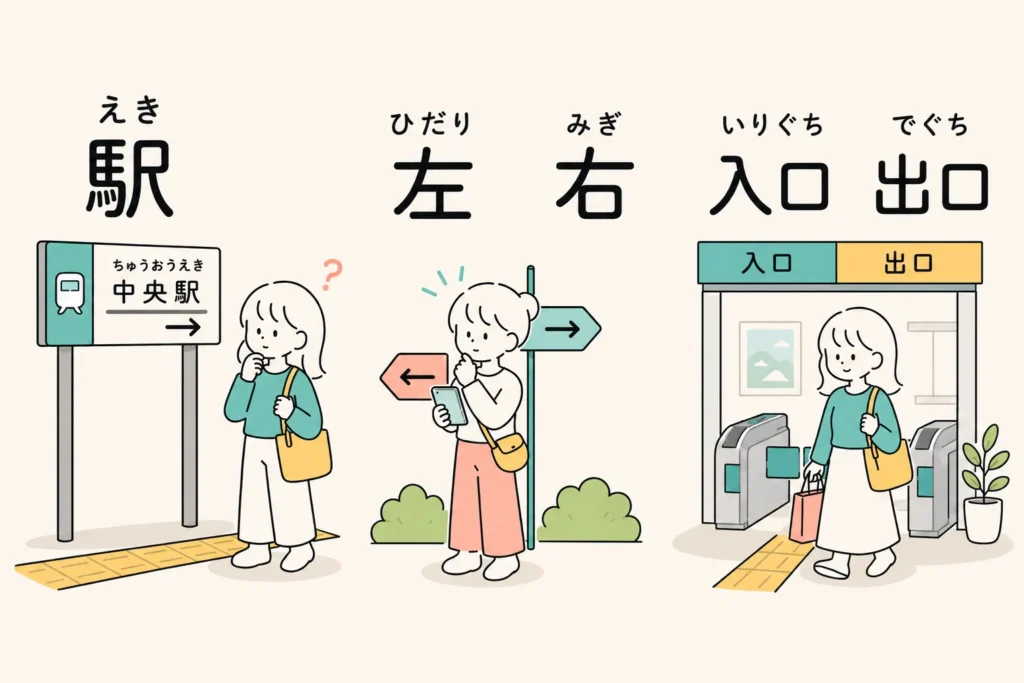
These kanji are especially useful on station signs, maps, addresses, entrances, exits, and travel apps.
| Kanji | Meaning | Reading & Example |
|---|---|---|
| 駅 | station | えき → 駅 · station |
| 道 | road · way |
みち → 道 · road
どう → 水道 · water supply · tap water |
| 国 | country |
こく →
外国 · foreign country
くに → 国 · country |
| 外 | outside · foreign |
がい →
外国 · foreign country
そと → 外 · outside |
| 内 | inside · within |
ない →
国内 · within the country
うち → 内 · inside |
| 上 | up · above |
じょう →
上手 · good at
うえ → 上 · above · on top |
| 下 | down · below |
か →
地下 · underground
した → 下 · below · under |
| 右 | right | みぎ → 右 · right |
| 左 | left |
さ →
左右 · left and right
ひだり → 左 · left |
| 中 | middle · inside |
ちゅう →
中国 · China
なか → 中 · inside |
| 北 | north | きた → 北口 · north exit |
| 西 | west | にし → 西口 · west exit |
| 東 | east |
とう →
東京 · Tokyo
ひがし → 東 · east |
| 南 | south |
なん →
南北 · north and south
みなみ → 南口 · south exit |
| 出 | exit · go out | で → 出口 · exit |
| 入 | enter · go in |
にゅう →
入学 · enter school
はい → 入る · to enter |
See Them in a Conversation
A: 駅はどこですか。 Where is the station?
B: この道をまっすぐ行って、右です。 Go straight down this road, then it is on the right.
A: 出口は近いですか。 Is the exit nearby?
B: はい、駅の中にあります。 Yes, it is inside the station.
Kanji in this conversation:
駅(えき) · 道(みち) · 行く(いく) · 右(みぎ) · 出口(でぐち) · 近い(ちかい) · 中(なか)
Nature and Everyday Life
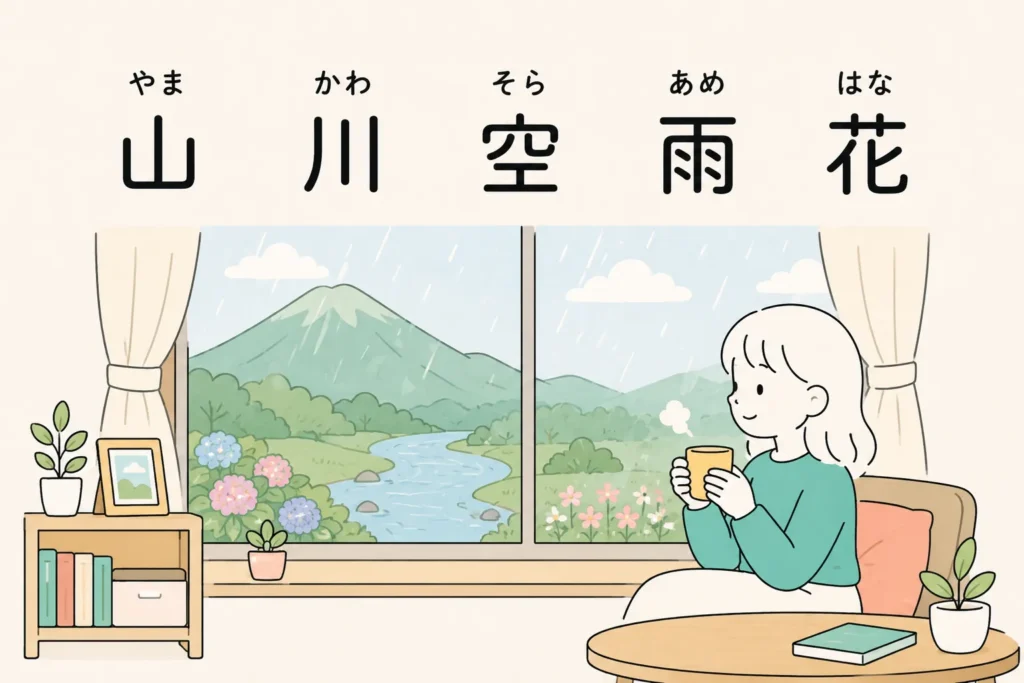
You will see these kanji in weather, landscapes, place names, days of the week, and daily life.
| Kanji | Meaning | Reading & Example |
|---|---|---|
| 火 | fire |
か →
火曜日 · Tuesday
ひ → 火 · fire |
| 水 | water |
すい →
水曜日 · Wednesday
みず → 水 · water |
| 木 | tree · wood |
もく →
木曜日 · Thursday
き → 木 · tree |
| 金 | gold · money |
きん →
金曜日 · Friday
かね → お金 · money |
| 土 | earth · soil |
ど →
土曜日 · Saturday
つち → 土 · soil |
| 海 | sea |
かい →
海外 · overseas
うみ → 海 · sea |
| 川 | river | かわ → 川 · river |
| 山 | mountain |
さん →
富士山 · Mount Fuji
やま → 山 · mountain |
| 花 | flower | はな → 花 · flower |
| 天 | sky · heaven | てん → 天気 · weather |
| 空 | sky · empty |
くう →
空気 · air
そら → 空 · sky |
| 晴 | clear weather | は → 晴れ · clear weather |
| 雨 | rain | あめ → 雨 · rain |
| 雪 | snow | ゆき → 雪 · snow |
| 雲 | cloud | くも → 雲 · cloud |
| 風 | wind |
ふう →
台風 · typhoon
かぜ → 風 · wind |
Everyday Actions and Descriptions
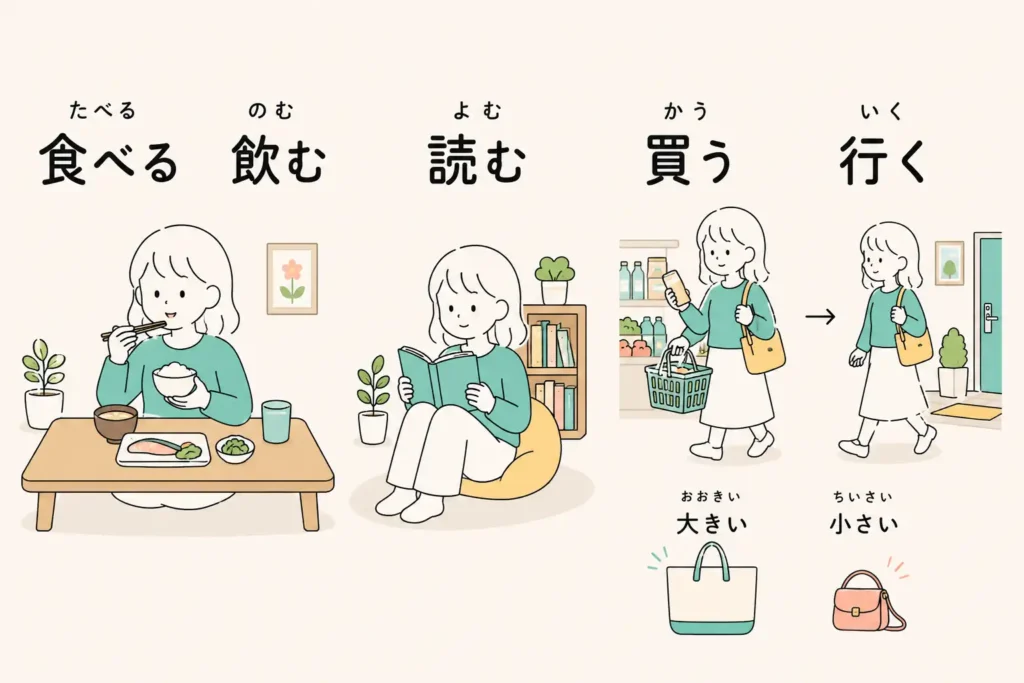
This group contains some of the first verbs and adjectives many Japanese learners use.
| Kanji | Meaning | Reading & Example |
|---|---|---|
| 見 | see · look |
けん →
見学 · study visit
み → 見る · to see · watch |
| 聞 | hear · listen · ask |
ぶん →
新聞 · newspaper
き → 聞く · to listen · ask |
| 書 | write |
しょ →
図書館 · library
か → 書く · to write |
| 言 | say · word |
げん →
言語 · language
い → 言う · to say |
| 話 | speak · talk |
わ →
電話 · telephone
はな → 話す · to speak |
| 読 | read |
どく →
読書 · reading
よ → 読む · to read |
| 行 | go · travel |
こう →
旅行 · travel
い → 行く · to go |
| 買 | buy | か → 買う · to buy |
| 食 | eat · food |
しょく →
食事 · meal
た → 食べる · to eat |
| 飲 | drink | の → 飲む · to drink |
| 休 | rest |
きゅう →
休日 · day off · holiday
やす → 休む · to rest |
| 会 | meet |
かい →
会社 · company
あ → 会う · to meet |
| 多 | many · much |
た →
多分 · probably
おお → 多い · many · much |
| 少 | few · little |
しょう →
少女 · girl
すく → 少ない · few · not much |
| 古 | old | ふる → 古い · old |
| 新 | new |
しん →
新聞 · newspaper
あたら → 新しい · new |
| 大 | big |
だい →
大学 · university
おお → 大きい · big |
| 小 | small |
しょう →
小学校 · elementary school
ちい → 小さい · small |
| 長 | long |
ちょう →
社長 · company president
なが → 長い · long |
| 短 | short |
たん →
短時間 · short time
みじか → 短い · short |
| 遠 | far |
えん →
遠足 · school excursion
とお → 遠い · far |
| 近 | near |
きん →
最近 · recently
ちか → 近い · near |
| 白 | white |
はく →
白紙 · blank paper
しろ → 白い · white |
| 黒 | black |
こく →
黒板 · blackboard
くろ → 黒い · black |
| 高 | high · expensive |
こう →
高校 · high school
たか → 高い · high · expensive |
| 安 | cheap · safe |
あん →
安心 · peace of mind
やす → 安い · cheap |
See Them in a Conversation
A: 今日は何をしますか。 What are you doing today?
B: 本を読んで、テレビを見ます。 I’ll read a book and watch TV.
A: その後は? What about after that?
B: 友だちとごはんを食べます。 I’ll eat with a friend.
Kanji in this conversation: 今日(きょう) · 何(なに) · 本(ほん) · 読む(よむ) · 見る(みる) · 後(あと) · 友だち(ともだち) · 食べる(たべる)
You may notice 読んで in the conversation above. My guide to the Japanese te form explains how verbs like 読む, 見る, 食べる, and 行く change in real sentences.
Practice These Kanji with AI
A list is a good starting point, but you still need to use the kanji before they stick.
None of the tools below require a paid subscription. Whether you use ChatGPT, Claude, or another AI chat tool, copy any of these prompts and swap in the kanji you are currently studying.
Prompt 1: Turn Any Kanji into Practice Sentences
Pick a few kanji from a theme you recently finished and turn them into fresh example sentences instead of only reading the ones in this list.
Best for: learners who finished a theme group above and want more sentence exposure
📋 Copy this prompt:
I'm a beginner studying JLPT N5 kanji. Give me 5 simple example sentences using these kanji: [insert kanji, e.g. 日, 学, 行]. For each sentence, include furigana, romaji, and an English translation. Keep the grammar at absolute beginner level.
The AI will return five short sentences you can read aloud or copy into a flashcard app. If a sentence uses grammar you have not learned yet, ask it to rewrite that one sentence more simply.
Prompt 2: Quiz Yourself on Kanji Readings
Instead of only re-reading the tables above, this turns the same kanji into a short recall test.
Best for: learners who want low-pressure review without building their own quiz
📋 Copy this prompt:
Create a 10-question multiple-choice quiz testing the readings of these N5 kanji in context: [insert kanji list]. Each question should show a real word using one kanji and give four reading options. Show the answer key at the end, after all 10 questions.
Try answering before you look at the answer key. If you miss a question, ask the AI for one more real-word example using that same reading.
Prompt 3: Get More Examples for a Confusing Kanji
Some kanji, like 生 or 行, have enough common readings that one or two example words are not always enough.
Best for: learners stuck on a specific kanji with several common readings
📋 Copy this prompt:
Explain why [insert kanji] has multiple readings in Japanese. Give me 4 real words that use different readings of this kanji, each with furigana and an English meaning, ordered from most common to least common for a beginner.
This works well as a follow-up whenever a kanji from this list still feels shaky after the real-word examples above.
Download the Free N5 Kanji PDF and Printable Chart
Sometimes you want more than a list.
Other times, you want a clean chart you can print or keep nearby for quick review.
That is why I made two different resources.
N5 Kanji Self-Study PDF
The PDF is for actually learning and reviewing the kanji.
It includes:
- 112 beginner kanji
- Two useful words for each kanji
- Kana and romaji
- Simple English meanings
- Helpful verb and adjective labels where useful
- The first 20 kanji I would learn
- Short beginner conversations
- Kanji families
- Easily confused kanji
- A 14-day review tracker
The main idea is simple:
Do not try to memorize every possible reading at once. Start with useful words and notice how the kanji is actually read inside them.
Printable N5 Kanji Chart
The printable chart is designed for quick reference.
It puts all 112 kanji into a clean themed overview so you can print it for your desk, save it to your device, or use it for short review sessions.
How Many Kanji Are in JLPT N5? Why Different Lists Give Different Numbers
There is no single fixed modern official list saying exactly which kanji belong to JLPT N5.
That is why you may see one study resource with around 80 characters, another with 100, and others with 103, 107, or 112.
The official JLPT N5 level description defines N5 by what learners should be able to understand, including typical expressions and sentences written in hiragana, katakana, and basic kanji. It does not give learners a fixed kanji count to memorize.
For self-study, I would focus less on finding the one perfect number and more on recognizing a useful core of beginner kanji inside actual words.
That is why this guide uses 112 common beginner kanji as a practical study set, rather than claiming that these are the exact 112 official characters tested on N5.
Preparing for the actual exam? The official JLPT sample questions can also help you see how different question types are presented.
Is There an Official JLPT N5 Kanji List?
No. The JLPT does not currently publish a fixed list of the exact vocabulary, kanji, and grammar items tested at each level.
The official JLPT FAQ explains that after the 2010 revision, the test stopped publishing its old Test Content Specifications. The JLPT says it made this change because the goal is to measure not only memorized vocabulary, kanji, and grammar, but also the ability to use language knowledge in communicative tasks.
This is why different websites and textbooks may give you different N5 kanji totals.
The 112 characters on this page are best understood as:
A practical beginner study set for N5 preparation, not an official fixed syllabus.
Which N5 Kanji Should You Learn First?
Looking at 112 kanji at once can feel like a lot.
If I were completely new to kanji, I would start with these 20:
一 二 三 日 月 人 大 小 中 上 下 山 川 水 火 見 行 食 飲 学
They give you a useful mix of numbers, time, people, directions, nature, study vocabulary, and everyday actions.
More importantly, many of them quickly lead to words that beginners meet again and again.
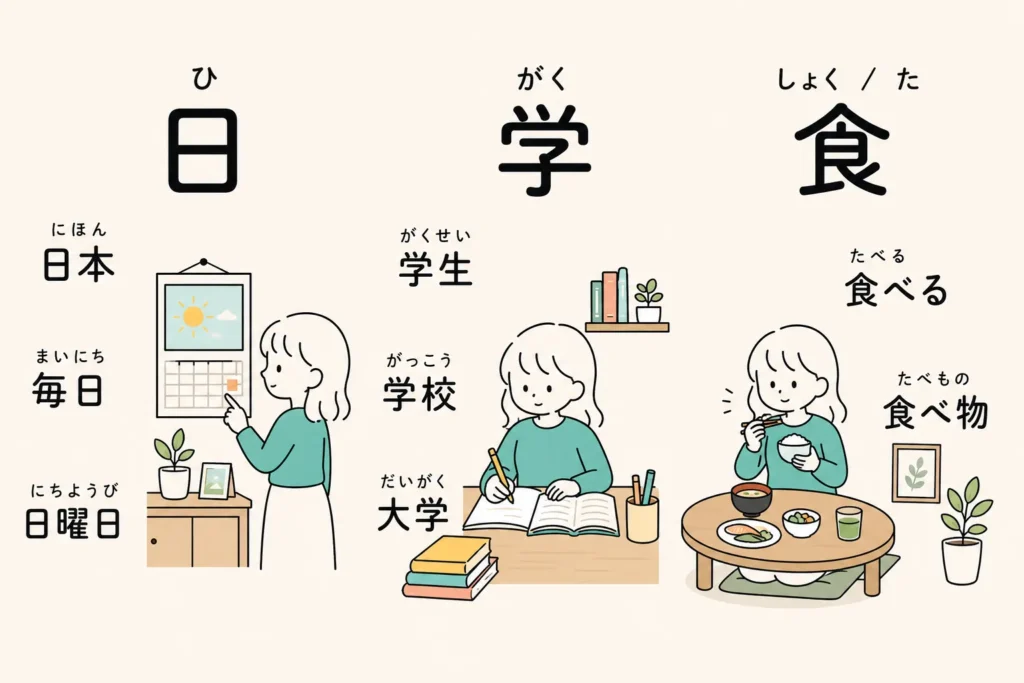
日
日本 にほん nihon · Japan
毎日 まいにち mainichi · every day
日曜日 にちようび nichiyoubi · Sunday
学
学生 がくせい gakusei · student
学校 がっこう gakkou · school
大学 だいがく daigaku · university
食
食べる たべる taberu · to eat
食べ物 たべもの tabemono · food
This is the point where kanji starts to feel less like memorizing isolated symbols and more like building a vocabulary network.
You may also start spotting familiar words in subtitles and shows. My collection of Japanese anime phrases is another way to notice beginner Japanese in context.
Do You Need to Memorize Every N5 Kanji Reading?
No.
I would not recommend trying to memorize every possible on’yomi and kun’yomi reading of every kanji at once.
Take 生.
Depending on the word, it can be read differently:
- 学生(がくせい) · student
- 先生(せんせい) · teacher
- 生まれる(うまれる) · to be born
If you begin with a long list of isolated readings, one simple kanji can suddenly feel overwhelming.
But when each reading is attached to a useful word, it has context.
The same thing happens with 日:
- 日本(にほん)
- 毎日(まいにち)
- 日曜日(にちようび)
Or 行:
- 行く(いく)
- 銀行(ぎんこう)
- 旅行(りょこう)
The goal is not to pretend these extra readings do not exist. It is to learn them as you meet them in useful words.
For kanji that simply refuse to stick, short flashcard reviews can help. I also compared a free Quizlet alternative for learners who want another way to build and review vocabulary sets.
Frequently Asked Questions
How many kanji are in JLPT N5?
There is no single fixed official kanji list for JLPT N5.
Different study resources may give different totals because the modern JLPT does not publish exact lists of the vocabulary, kanji, and grammar items tested at each level.
This guide uses 112 common beginner kanji as a practical self-study set.
Is there an official JLPT N5 kanji list?
No.
The JLPT no longer publishes fixed Test Content Specifications containing exact vocabulary, kanji, and grammar lists for each level.
Where can I download a free N5 kanji PDF?
You can download the free N5 kanji self-study PDF on this page.
It includes all 112 characters, useful words, kana, romaji, selected part-of-speech labels, short conversations, kanji families, easily confused characters, and a review tracker.
Is there a printable N5 kanji chart?
Yes.
The printable N5 kanji chart groups all 112 characters by theme for quick reference and review.
Do I need to memorize every on’yomi and kun’yomi reading?
No.
For beginners, it is usually more manageable to learn how a kanji is read inside common words rather than memorizing every possible reading in isolation.
For example, start with:
- 学生(がくせい)
- 先生(せんせい)
- 生まれる(うまれる)
instead of trying to memorize every possible reading of 生 on day one.
Do I need to know stroke order for JLPT N5?
The JLPT uses multiple-choice, computer-scored answer sheets and does not directly test handwriting. If your main goal is N5 reading recognition, you can prioritize recognizing kanji inside words. Writing practice can still be useful if it helps you remember character shapes.
How many N5 kanji should I learn per day?
There is no perfect number.
For many beginners, three to eight new kanji per day can be manageable if you also leave time for vocabulary and review.
I would rather learn five kanji through useful words and remember them than rush through 20 isolated characters.
Final Thoughts
This n5 kanji list can look intimidating with 112 characters on one page.
But you are not really learning 112 mysterious symbols.
You are slowly learning words such as:
日本 学生 学校 電車 毎日 食べる 飲む 行く
Start with the first 20. Learn useful words. Notice when the same kanji appears again with a different reading.
You do not need to master every possible pronunciation today.
You need to recognize a little more Japanese than you did yesterday.