Key Takeaways
- ChatGPT prompts for learning Korean work best when they force you to produce Korean, not just read it.
- The most effective prompts include a “what AI should NOT do” rule — this is what most prompt guides skip.
- You don’t need all 10 prompts. Match your stuck point to the right prompt and start there.
Most people use ChatGPT wrong for Korean learning.
They ask it to generate Korean — more vocabulary lists, more example sentences, more grammar explanations. The AI produces. You read. You feel productive. Then you close the tab and realize you still cannot say anything.
The prompts that actually work do the opposite. They stop ChatGPT from doing the heavy lifting and force you to produce Korean instead.
A good AI learning prompt comes down to four things: your level, your goal, what the AI should do, and — most importantly — what the AI should not do. That last part is what most prompt guides skip entirely.
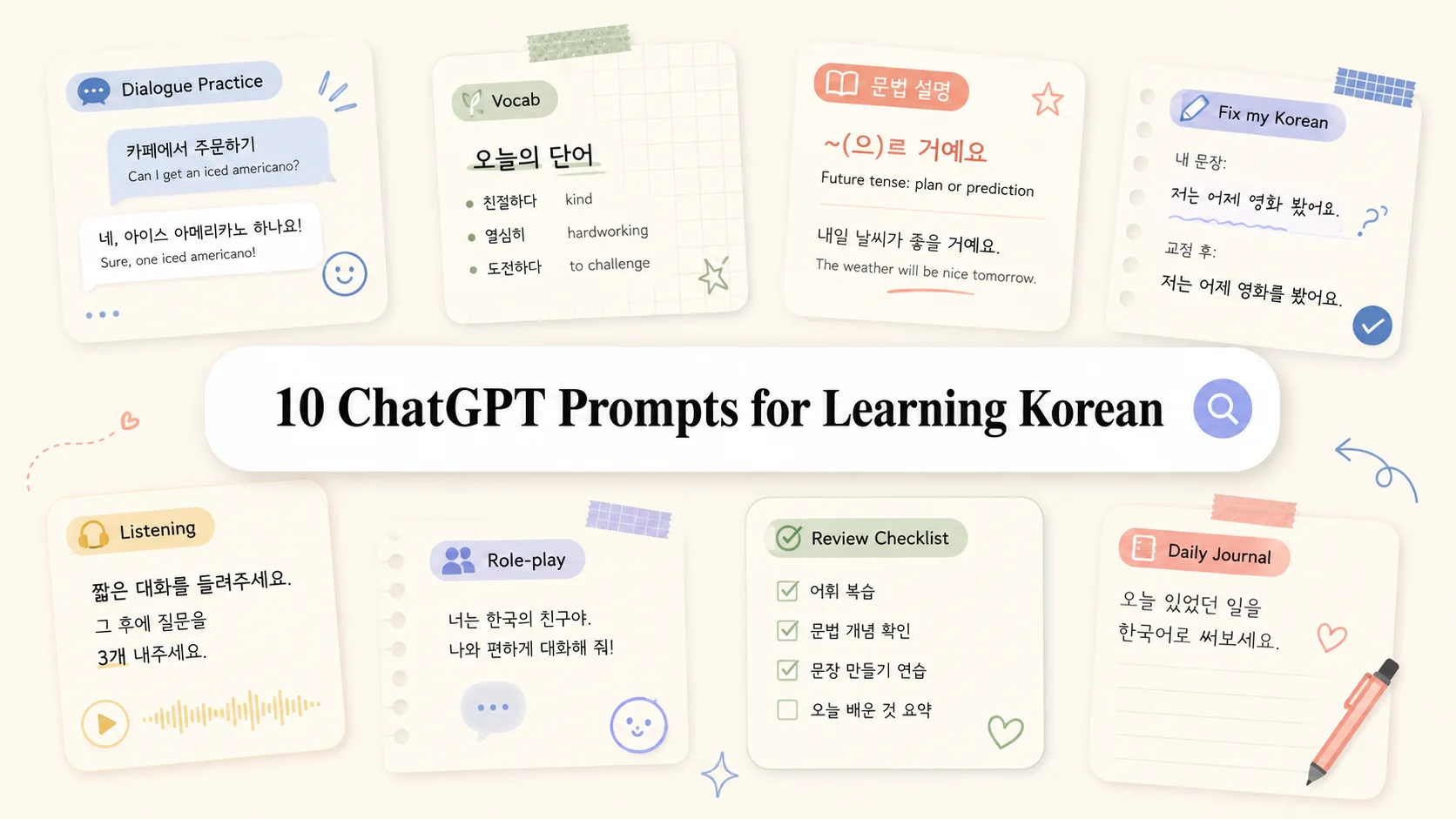
Here are 10 prompts I actually use, organized by what they fix. You can copy each prompt directly into ChatGPT and adapt the level, situation, or material to your own Korean study routine.
If You Only Try 3 Prompts
- Vocabulary: Prompt 1
- Speaking: Prompt 4
- Daily study: Prompt 3
Prompt 1: Turn Passive Vocabulary into Active Vocabulary
The problem: You recognize a word the moment you see it in a Korean news article or drama subtitle. But when you try to use it yourself, it is not there.
That gap between recognizing a word and being able to retrieve it is the difference between passive and active vocabulary. Recognition is easy. Production is hard. Most study methods only train the first one.
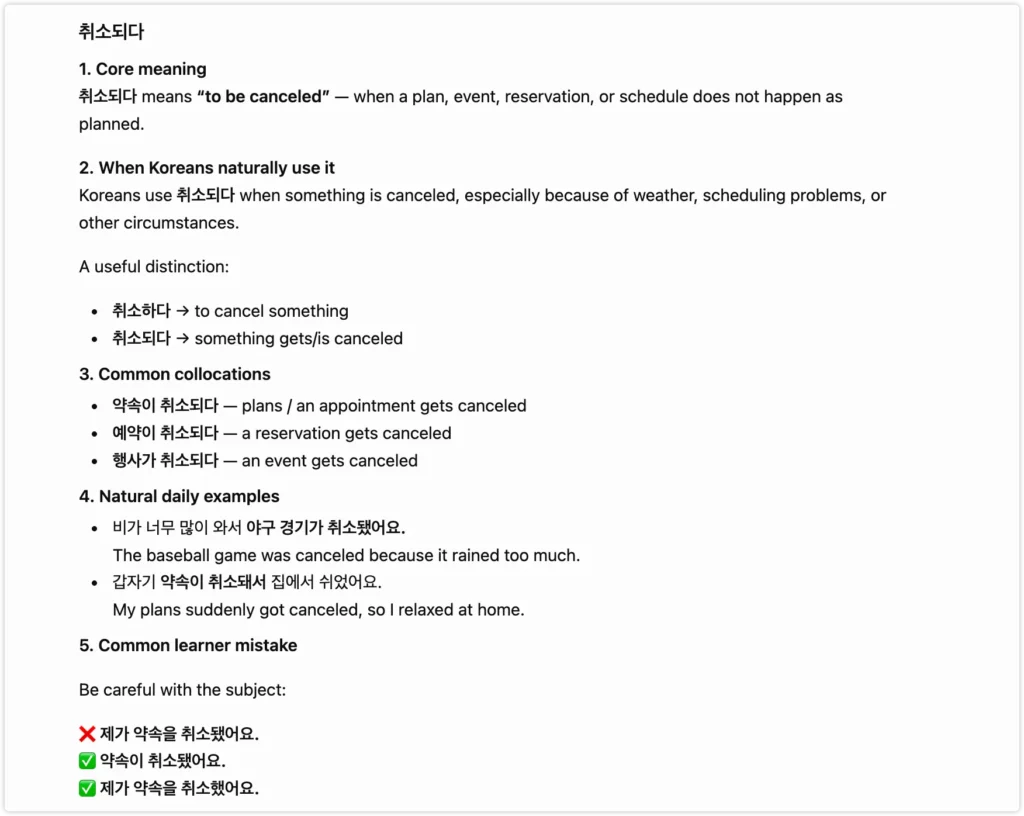
I ran into this exact problem reading a Yonhap News article about the cancelled Squid Game US spin-off. I could read 취소 and 우선순위 in context and understand the sentence — but when I tried to use either word myself, nothing came out. That is when I started using this prompt instead of just saving new words to a list. If you want to understand why that gap exists and how to close it systematically, this guide on vocabulary activation breaks it down in full.
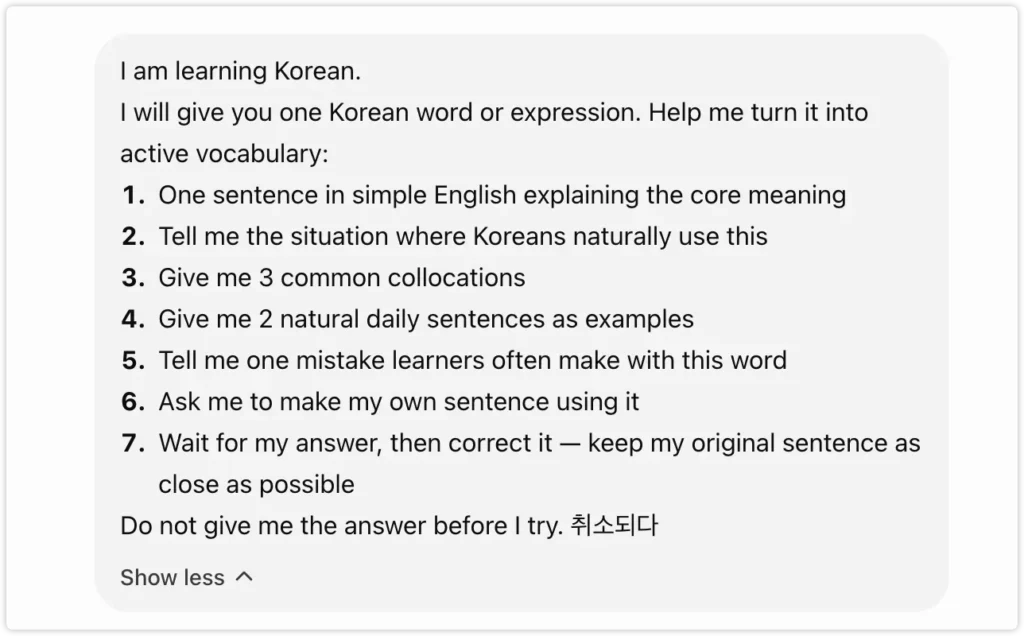
Copy this prompt:
I am learning Korean.

I will give you one Korean word or expression. Help me turn it into active vocabulary:

1. One sentence in simple English explaining the core meaning
2. Tell me the situation where Koreans naturally use this
3. Give me 3 common collocations
4. Give me 2 natural daily sentences as examples
5. Tell me one mistake learners often make with this word
6. Ask me to make my own sentence using it
7. Wait for my answer, then correct it — keep my original sentence as close as possible

Do not give me the answer before I try.
Want to make it harder?
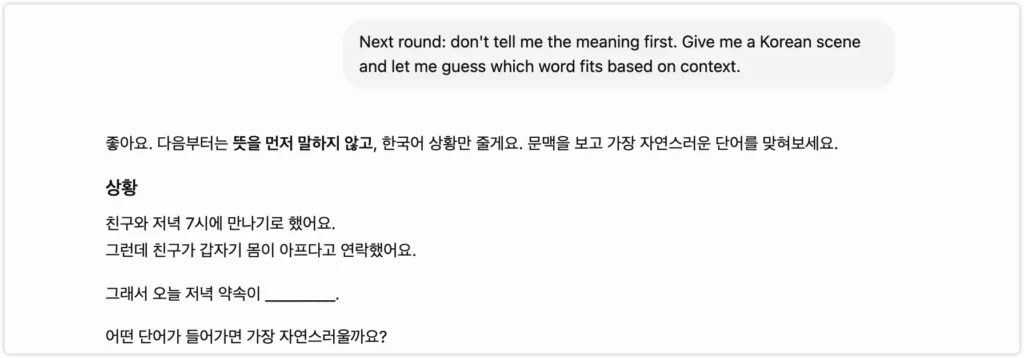
Next round: don't tell me the meaning first. Give me a Korean scene and let me guess which word fits based on context.
Prompt 2: Learn Grammar Through Real Scenarios, Not Definitions
The problem: Two grammar patterns look almost identical on paper. You read both definitions three times. You still freeze when you have to choose between them in a real sentence.
Grammar definitions explain what a form is. Real scenarios show you when a speaker actually reaches for it — and why.
Copy this prompt:
I am learning Korean.

I will give you one Korean grammar pattern. Help me understand it through real situations:

1. One sentence in simple English for the core meaning
2. The speaker's feeling or intention when using this pattern
3. Three real situations where a Korean person would naturally use it
4. Three natural example sentences
5. One similar grammar pattern learners often confuse it with
6. The real difference between the two
7. A quick two-choice exercise for me to practice

Avoid heavy grammar terminology.
Follow-up prompt:
Give me 5 sentence pairs where both grammar patterns are grammatically possible but feel different. Don't tell me which is which — let me figure it out.
Prompt 3: Turn Your Day into a Korean Lesson
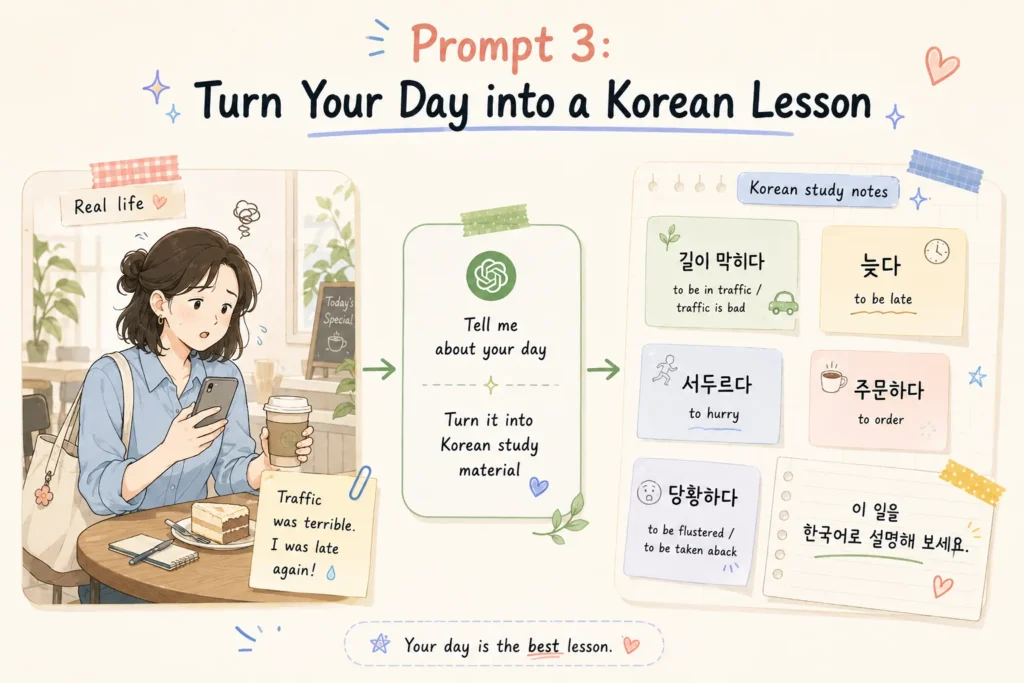
The problem: Generic vocabulary lists are forgettable. Words connected to your own life are not.
When you learn 막히다 because you were stuck in traffic, or 재촉하다 because your manager kept rushing you, the word has a memory attached to it. That is what makes it stick.
Copy this prompt:
I will tell you in Chinese or English about something that happened to me today. Turn it into my Korean study material:

Step 1:
1. Pick the 5 most useful Korean expressions for describing this situation
2. Give one natural example sentence for each
3. Ask me to describe what happened in Korean

After I answer:
4. Only correct what is unnatural or wrong — keep my original sentence as close as possible
5. Pick the 2 most important errors and explain them
6. Show me how a Korean person would say it more naturally

Do not give me the complete Korean version before I try.
Prompt 4: Practice Real Conversation Without Reading AI Essays
The problem: You ask ChatGPT to practice conversation with you. It replies with four polished paragraphs. You spend the next five minutes reading instead of speaking.
Real conversation is short. Replies are quick. The pressure to respond is what builds actual speaking ability.
If you are not sure where you are in your Korean journey, this guide on realistic Korean learning timelines can help you find your stuck point before you start drilling conversation.
Copy this prompt:
Please be my Korean conversation partner.

My level: [beginner / intermediate / advanced]
Today's scenario: [café / chatting with a friend / seeing a doctor / traveling / on a date]

Rules:
1. Speak mostly in Korean
2. Keep your replies short — like a real conversation
3. Do not translate everything into English automatically
4. If a mistake doesn't block understanding, keep going
5. Every 3 to 4 exchanges, correct one important error only
6. Do not rewrite my whole sentence into perfect Korean
7. Ask natural follow-up questions to keep me responding

Start now.
Want more realistic conversation?
Use more natural spoken Korean — include common contractions, sentence-final particles, and casual speech patterns. Don't simplify unless I ask.
Prompt 5: Get Your Writing Corrected Without Getting It Rewritten
The problem: You write a sentence. ChatGPT rewrites it completely. The new version is beautiful and completely useless to you, because you have no idea what you actually got wrong.
A good correction shows you the gap between what you wrote and what works — not a finished essay you had no part in producing.
Copy this prompt:
I will give you a piece of Korean I wrote.

Please correct it like a Korean teacher, not an editor:

1. Keep my original sentence visible
2. Only mark what is wrong or unnatural
3. Make the smallest correction possible
4. Briefly explain why
5. Tell me which category my sentence falls into: wrong / grammatically fine but unnatural / natural
6. At the end, you can offer one more fluent version as a bonus

Do not rewrite the whole thing from scratch unless I ask.
After the correction:
Summarize all the errors from this session. What are the 3 things I should review most?
Prompt 6: Check Whether Your Korean Is Natural, Not Just Correct
The problem: “Correct” and “natural” are not the same thing in Korean. A sentence can be grammatically right and still sound like something no Korean person would say — and treating one problem like the other sends you in the wrong direction.
Copy this prompt:
I will give you a Korean sentence I want to use in real life. Judge it from four angles:

1. Is the grammar correct?
2. Is it natural in everyday Korean?
3. Who would say this, and in what situation?
4. How would a Korean person more likely say it?

Then give me three versions: neutral / casual spoken / polite, and briefly explain the difference between the three.

Do not mark my sentence as "wrong" just because a more common version exists.
Prompt 7: Extract What Is Actually Worth Learning from K-Dramas and YouTube
The problem: One minute of real Korean content might contain fifty unfamiliar words. Trying to learn all of them means learning none of them.
The goal is not to annotate everything. It is to extract the two or three things that will still be useful six months from now.
Copy this prompt:
I will paste a short transcript below.

Only pick what is genuinely worth learning:
1. Five words or expressions worth remembering
2. Two grammar patterns used in natural context
3. Two expressions that are distinctly colloquial or reflect how Koreans actually speak
4. One sentence worth shadowing for pronunciation

For each item: meaning / why it is worth learning / why it is used this way / one new natural example sentence

At the end, give me three practice questions using what I just learned.
If you are past beginner level:
Skip vocabulary that a TOPIK [level] learner would already know. Prioritize expressions that are useful beyond this specific clip.
Prompt 8: Turn a Transcript into Listening Practice
The problem: You can read Korean subtitles and understand everything. You turn off the subtitles and understand almost nothing.
The gap is usually not vocabulary. It is that you have never trained your ear to catch Korean the way it actually sounds — with contractions, weak syllables, and sounds that blur together in fast speech.
Copy this prompt:
I will paste a Korean transcript below. Turn it into listening practice:

1. Pick 5 sentences that would be hard to catch by ear
2. Explain what makes each one difficult: linking, reduction, weakening, or pronunciation shift
3. For each sentence, blank out one key expression as a listening gap-fill
4. Put the answers at the very end, not inline
5. Pick 3 sentences for shadowing practice — mark natural pause points with / and stress points

Do not translate the whole transcript unless I ask.
Prompt 9: Make ChatGPT Actually Test You Instead of Just Giving You Answers
The problem: You see the answer, think “I knew that,” and move on. Three days later it is gone. Recognition is not the same as recall — and the only way to test recall is to try without looking.
Copy this prompt:
I want to review my recent Korean. Test me using active recall — not passive review:

1. One question at a time only
2. Do not show the answer before I respond
3. Mix these types: recall Korean from meaning / complete the sentence / choose between similar expressions / spot what is unnatural / respond to a real situation
4. Wait for my answer before continuing
5. If I get it wrong the first time, give a hint only — not the full answer
6. Bring back things I got wrong later in the session
7. Reduce repeats on things I clearly know

At the end, give me three lists: solid / hesitated / needs more review.
Prompt 10: Use Your Own Mistakes as Study Material
The problem: You have pages of correction notes, saved vocabulary, and grammar questions you never revisited. That is not a study archive. It is a graveyard.
Your own errors are the most targeted study material you have. They are exactly the gaps between what you think you know and what you actually know.
Copy this prompt:
I will paste my recent error log, correction notes, new vocabulary, grammar questions, and unnatural expressions.

First, organize everything into:
1. Words I recognize but cannot use actively
2. Grammar patterns I keep confusing
3. Expressions I translated too directly from Chinese or English
4. Sentence structure mistakes that keep reappearing

Then generate:
- 5 active recall questions
- 5 sentence completion exercises
- 3 error correction drills
- 3 real conversation scenarios using this material

Put the things I got wrong most often back in more than once. At the end, tell me the 3 things I should focus on next.
The Four Things Every Good Prompt Has
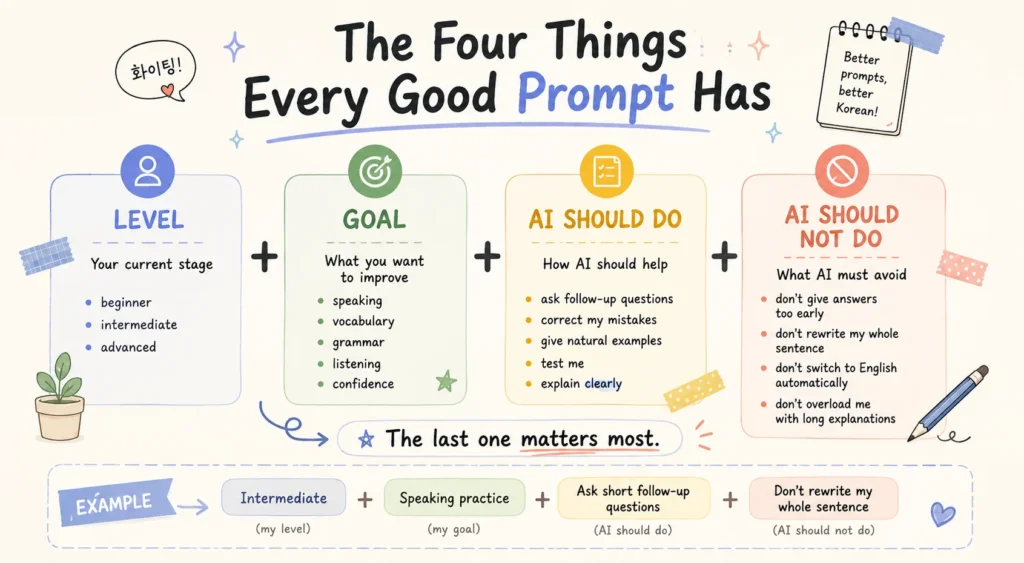
Your level + your goal + what AI should do + what AI should NOT do
The fourth one matters most.
The most useful limits to add to any Korean learning prompt:
- Don’t give me the answer before I try
- Don’t rewrite my whole sentence
- Don’t explain every new word
- Don’t switch to English automatically
- Bring back things I got wrong later
Every one of these limits does the same thing: it stops ChatGPT from completing the task for you.
Which Prompt Should You Start With?
| Your situation | Start with |
|---|---|
| You recognize words but freeze when speaking | Prompt 1 |
| Grammar patterns keep blurring together | Prompt 2 |
| You want to learn Korean that connects to your real life | Prompt 3 |
| You freeze the moment you try to say something | Prompt 4 |
| AI keeps rewriting your sentences instead of correcting them | Prompt 5 |
| You want to know if your Korean sounds natural | Prompt 6 |
| You study with K-dramas or YouTube | Prompt 7 |
| You read subtitles fine but cannot follow without them | Prompt 8 |
| You study something and forget it the next day | Prompt 9 |
| You have lots of notes but never go back to them | Prompt 10 |
The best ChatGPT prompts for learning Korean are not the ones that generate the most Korean. They are the ones that make you generate more Korean.
Pick one prompt. Use it for 10 minutes tonight.
The goal is not to get more Korean from ChatGPT. It is to get more Korean out of yourself.
ChatGPT Prompts for Learning Korean FAQs
Can ChatGPT actually help you learn Korean? Yes — but only if you use it for output, not just input. The prompts above are built around retrieval, correction, and speaking practice. Using ChatGPT only to generate vocabulary lists or grammar explanations is much less useful if you never have to retrieve or produce the Korean yourself.
Is ChatGPT accurate enough for Korean? ChatGPT is useful for conversation practice, corrections, and grammar drills, but I would still verify pronunciation, subtle particle differences, or expressions you plan to reuse in formal writing.
Can beginners use these prompts? Most of them, yes. Prompts 1, 2, 3, and 4 work well from the beginner stage. Prompts 7, 8, and 10 are more useful once you have enough Korean to work with real content or your own error notes.
Which prompt should I start with? Use the table above to match your situation. If you are not sure, start with Prompt 4 — a 10-minute conversation session will tell you more about where you are than any diagnostic quiz.