Key Takeaways
- Japanese anime phrases are often real Japanese, but some sound too dramatic, rude, or character-like for daily life.
- This guide groups common anime phrases by scene and approximate JLPT level so beginners can learn them without feeling lost.
- Use the AI practice prompts near the end to turn anime lines into natural Japanese you can actually say.
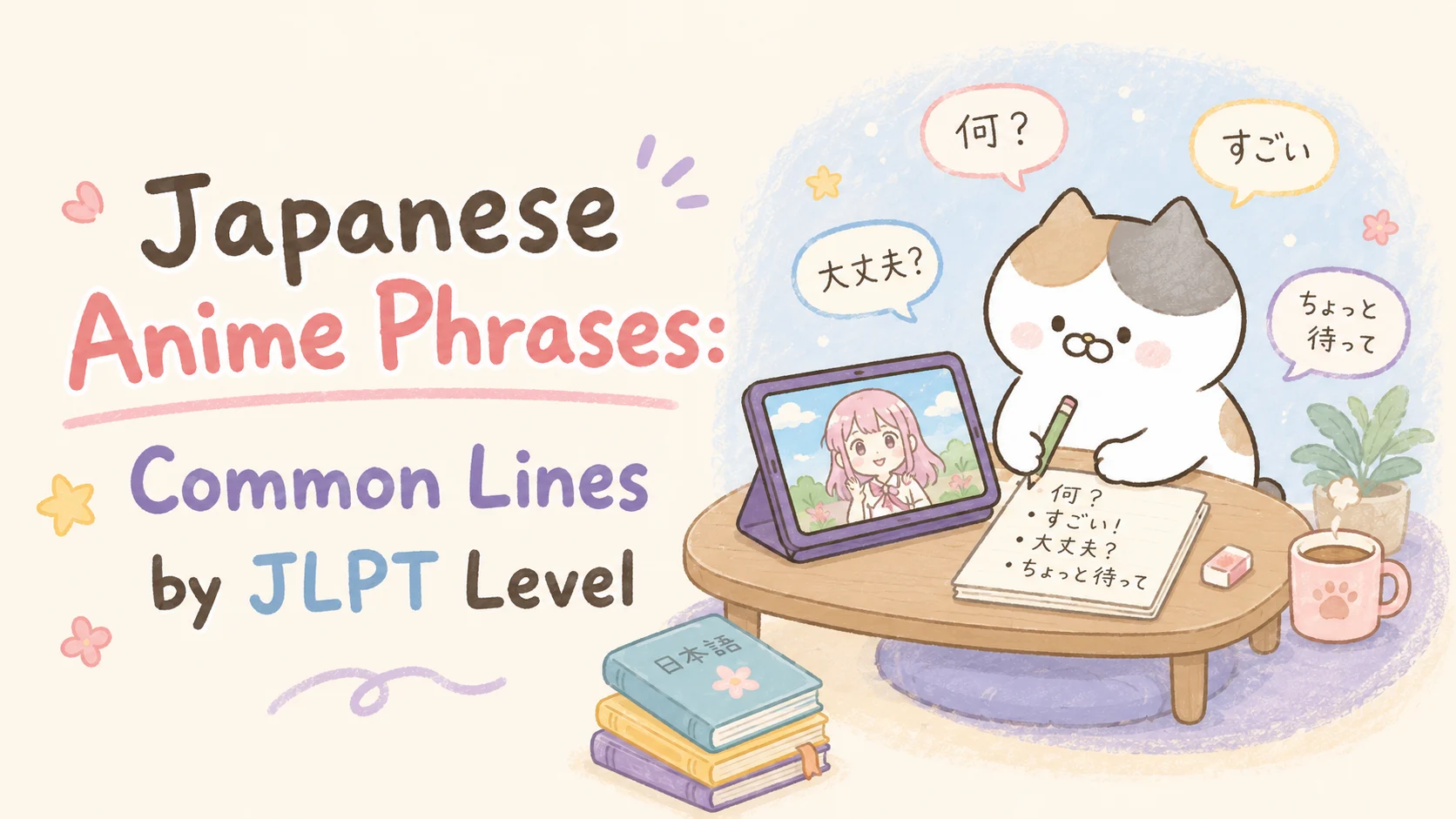
Anime is one of the most fun ways to hear Japanese in context. A character shouts 何(なに), whispers 大丈夫(だいじょうぶ), or says 行くぞ(いくぞ) before a fight, and suddenly the phrase sticks in your head.
But there is one problem.
Not every Japanese phrase you hear in anime sounds natural in real life. Some lines are safe and common. Some are casual. Some sound dramatic, rude, or too character-like if you copy them directly.
This guide organizes common Japanese anime phrases by meaning, scene, approximate JLPT level, and real-life usage. You will learn what each phrase means, when you might hear it, whether you can actually say it, and how to practice it with AI.
If you want a more travel-friendly list, I also made a guide to Japanese phrases for beginners.
Japanese Anime Phrases at a Glance
Use this table as a quick cheat sheet before you go deeper.
The JLPT level here is approximate. Some anime slang does not fit perfectly into official JLPT categories. I grouped each phrase by vocabulary, grammar, and usage difficulty so beginners have a useful starting point.
| Japanese | Reading | Meaning | Common Scene | Approx. Level | Real-Life Use |
|---|---|---|---|---|---|
| ありがとう | ありがとう | Thank you | Daily life | N5 | Safe |
| ごめん | ごめん | Sorry | Daily life | N5 | Casual |
| 大丈夫 | だいじょうぶ | Are you okay? / It is okay | Care, worry | N5 | Safe |
| すごい | すごい | Amazing / awesome | Surprise | N5 | Safe |
| かわいい | かわいい | Cute | Reaction | N5 | Safe |
| 何? | なに? | What? | Shock | N5 | Casual |
| 本当? | ほんとう? | Really? | Surprise | N5 | Casual |
| うそ! | うそ! | No way! / That is a lie! | Shock | N5 | Casual |
| ちょっと待って | ちょっとまって | Wait a second | Urgent moment | N5-N4 | Safe casual |
| やめて | やめて | Stop it | Conflict | N5-N4 | Direct |
| 助けて | たすけて | Help me | Danger | N5-N4 | Safe in emergencies |
| 行こう | いこう | Let’s go | Daily / action | N5-N4 | Safe casual |
| 行くぞ | いくぞ | Let’s go / I’m going in | Fight scene | N4 | Dramatic |
| 任せて | まかせて | Leave it to me | Confidence | N4 | Safe casual |
| なるほど | なるほど | I see | Understanding | N4 | Safe |
| しょうがない | しょうがない | It can’t be helped | Resignation | N4 | Safe casual |
| よかった | よかった | I’m glad / what a relief | Relief | N4 | Safe |
| 頑張って | がんばって | Do your best | Encouragement | N5-N4 | Safe |
| 信じられない | しんじられない | I can’t believe it | Shock | N3-ish | Safe but dramatic |
| 負けない | まけない | I won’t lose | Fight / resolve | N4-N3 | Dramatic |
| 好き | すき | I like you / I like it | Romance | N5 | Safe by context |
| 大好き | だいすき | I really like you / I love it | Romance | N5 | Safe by context |
| 一緒にいたい | いっしょにいたい | I want to be with you | Romance | N4-N3 | Intimate |
| 恥ずかしい | はずかしい | Embarrassing / I’m embarrassed | Romance / comedy | N4 | Safe |
| うるさい | うるさい | Noisy / shut up | Argument | N5-ish | Harsh |
| ばか | ばか | Idiot / stupid | Comedy / insult | N5-ish | Risky |
| お前 | おまえ | You | Conflict | N4-ish | Avoid with strangers |
| てめえ | てめえ | You | Threat / insult | Outside beginner use | Avoid |
Common Japanese Anime Phrases You Hear All the Time
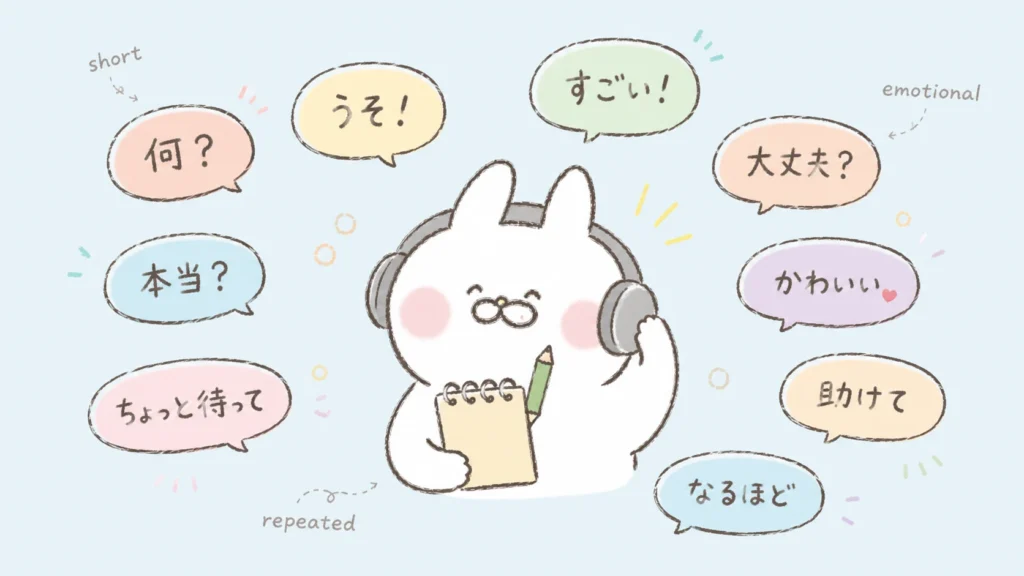
These are the phrases beginners tend to notice first because they are short, emotional, and repeated across many anime scenes.
1. 何(なに)
Meaning: What?
You will hear 何? when a character is shocked, confused, or reacting quickly.
In real life, 何? is casual and direct. It is fine with friends, but with strangers or teachers, use a softer version.
Safer version:
何ですか。
Meaning: What is it?
2. すごい
Meaning: Amazing, awesome, impressive
This is one of the most useful Japanese anime phrases because it also works in real life. You can use it when someone shows you something impressive, when food looks good, or when you are surprised.
Example:
すごいですね。
Meaning: That is amazing.
3. かわいい
Meaning: Cute
You will hear かわいい in slice-of-life anime, romance scenes, comedy moments, and idol-related scenes. It is also very common in daily Japanese.
Use it for pets, clothes, characters, objects, and people, but be careful when commenting on real people if you are not close.
4. 大丈夫(だいじょうぶ)
Meaning: Are you okay? / It is okay / I am fine
大丈夫 is useful because it changes meaning based on context.
If someone falls, 大丈夫? means “Are you okay?”
If someone apologizes, 大丈夫 can mean “It is okay.”
If someone offers help, 大丈夫です can mean “I am fine.”
This is one of the safest anime phrases to learn because it is natural in real conversations.
5. ちょっと待って(まって)
Meaning: Wait a second
This phrase appears constantly in anime when someone is surprised, interrupted, or trying to stop another character.
待って comes from the te form of 待つ(まつ), meaning “to wait.” Many short anime lines use casual verb forms. If words like 待って, 行って, or 助けて still confuse you, review my Japanese te form guide first.
Polite version:
ちょっと待ってください。
Meaning: Please wait a second.
6. やめて
Meaning: Stop it
やめて is direct. In anime, it may appear in comedy, romance, conflict, or danger scenes.
In real life, it depends on tone. If you need to be serious, やめてください is safer and more polite.
7. 助けて(たすけて)
Meaning: Help me
Common in danger scenes, but it’s also a real, everyday phrase — use it when you genuinely need help.
Polite version: 助けてください
Meaning: Please help me.
8. なるほど
Meaning: I see, that makes sense
This phrase is very natural in real life. It shows that you understand what someone explained.
It is useful in study, work, and conversation.
9. しょうがない
Meaning: It can’t be helped
This phrase appears when a character accepts a situation they cannot change. It is also common in real life.
A softer version is:
仕方がない(しかたがない)。
Meaning: It cannot be helped.
10. 頑張って(がんばって)
Meaning: Do your best, good luck
This is one of the most common encouragement phrases. You can say it before an exam, performance, interview, or difficult task.
Example:
明日のテスト、頑張って。
Meaning: Good luck on tomorrow’s test.
Japanese Anime Phrases by Approximate JLPT Level
The official JLPT has five levels, from N5 as the easiest to N1 as the most difficult. N4 and N5 focus on basic Japanese, while N3 works as a bridge between basic and more advanced everyday Japanese.
In this guide, I use JLPT levels as a learner-friendly reference, not as an official vocabulary list.
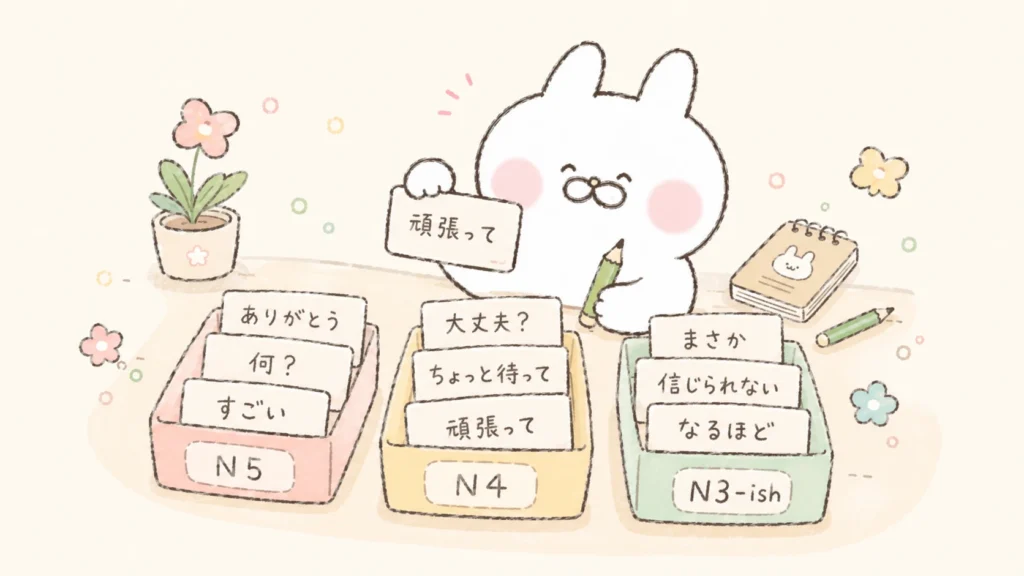
JLPT N5 Anime Phrases
N5-level anime phrases are usually short, direct, and easy to recognize. Many are everyday words you can use outside anime too.
| Japanese | Reading | Meaning | Real-Life Note |
|---|---|---|---|
| ありがとう | ありがとう | Thank you | Safe and common |
| ごめん | ごめん | Sorry | Casual. Use ごめんなさい for safer speech |
| はい | はい | Yes | Safe |
| いいえ | いいえ | No | Safe, but sometimes too direct |
| 何? | なに? | What? | Casual |
| 誰? | だれ? | Who? | Casual |
| どこ? | どこ? | Where? | Casual |
| 本当? | ほんとう? | Really? | Casual |
| うそ! | うそ! | No way! | Casual and emotional |
| すごい | すごい | Amazing | Safe |
| かわいい | かわいい | Cute | Safe by context |
| 好き | すき | I like it / I like you | Safe, but context matters |
JLPT N4 Anime Phrases
N4-ish phrases often include more complete grammar, short casual sentences, or useful reaction patterns.
| Japanese | Reading | Meaning | Real-Life Note |
|---|---|---|---|
| ちょっと待って | ちょっとまって | Wait a second | Safe casual |
| やめて | やめて | Stop it | Direct |
| 助けて | たすけて | Help me | Safe when needed |
| 行こう | いこう | Let’s go | Safe casual |
| 行くぞ | いくぞ | Let’s go / I’m going in | Dramatic, masculine |
| 任せて | まかせて | Leave it to me | Safe casual |
| よかった | よかった | I’m glad / what a relief | Safe |
| しょうがない | しょうがない | It can’t be helped | Safe casual |
| 大丈夫だった? | だいじょうぶだった? | Were you okay? | Casual |
| どうして? | どうして? | Why? | Safe casual |
| もう一回 | もういっかい | One more time | Safe |
| 早く | はやく | Hurry up | Direct |
JLPT N3-ish Anime Phrases
N3-ish phrases often feel more expressive. They may show emotion, disbelief, regret, or stronger personal feelings.
| Japanese | Reading | Meaning | Real-Life Note |
|---|---|---|---|
| 信じられない | しんじられない | I can’t believe it | Safe but dramatic |
| 負けない | まけない | I won’t lose | Dramatic |
| 一緒にいたい | いっしょにいたい | I want to be with you | Intimate |
| 恥ずかしい | はずかしい | I’m embarrassed | Safe |
| まさか | まさか | No way / it can’t be | Dramatic |
| 気にしないで | きにしないで | Don’t worry about it | Safe casual |
| どうすればいい? | どうすればいい? | What should I do? | Safe casual |
| 間違ってる | まちがってる | You are wrong / it is wrong | Direct |
| 約束する | やくそくする | I promise | Safe by context |
| 絶対に | ぜったいに | Definitely / absolutely | Strong, common |
Anime Phrases by Scene
Learning by scene is easier than memorizing a random list. When you connect a phrase to a situation, you are more likely to recognize it while watching anime.
Surprise and Shock
| Japanese | Reading | Meaning | Use It in Real Life? |
|---|---|---|---|
| 何? | なに? | What? | Casual |
| うそ! | うそ! | No way! | Casual |
| 本当? | ほんとう? | Really? | Casual |
| まさか | まさか | It can’t be | Dramatic |
| 信じられない | しんじられない | I can’t believe it | Safe but emotional |
Real-life tip:
If you are speaking to someone you do not know well, add ですか or soften your tone.
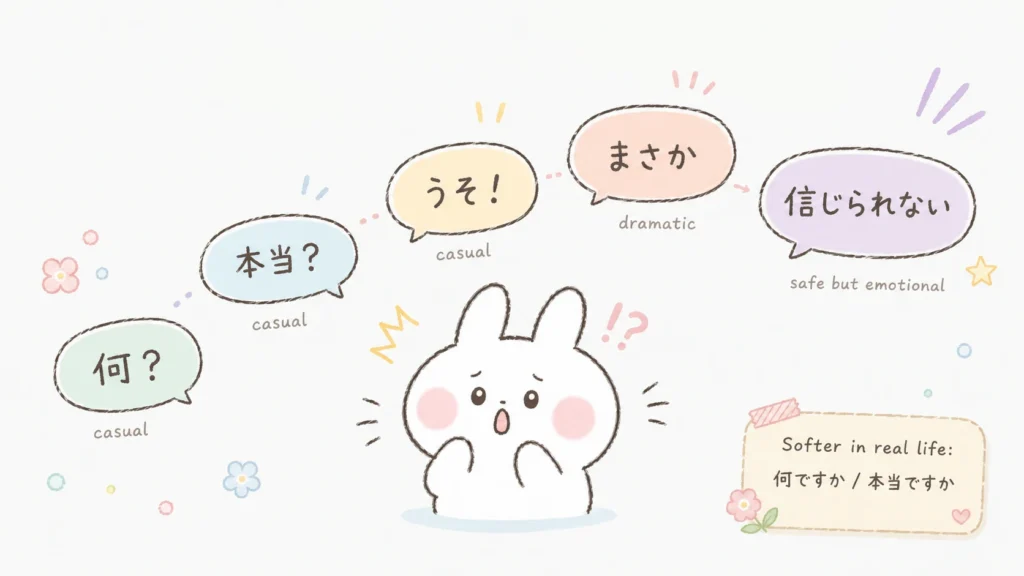
Instead of:
何?
Use:
何ですか。
Meaning: What is it?
Friendship and Encouragement
| Japanese | Reading | Meaning | Use It in Real Life? |
|---|---|---|---|
| 大丈夫 | だいじょうぶ | It is okay / Are you okay? | Safe |
| 頑張って | がんばって | Do your best | Safe |
| 任せて | まかせて | Leave it to me | Casual |
| よかった | よかった | I’m glad | Safe |
| 気にしないで | きにしないで | Don’t worry about it | Safe casual |
Example:
大丈夫。私に任せて。
Meaning: It is okay. Leave it to me.
Fight Scenes
Fight scenes are where anime Japanese becomes the most dramatic. These phrases are fun to recognize, but not always natural to copy.
| Japanese | Reading | Meaning | Real-Life Note |
|---|---|---|---|
| 行くぞ | いくぞ | Let’s go / I’m going in | Dramatic |
| やめろ | やめろ | Stop it | Very direct |
| 助けて | たすけて | Help me | Real emergency use |
| 負けない | まけない | I won’t lose | Dramatic |
| 早く | はやく | Hurry up | Direct |
Fight scenes often mention eyes, hands, faces, and bodies. You can review the basics in my body parts in Japanese guide.
Cute and Funny Reactions
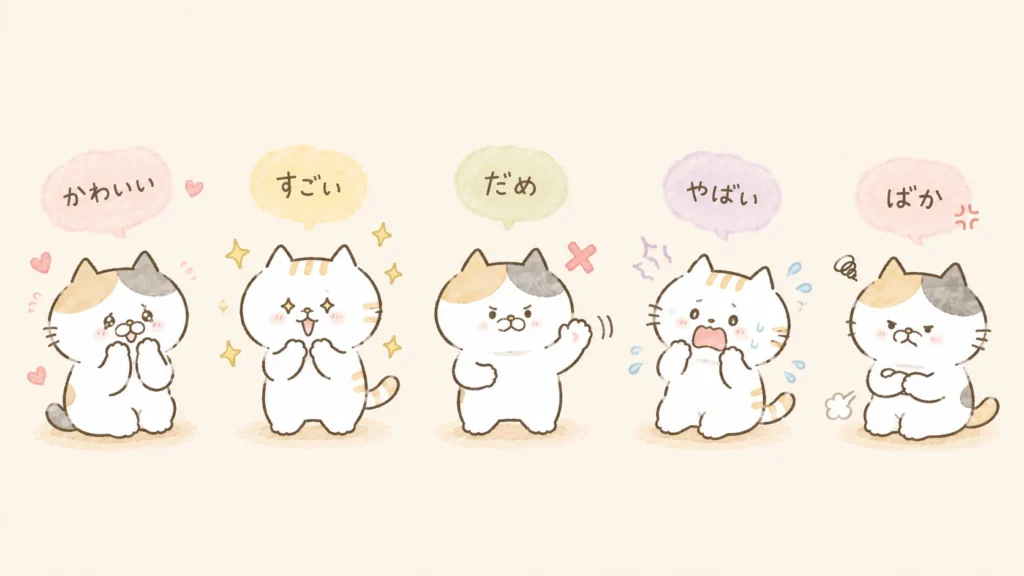
| Japanese | Reading | Meaning | Real-Life Note |
|---|---|---|---|
| かわいい | かわいい | Cute | Safe |
| すごい | すごい | Amazing | Safe |
| だめ | だめ | No / not allowed | Direct |
| ばか | ばか | Idiot | Risky |
| やばい | やばい | Crazy / amazing / bad | Casual slang |
Real-life tip:
やばい is common in casual Japanese, but it depends heavily on tone. It can mean “bad,” “amazing,” “crazy,” or “dangerous.”
Romance and Confession
| Japanese | Reading | Meaning | Real-Life Note |
|---|---|---|---|
| 好き | すき | I like you / I like it | Context matters |
| 大好き | だいすき | I really like you / I love it | Stronger |
| 一緒にいたい | いっしょにいたい | I want to be with you | Intimate |
| 恥ずかしい | はずかしい | I’m embarrassed | Safe |
| 会いたい | あいたい | I want to see you | Personal |
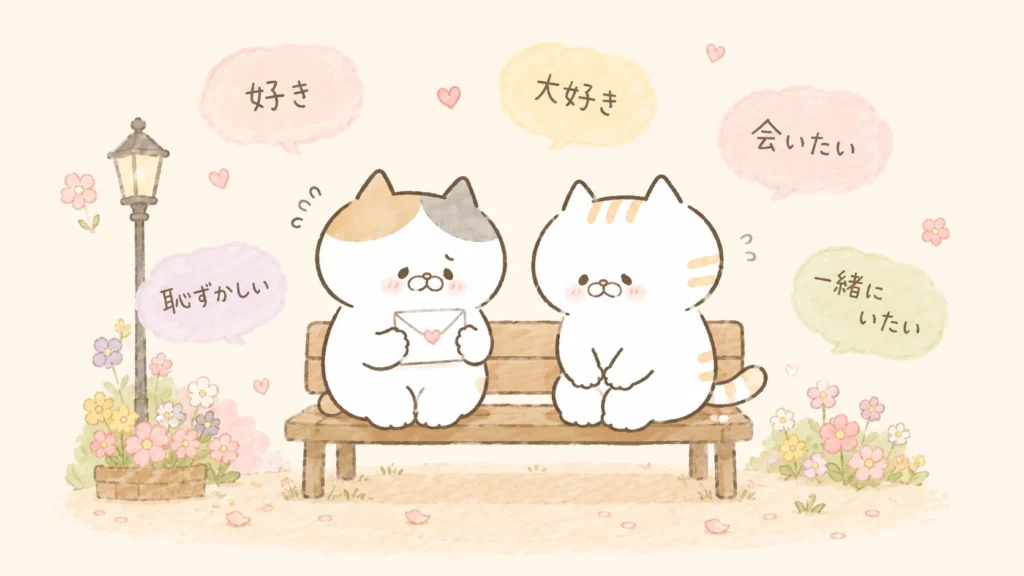
Example:
もっと一緒にいたい。
Meaning: I want to be with you longer.
Can You Use Anime Phrases in Real Life?
This is the most important part.
Anime Japanese is useful for listening practice, but character speech is often stylized. Some lines are written to show personality, power, age, gender, social role, or drama. That means a phrase can be grammatically real but still sound strange in daily life.
Use this simple label system:
| Label | Meaning |
|---|---|
| Safe | Natural in daily life |
| Casual | Use with friends or people close to you |
| Dramatic | Understand it, but do not copy it too much |
| Avoid | Rude, aggressive, or awkward in real life |
Anime Phrase Safety Table
| Phrase | Anime Use | Real-Life Use | Safer Version |
|---|---|---|---|
| すごい | Admiration, surprise | Safe | すごいですね |
| かわいい | Cute reaction | Safe | かわいいですね |
| 大丈夫 | Care, worry, reassurance | Safe | 大丈夫ですか |
| ちょっと待って | Stop someone quickly | Casual | 少し待ってください |
| やめて | Stop it | Casual / direct | やめてください |
| 行くぞ | Battle, action, confidence | Dramatic | 行こう / 行きましょう |
| 負けない | Strong resolve | Dramatic | 頑張ります |
| ばか | Teasing or insult | Risky | 冗談だよ |
| うるさい | Shut up / noisy | Avoid if direct | ちょっと静かにしてもらえますか |
| お前 | Rough “you” | Avoid with strangers | Name + さん |
| てめえ | Aggressive “you” | Avoid | Do not use |
Some anime lines sound cool because they are dramatic, not because they are natural. For more expressions that work better in real life, see my guide to Japanese idioms.
If you like emotional lines more than everyday phrases, you may also enjoy these Japanese quotes with meaning.
How to Turn Anime Phrases Into Natural Japanese?
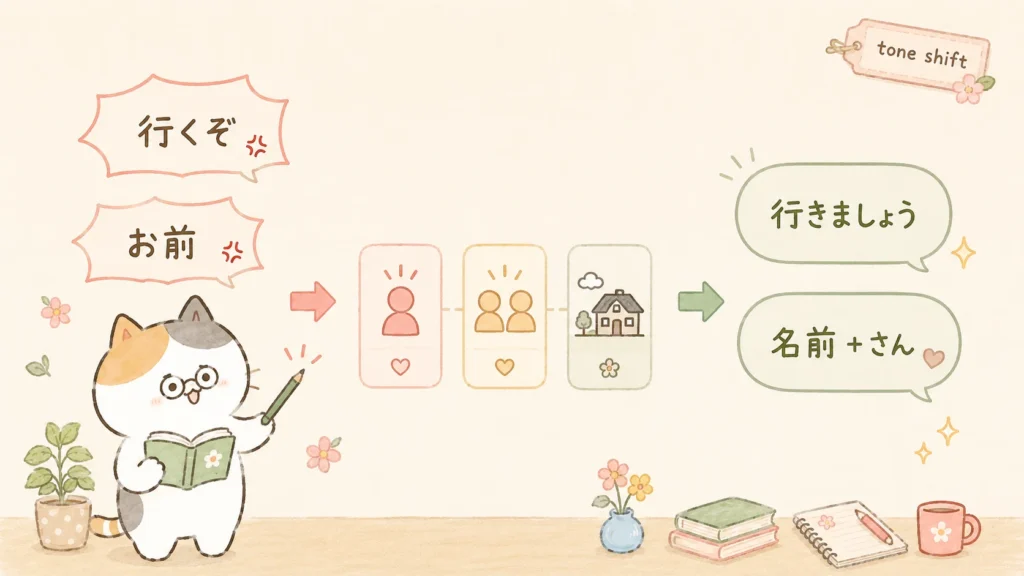
When you hear a phrase in anime, do not memorize it blindly. Ask three questions:
- Who is speaking?
- Who are they speaking to?
- Is the scene normal, emotional, romantic, funny, or violent?
Then turn the phrase into a safer version.
| Anime-style | Natural Casual | Polite Version |
|---|---|---|
| 何? | 何? | 何ですか |
| 待って | ちょっと待って | 少し待ってください |
| やめろ | やめて | やめてください |
| 行くぞ | 行こう | 行きましょう |
| うるさい | 静かにして | 静かにしてください |
| お前 | きみ / name | name + さん |
This is the real learning step. You are not just copying a cool line. You are learning how Japanese changes by relationship, tone, and situation.
Practice Japanese Anime Phrases with AI
AI can help you turn anime phrases into real practice. The key is to ask for scene, tone, and level.
Do not only ask:
“Explain this phrase.”
Ask:
“Explain this phrase at my JLPT level and tell me if I can say it in real life.”
💬 Speak this prompt: Explain the phrase at my level
Best for: Beginners who hear one anime phrase and want to understand the meaning, reading, tone, and real-life usage.
Prompt:
I heard this Japanese phrase in anime: [PHRASE].
Explain it for a JLPT N5/N4/N3 learner. Include the kana reading, literal meaning, natural English meaning, common anime scene, and whether I can use it in real life.
Also give me one safer version if the phrase sounds too casual, rude, or dramatic.
💬 Speak this prompt: Rewrite anime Japanese into natural Japanese
Best for: Learners who want to turn a dramatic anime line into something they can actually say.
Prompt:
Turn this anime-style Japanese phrase into natural real-life Japanese: [PHRASE].
Give me three versions: casual, polite, and very polite.
Explain who I can say each version to, and give one short example sentence for each version.
🗣️ Say this prompt: Quiz me by scene
Best for: Learners who want active recall instead of only reading a phrase list.
Prompt:
Quiz me on 10 Japanese anime phrases.
Give me one scene in English, then ask me which Japanese phrase fits best. After I answer, correct me gently and explain the nuance.
Include a mix of safe, casual, dramatic, and avoid phrases.
💬 Speak this prompt: Make flashcards from this list
Best for: Learners who want to review anime phrases later in Quizlet, Anki, Notion, or a simple table.
Prompt:
Turn these Japanese anime phrases into flashcards: [PASTE PHRASES].
Each flashcard should include: Japanese phrase, kana reading, English meaning, common scene, approximate JLPT level, and real-life usage label.
Use only four labels: Safe, Casual, Dramatic, Avoid.
After you choose 10 phrases from this guide, turn them into flashcards with my free Quizlet alternative workflow.
Mini Practice: Learn 10 Anime Phrases First
If you are a beginner, do not try to memorize every phrase at once. Start with these 10 because they are common, useful, and easy to recognize.
| Japanese | Reading | Meaning | Why Learn It First? |
|---|---|---|---|
| ありがとう | ありがとう | Thank you | Basic and safe |
| ごめん | ごめん | Sorry | Common in dialogue |
| 大丈夫 | だいじょうぶ | Are you okay? / It is okay | Very useful |
| すごい | すごい | Amazing | Easy reaction word |
| かわいい | かわいい | Cute | Very common |
| 何? | なに? | What? | Easy to hear |
| 本当? | ほんとう? | Really? | Common reaction |
| ちょっと待って | ちょっとまって | Wait a second | Useful te-form phrase |
| 頑張って | がんばって | Do your best | Common encouragement |
| なるほど | なるほど | I see | Natural in conversation |
Practice them like this:
- Say each phrase out loud.
- Imagine one anime scene where you might hear it.
- Write one real-life sentence using the safer version.
- Ask AI to quiz you.
- Review the same 10 phrases again tomorrow.
Common Mistakes Beginners Make with Anime Japanese
Mistake 1: Copying rude pronouns
Words like お前(おまえ) and てめえ appear in anime, especially in fights. They are not good default words for “you.”
In real Japanese, people often use a name instead of saying “you.”
Instead of:
お前は何してる?
Use:
田中さんは何をしていますか。
Meaning: What are you doing, Tanaka-san?
Mistake 2: Using command forms too much
Anime characters often shout short commands like 行け(いけ), やめろ, or 来い(こい). These can sound rough.
For real life, soften them.
| Rough | Softer |
|---|---|
| 行け | 行ってください |
| やめろ | やめてください |
| 来い | 来てください |
Mistake 3: Thinking every anime phrase is slang
Some anime phrases are normal Japanese. ありがとう, 大丈夫, なるほど, and 頑張って are all useful outside anime.
The goal is not to avoid anime Japanese. The goal is to know which phrases are safe.
Mistake 4: Ignoring tone
The same phrase can sound cute, angry, sarcastic, or rude depending on tone.
For example, 大丈夫 can mean:
- Are you okay?
- I am fine.
- It is okay.
- No thanks.
- Do not worry.
Context matters.
Mistake 5: Memorizing without using
If you only collect phrases, you will recognize them but not use them. Pick a small set and turn them into practice.
Start with 10 phrases. Make examples. Speak them out loud. Then add more.
Free Japanese Anime Phrases Cheat Sheet
Use the quick table in this guide as your first cheat sheet. If you want to make your own printable version, choose 20 phrases and organize them like this:
| Japanese | Reading | Meaning | Scene | Real-Life Label |
|---|---|---|---|---|
| 大丈夫 | だいじょうぶ | Are you okay? | Care | Safe |
| ちょっと待って | ちょっとまって | Wait a second | Urgent | Casual |
| 行くぞ | いくぞ | Let’s go | Fight | Dramatic |
| てめえ | てめえ | You | Conflict | Avoid |
A good anime phrase cheat sheet should not only tell you the meaning. It should tell you whether you can actually say the phrase.
Free Japanese Anime Phrases Cheat Sheet
Want more phrases to review later? Download the free cheat sheet with 150 Japanese anime phrases, grouped by scene, approximate JLPT level, and real-life usage.
Japanese Anime Phrase FAQs
Can I learn Japanese from anime?
Yes, anime can help you learn Japanese listening, pronunciation, common reactions, and casual phrases. But anime should not be your only study method. Some phrases are stylized, dramatic, or rude in real life, so you also need grammar, vocabulary, and real conversation practice.
Are Japanese anime phrases used in real life?
Some are. Phrases like ありがとう, 大丈夫, すごい, かわいい, なるほど, and 頑張って are common in real life. Phrases like 行くぞ, ばか, お前, and てめえ need more caution because they can sound dramatic, rough, or rude.
What are the most common Japanese anime phrases?
Some common Japanese anime phrases include 何(なに), うそ, 本当(ほんとう), 大丈夫(だいじょうぶ), すごい, かわいい, ちょっと待って, やめて, 助けて, 頑張って, and なるほど. These are short, emotional, and easy to notice while watching anime.
What does nani mean in anime?
何(なに), often written as “nani” by anime fans, means “what?” In anime, it is often used when a character is shocked or confused. In real life, 何? is casual. A more polite version is 何ですか。
What anime phrases should beginners avoid?
Beginners should be careful with rough or aggressive phrases such as てめえ, お前, うるさい, やめろ, and ばか. You can learn them for listening, but do not use them casually with strangers, teachers, coworkers, or people you do not know well.
Are anime phrases good for JLPT study?
Anime phrases can help with listening and vocabulary recognition, especially at beginner levels. However, the JLPT does not test “anime phrases” as a category. Use anime as extra input, then connect what you hear to grammar, vocabulary, reading, and listening practice.
How can I practice anime Japanese with AI?
Give AI one phrase and ask it to explain the meaning, scene, tone, JLPT level, and real-life usage. Then ask for a short dialogue, a safer version, and a quiz. This turns a phrase you heard in anime into active Japanese practice.
Final Thoughts
Japanese anime phrases are fun because they come with emotion. You do not just read the phrase. You hear the surprise, the courage, the embarrassment, or the drama behind it.
That makes anime a powerful entry point for Japanese learners.
Just remember: understanding a phrase is not the same as using it naturally. Learn what it means, check the scene, notice the tone, and ask whether it is safe for real life.
Start with a few common phrases. Practice them with AI. Then connect them to real Japanese grammar, vocabulary, and conversation.
That is how anime Japanese becomes real Japanese you can actually use.
Illustrations in this article are sourced from Okara Donut to Picnic