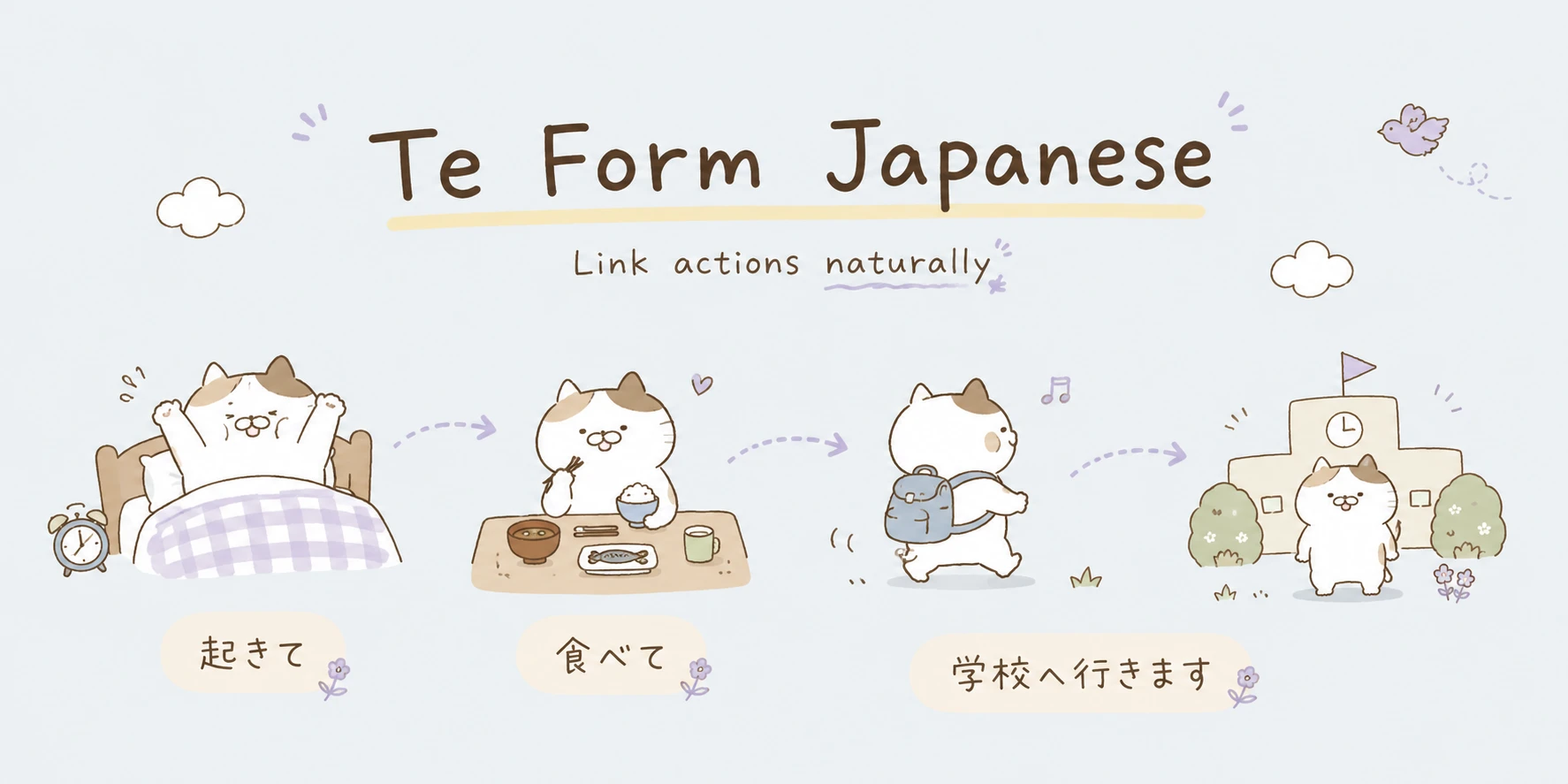
Te form Japanese is the base you need before you can connect actions, make requests, ask permission, or describe ongoing states — instead of speaking in short, disconnected pieces. Once you learn the conjugation rules for each verb group, it becomes the foundation for some of the most common patterns in Japanese, including ています、てください and てもいいですか。
I first noticed the te form while watching Arashi ni Shiyagare, a Japanese variety show. A guest connected several compliments with て before the sentence ever ended, and I remember thinking: wait, one small て can hold all of that together?
This guide breaks the te form down by verb group, shows the common sound-change patterns, and gives you examples you can actually practice with.
Key Takeaways
- The Japanese te form connects actions, requests, permission, and ongoing or resulting states.
- Godan verbs are the hardest part because they split into five sound-change patterns.
- Ichidan verbs are simpler: drop る and add て.
- 行く is the one common exception to memorize: it becomes 行って, not 行いて.
- Start with the chart, then practice with short daily sentences or the AI drills below.
Want the full chart beside you while you study? Download the free printable te-form PDF below.
What Is the Te Form in Japanese?
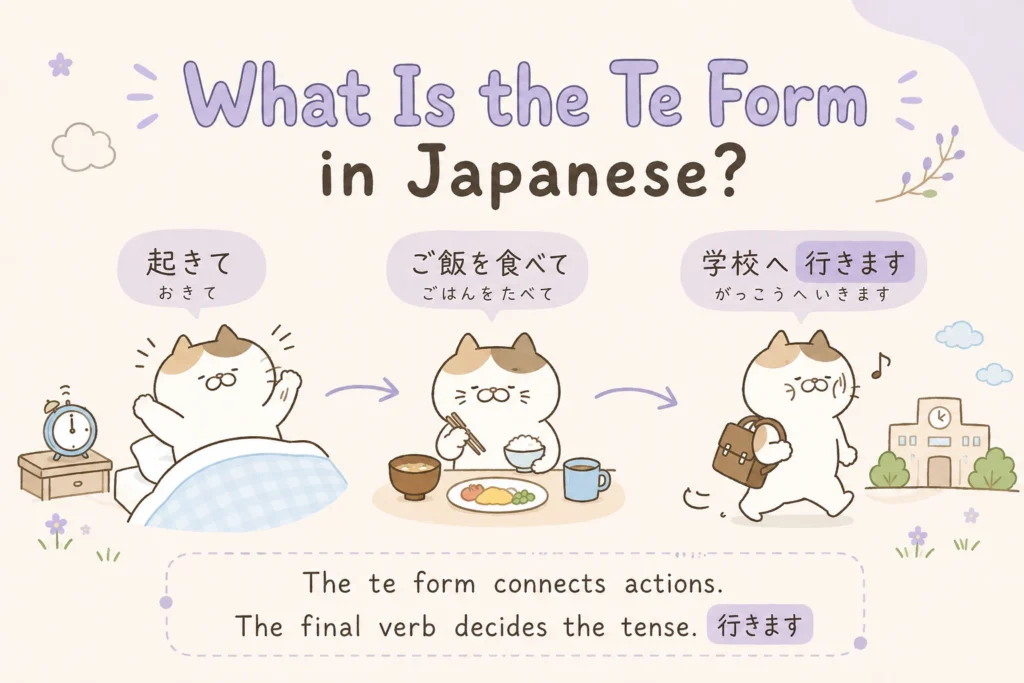
The te form is a connecting form of a verb, adjective, or noun that links it to the next part of the sentence. It carries no tense of its own. Whether a te form sentence ends up meaning past, present, or future depends entirely on the final verb at the end of the sentence.
That is what makes the te form so useful. You can chain several actions together and the listener still understands the timing, because only the last word in the chain decides the tense.
起きて、ご飯を食べて、学校へ行きます。
I wake up, eat breakfast, and go to school.
Here, 起きて and 食べて are both in te form. Neither one tells you the tense by itself. The final verb, 行きます, is what places the whole sentence in the present or near future.
Te Form Conjugation Cheat Sheet
Verbs split into three groups in Japanese, and each group conjugates into te form differently.
| Verb Group | Rule | Example |
|---|---|---|
| Godan (Group 1) | Ending changes depending on the final kana | 書く(かく)→ 書いて(かいて) |
| Ichidan (Group 2) | Drop る, add て | 食べる(たべる)→ 食べて(たべて) |
| Irregular (Group 3) | Memorize directly | する → して 来る(くる)→ 来て(きて) |
Godan verbs cause the most confusion because they do not follow one single pattern. They split into five smaller groups depending on the final kana of the dictionary form. The next section breaks those down one at a time.
How to Tell If a Verb Is Godan or Ichidan
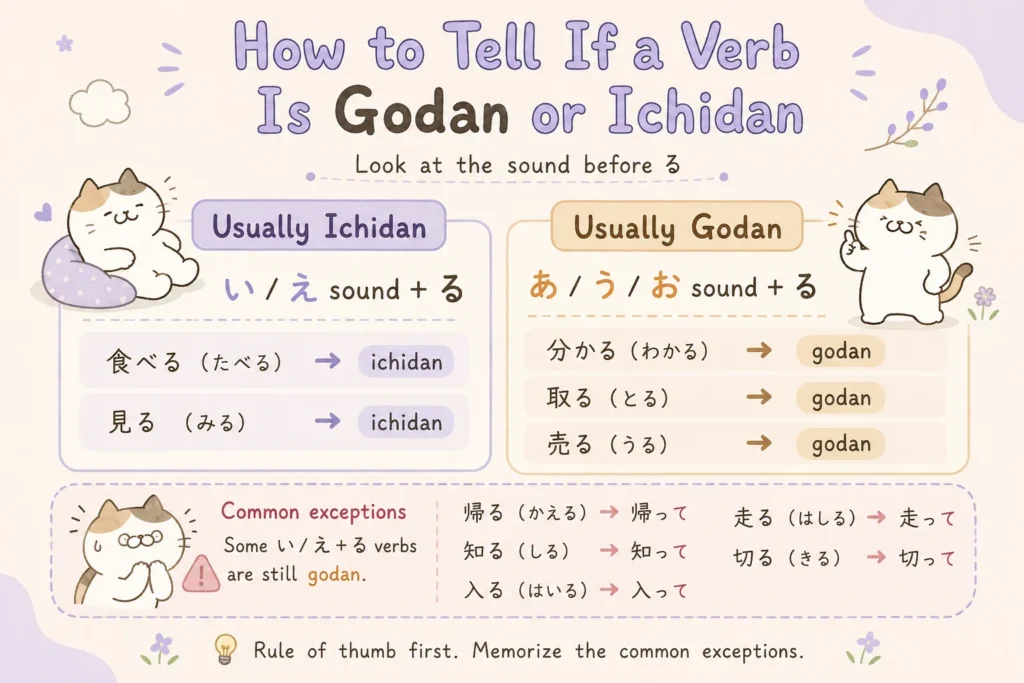
Most learners assume any verb ending in る is ichidan. That assumption fails often enough to cause real mistakes.
A useful rule of thumb is to look at the sound right before る.
If the sound before る is an い or え sound, the verb is usually ichidan. If the sound before る is an あ, う, or お sound, the verb is usually godan.
食べる(たべる)to eat → e-sound before る → ichidan
見る(みる)to see → i-sound before る → ichidan
分かる(わかる)to understand → a-sound before る → godan
取る(とる)to take → o-sound before る → godan
売る(うる)to sell → u-sound before る → godan
The problem is the word “usually.” A handful of common verbs end in an い or え sound right before る but still conjugate as godan. These have to be memorized individually, because they break the pattern above.
帰る(かえる)to return → godan → 帰って(かえって)
知る(しる)to know → godan → 知って(しって)
入る(はいる)to enter → godan → 入って(はいって)
走る(はしる)to run → godan → 走って(はしって)
切る(きる)to cut → godan → 切って(きって)
If you conjugate one of these as ichidan, the form will be wrong even if the meaning is clear. 帰る does not become 帰て. It becomes 帰って.
When in doubt with a new る verb, look it up once and note which group it belongs to before you try to use it in a sentence.
How to Conjugate Godan Verbs into Te Form
Godan verbs are sometimes called u-verbs, because their dictionary form ends in a kana with a u-sound. But the te form is not made by adding one single ending to every godan verb. The pattern changes depending on the final kana of the dictionary form.
| Ending | Te Form Pattern | Examples |
|---|---|---|
| う, つ, る | って | 会う(あう)→ 会って(あって) 待つ(まつ)→ 待って(まって) 帰る(かえる)→ 帰って(かえって) |
| ぶ, む, ぬ | んで | 遊ぶ(あそぶ)→ 遊んで(あそんで) 飲む(のむ)→ 飲んで(のんで) 死ぬ(しぬ)→ 死んで(しんで) |
| く | いて | 書く(かく)→ 書いて(かいて) |
| ぐ | いで | 泳ぐ(およぐ)→ 泳いで(およいで) |
| す | して | 話す(はなす)→ 話して(はなして) |
Notice that ぶ, む, and ぬ all conjugate with んで, not んて. The で is voiced, which trips up a lot of learners who try to write or type the form from memory.
There is also one very common exception: 行く(いく, to go)does not become 行いて. It becomes 行って(いって).
行く(いく)→ 行って(いって)
Need a quick reference while practicing? Download the printable te-form cheat sheet with all five godan patterns, ichidan rules, irregular verbs, and the 行く exception.
A Convenience Store Memory Trick
Here is a memory trick that makes the five main patterns easier to hold onto. Picture a late-night walk home from the convenience store.
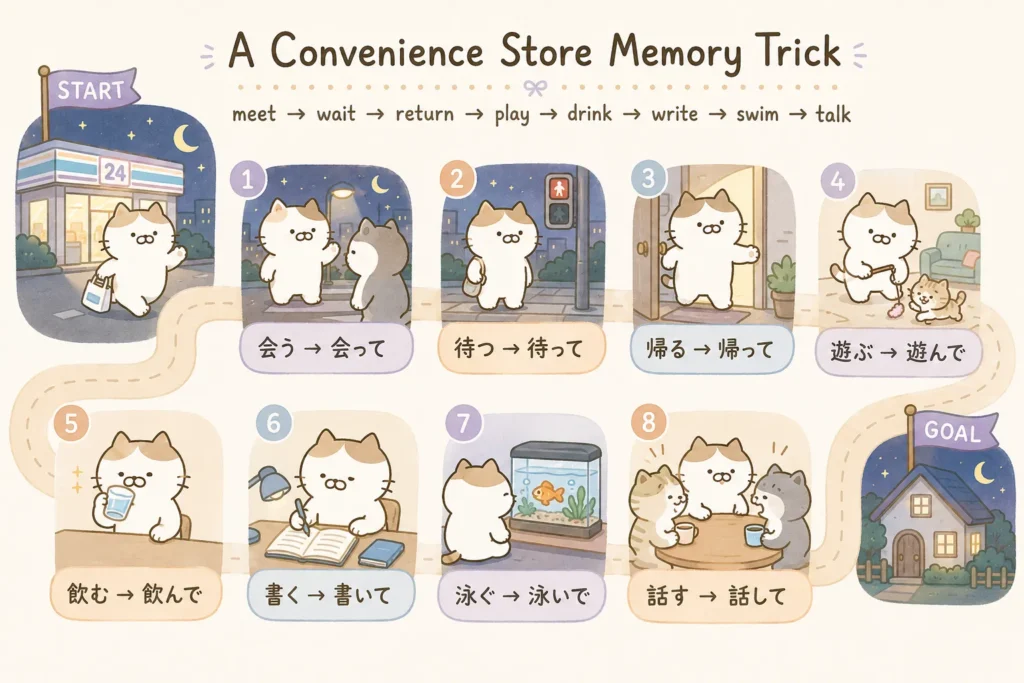
Memory route:
meet → wait → return → play → drink → write → swim → talk
First, you 会う(あう, meet)a friend, so you 会って(あって)and walk together. You 待つ(まつ, wait)at a red light, so you 待って(まって)for it to change. Then you get home and 帰る(かえる, return), so you 帰って(かえって)and open the door.
う, つ, る → って
会う(あう)→ 会って(あって)
待つ(まつ)→ 待って(まって)
帰る(かえる)→ 帰って(かえって)
Then your dog wants to 遊ぶ(あそぶ, play)when you walk in, so it comes running over: 遊んで(あそんで). You 飲む(のむ, drink)a glass of water, so you finish 飲んで(のんで)and feel better.
ぶ, む → んで
遊ぶ(あそぶ)→ 遊んで(あそんで)
飲む(のむ)→ 飲んで(のんで)
ぬ follows the same んで pattern. It appears in very few common verbs, but 死ぬ(しぬ, to die)is the one you are most likely to encounter.
ぬ → んで
死ぬ(しぬ)→ 死んで(しんで)
Finally, you sit down and 書く(かく, write)up your notes for the day, so you finish 書いて(かいて). If you imagine a fish tank nearby, the fish are 泳ぐ(およぐ, swim), so they go 泳いで(およいで)in circles.
く → いて
ぐ → いで
書く(かく)→ 書いて(かいて)
泳ぐ(およぐ)→ 泳いで(およいで)
Last, you 話す(はなす, talk)about your day with your family, so you sit down and 話して(はなして).
す → して
話す(はなす)→ 話して(はなして)
If you forget the rule mid-sentence, replay the short scene in order: meet, wait, return, play, drink, write, swim, talk. That is often faster than trying to recall the rule by name.
Can a Te Form Song Help You Memorize the Rules?
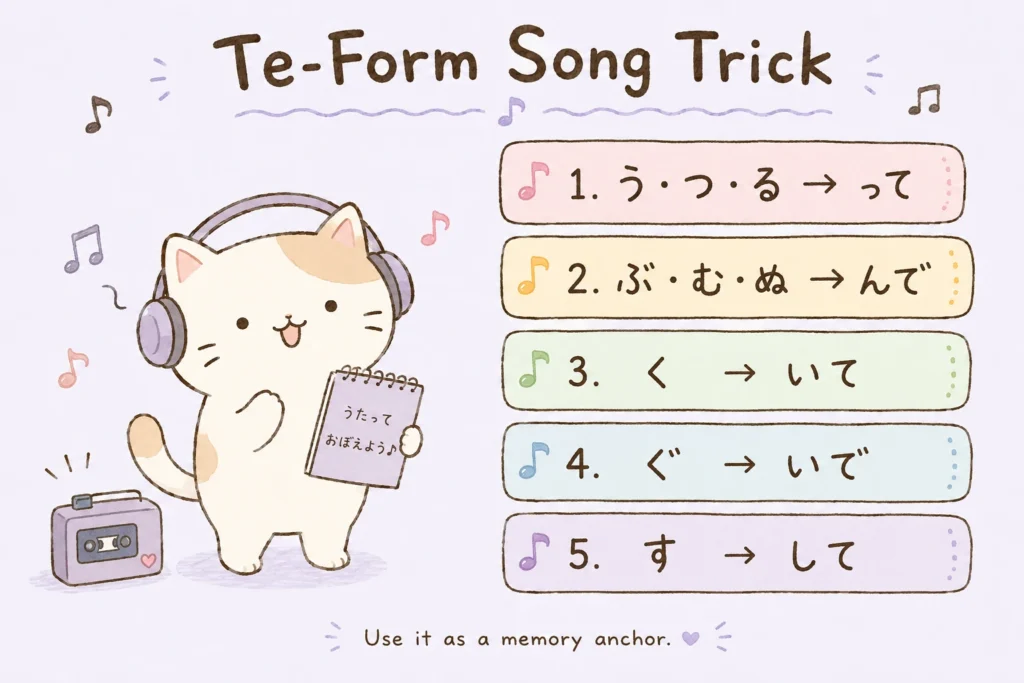
Some learners set the five godan patterns to a familiar melody, the same way English speakers use the alphabet song to learn their letters. Singing う・つ・る becomes って, ぶ・む・ぬ becomes んで, く becomes いて, ぐ becomes いで, す becomes して to a simple tune can make the patterns easier to recall under pressure, especially during a conversation when you do not have time to think through the rule step by step.
A song is not a replacement for practice, though. It works best as a memory anchor alongside the convenience store scene above and the AI drills further down this guide, not as the only method you rely on.
Ichidan and Irregular Verbs
Ichidan verbs, sometimes called ru-verbs, are the simplest group to conjugate. Drop the final る and add て.
食べる(たべる)+ て = 食べて(たべて)
見る(みる)+ て = 見て(みて)
起きる(おきる)+ て = 起きて(おきて)
There are only two irregular verbs in Japanese, but they appear constantly in everyday conversation, so they are worth memorizing on their own.
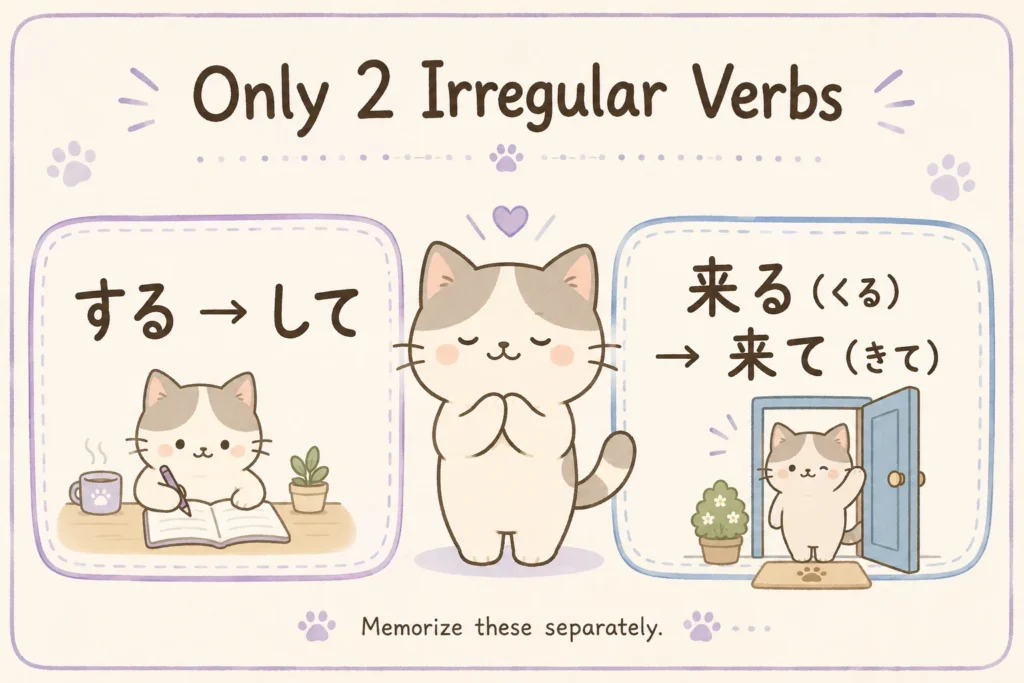
する → して
来る(くる)→ 来て(きて)
い-Adjectives and な-Adjectives in Te Form
The te form is not limited to verbs. Adjectives and nouns connect the same way, which lets you describe more than one quality in a single sentence.
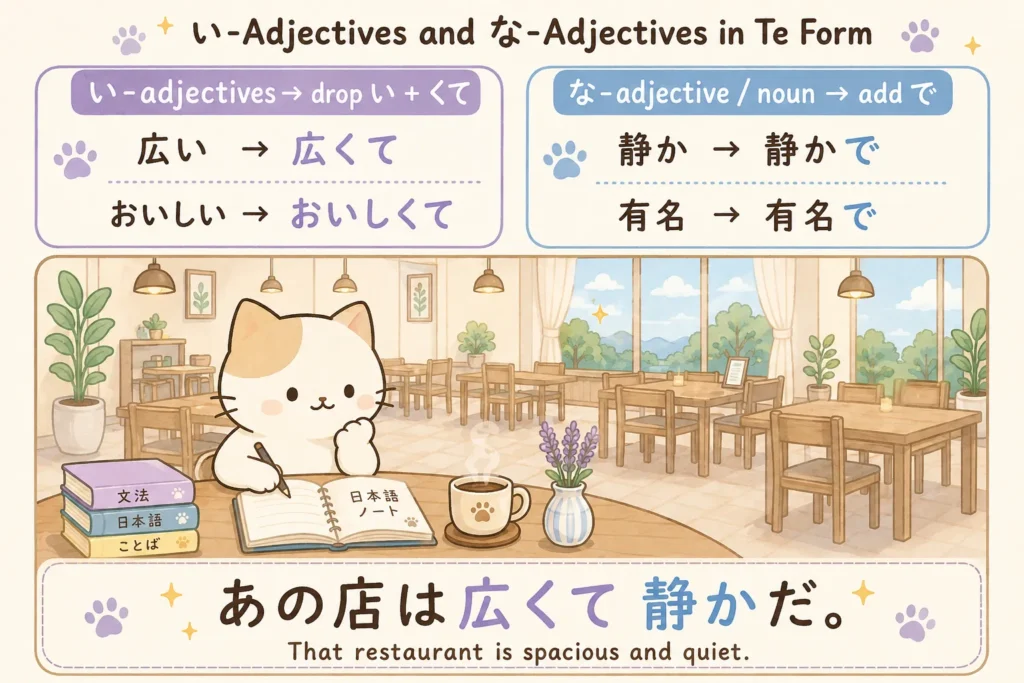
For い-adjectives, drop the final い and add くて.
広い(ひろい)+ くて = 広くて(ひろくて)
おいしい + くて = おいしくて
For な-adjectives and nouns, add で.
静か(しずか)+ で = 静かで(しずかで)
有名(ゆうめい)+ で = 有名で(ゆうめいで)
あの店は広くて静かだ。
That restaurant is spacious and quiet.
The full breakdown of い-adjective conjugation, including exceptions like いい and かっこいい, is covered in the い-adjective conjugation rules guide. For な-adjective te form patterns and tricky words like きれい and 好き, see the な-adjective te form rules.
5 Ways to Use the Te Form in Conversation
Once a verb, adjective, or noun is in te form, it can attach to other words to build some of the most common sentence patterns in Japanese. If you are learning te form for real conversations, you can also review these everyday Japanese phrases to see how short patterns appear in travel and daily situations.
Connecting Actions in Sequence
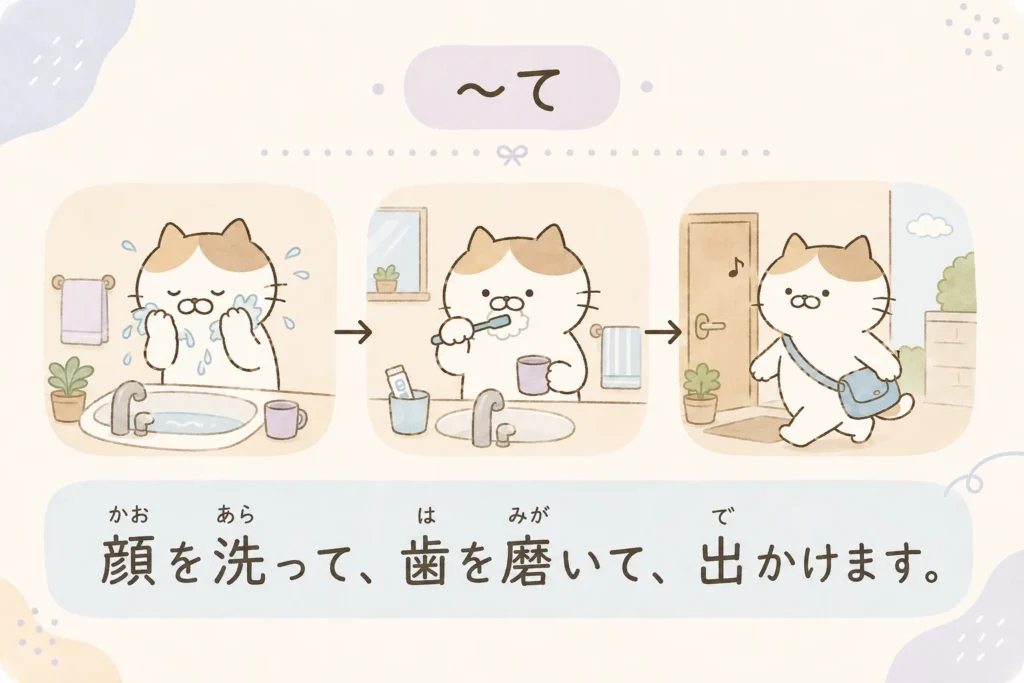
顔を洗って、歯を磨いて、出かけます。
I wash my face, then brush my teeth, then head out.
Making a Polite Request: てください
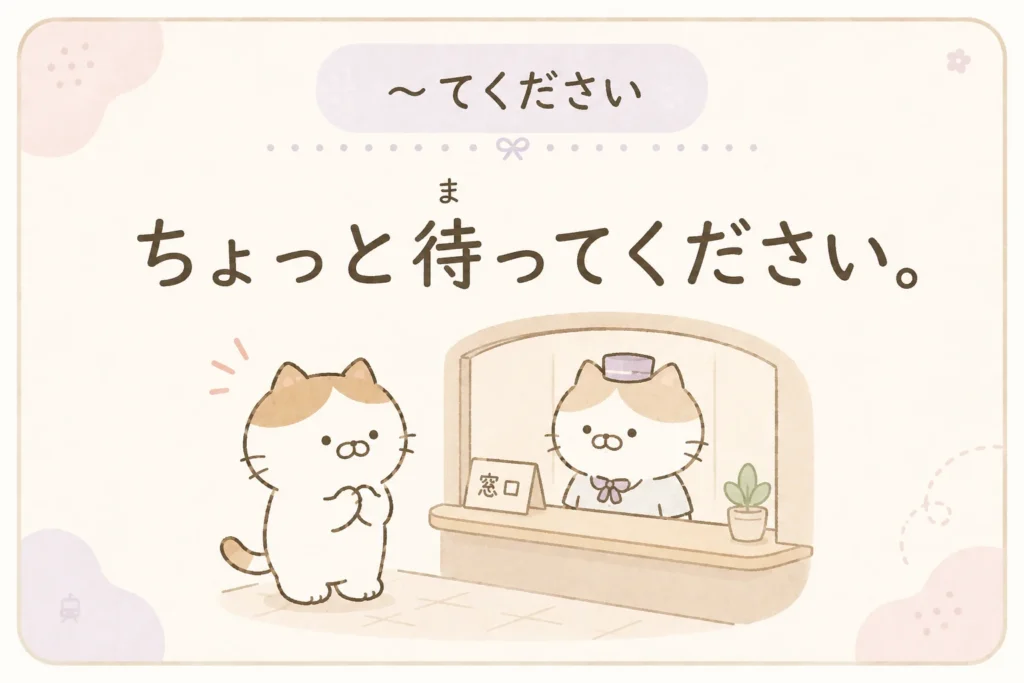
ちょっと待ってください。
Please wait a moment.
Describing an Ongoing Action: ている
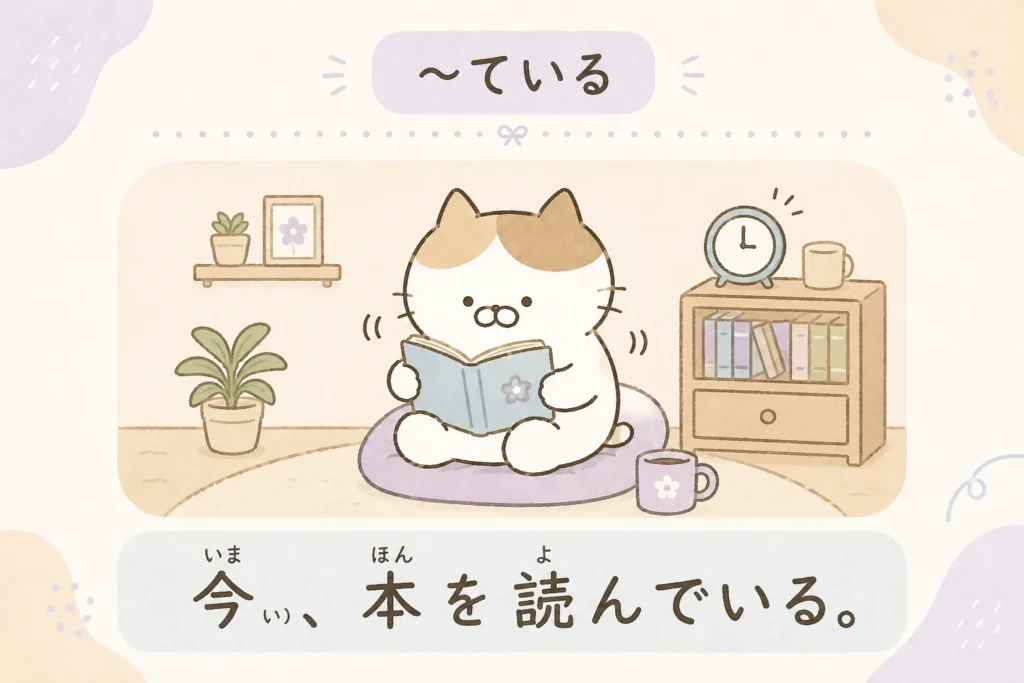
今、本を読んでいる。
I am reading a book right now.
ている does not always mean an action happening right now. With certain verbs, it describes a state that resulted from a completed action.
結婚しています。
I am married. Literally: have gotten married and remain so.
ドアが開いています。
The door is open. Literally: has been opened and remains that way.
If a sentence with ている sounds odd as “is doing,” try reading it as a resulting state instead.
There is a related pattern, てある, that often gets confused with this resultant-state use of ている. The difference comes down to whose action caused the state.
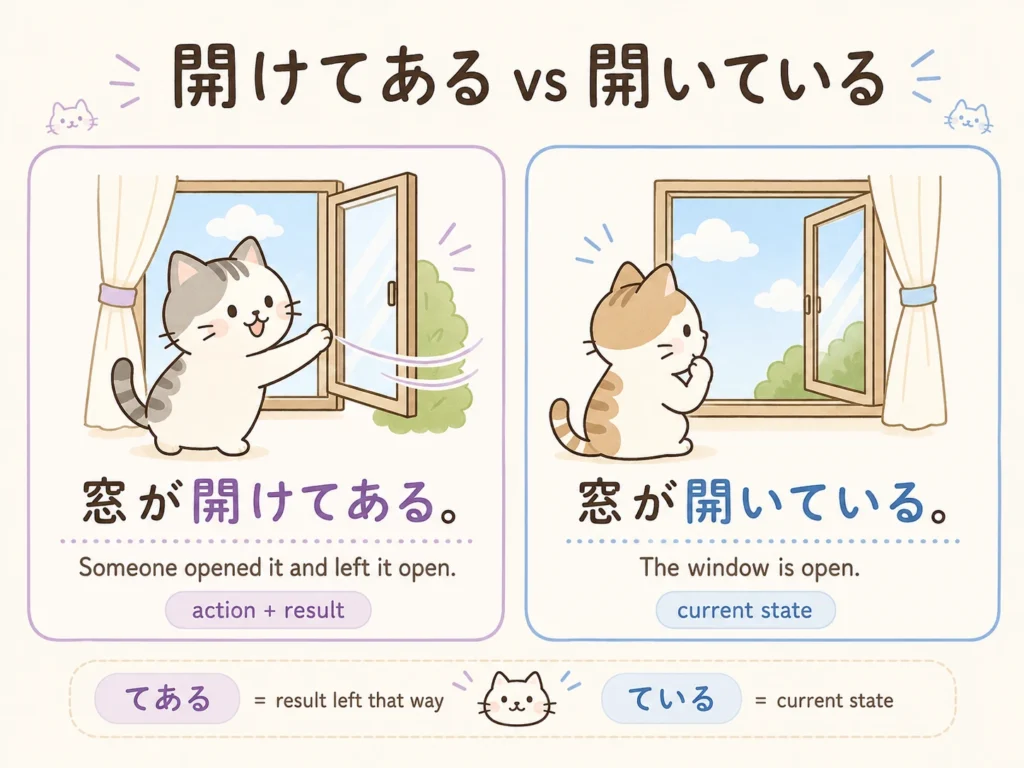
窓が開けてある。
The window has been left open. Implies someone deliberately opened it and left it that way.
窓が開いている。
The window is open. No focus on who opened it.
| Pattern | Focus | Simple Meaning |
|---|---|---|
| ている | action or resulting state | is doing / has become |
| てある | a prepared state caused by someone | has been done / is set up |
Asking for Permission: てもいいですか
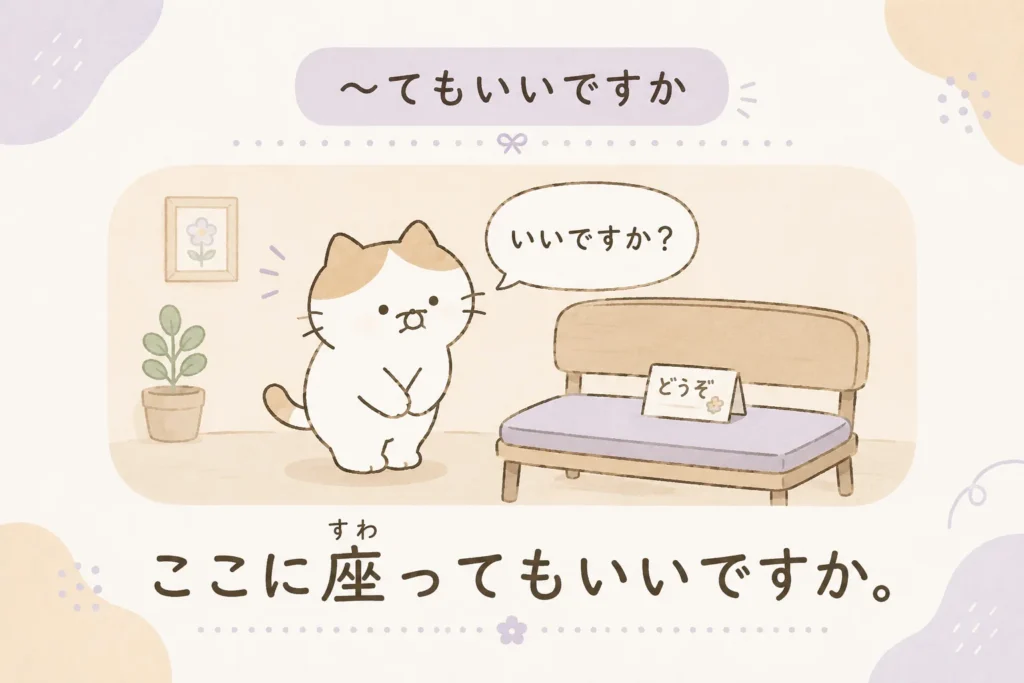
ここに座ってもいいですか。
Is it okay if I sit here?
Stating Prohibition: てはいけません
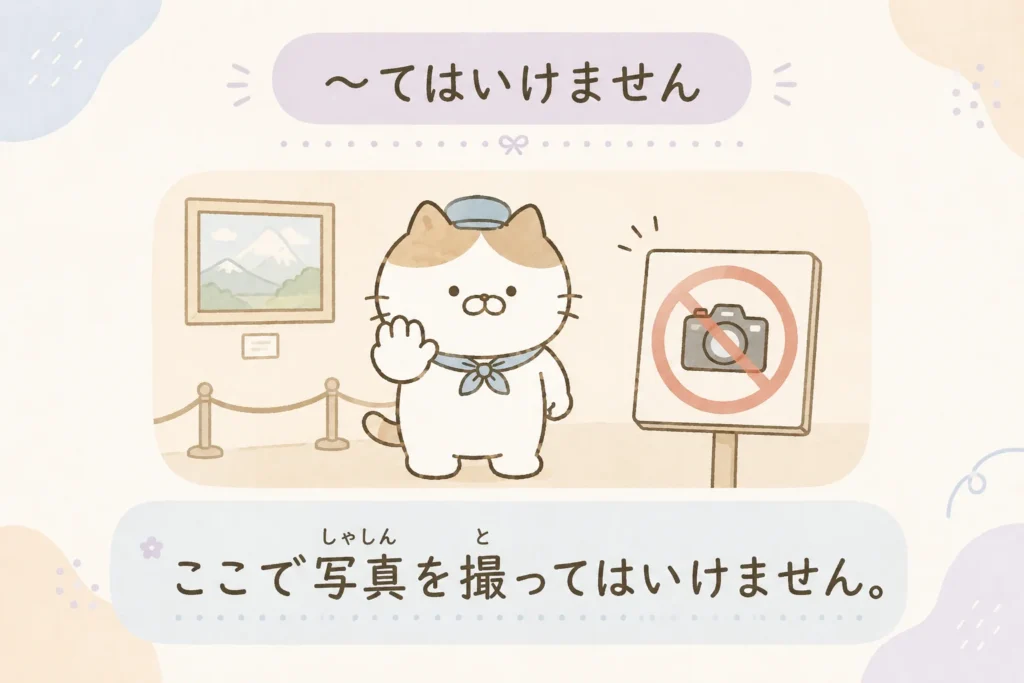
ここで写真を撮ってはいけません。
You must not take photos here.
What About Negative Te Form?
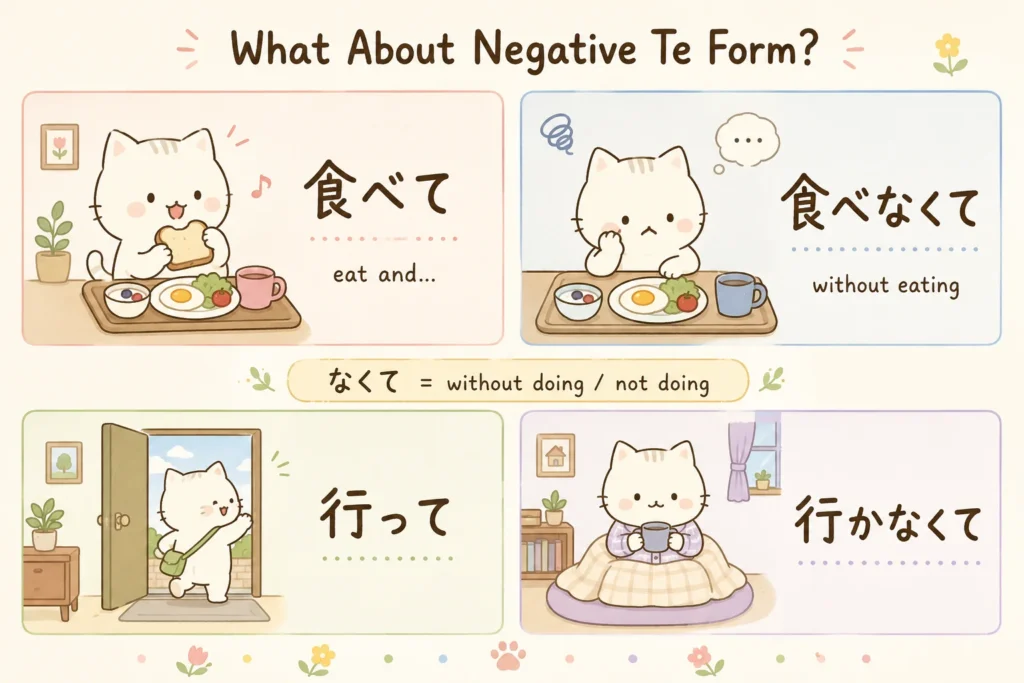
Everything so far has been the positive te form. Japanese also has a negative connecting form, and it does not use て at all.
For verbs, drop ない from the negative form and add で.
食べない → 食べないで
見ない → 見ないで
朝ご飯を食べないで、学校に行った。
I went to school without eating breakfast.
For adjectives, change the negative くない to くなくて.
高くない → 高くなくて
高くなくて、便利です。
It is not expensive and convenient.
One more pattern worth knowing early: ないでください, used to ask someone not to do something.
ここで写真を撮らないでください。
Please do not take photos here.
行く: The One Exception You Need to Memorize
行く(いく, to go)ends in く, so by the rule above, it should become 行いて. It does not.
行く(いく)→ 行って(いって)
This is the only godan verb that breaks its own group’s pattern. Every other く-ending verb, like 書く(かく)or 聞く(きく), follows the regular rule. 行く is the lone exception, and it shows up often enough in daily conversation that memorizing it on its own is worth the effort.
Ending a Sentence with Te
Sometimes you will hear a sentence end on て with nothing after it.
ちょっと待って。
Wait.
On its own, a bare te form like this works as a casual request or command, similar to dropping ください. It is informal, so it fits with friends or family, not in polite or formal speech.
There is a second, softer use of a trailing te form. A speaker starts a reason or explanation, then lets the sentence trail off instead of finishing it.
今日はちょっと体調(たいちょう)が悪くて...
I'm not feeling that well today, so...
The rest of the thought, asking to leave early, declining an invitation, is left unsaid. Letting the listener fill in the ending is a common way to soften a request or a refusal in Japanese, rather than stating it directly.
More Te-Form Patterns You Will See Next
Once a verb is in te form, it can attach to several other auxiliary verbs to build more specific meanings. You do not need to master all of these right away, but recognizing them will help once you move past N5.
| Pattern | Meaning | Example |
|---|---|---|
| てみる | try doing | 食べてみる try eating it |
| ておく | do in advance | 予約しておく book it in advance |
| てしまう | do accidentally / finish completely | 忘れてしまった ended up forgetting |
| てくれる | someone does something for me | 手伝ってくれる helps me |
Each of these works the same way: take the te form you already know how to build, and attach the auxiliary verb after it.
Common Mistake: Treating Te Form Like Every English “And”
Te form can connect actions, reasons, and related states. But it is not a universal replacement for every English “and.”
Use て when the ideas belong to the same flow.
朝ご飯を食べて、学校に行きました。
I ate breakfast and went to school.
Here, the actions happen in sequence, so the te form sounds natural.
But if the ideas are just separate facts, forcing them into one te-form chain sounds unnatural.
❌ Unnatural
私は学生で、犬が好きで、昨日雨でした。
I am a student, I like dogs, and it rained yesterday.
The grammar pieces are not the problem. The problem is that the ideas do not belong to one natural chain. Being a student, liking dogs, and yesterday’s weather are separate facts.
✅ More Natural
私は学生です。犬が好きです。昨日は雨でした。
I am a student. I like dogs. It rained yesterday.
When the actions or states do not naturally connect, separate sentences usually sound better than one long te-form sentence.
50 Essential Te-Form Verbs for Practice
You do not need to memorize all 50 at once. Use this list as a practice bank. Pick 5 to 10 verbs each day, say the te form out loud, then write one short sentence with each verb.
For a longer printable version, download the PDF at the end of this guide. It includes 100 te-form verbs, grouped by conjugation pattern, with readings and meanings.
Godan Verbs: う, つ, る → って
| Dictionary Form | Reading | Meaning | Te Form |
|---|---|---|---|
| 会う | あう | to meet | 会って |
| 買う | かう | to buy | 買って |
| 使う | つかう | to use | 使って |
| 思う | おもう | to think | 思って |
| 言う | いう | to say | 言って |
| 待つ | まつ | to wait | 待って |
| 持つ | もつ | to hold / have | 持って |
| 立つ | たつ | to stand | 立って |
| 帰る | かえる | to return | 帰って |
| 入る | はいる | to enter | 入って |
| 知る | しる | to know | 知って |
| 走る | はしる | to run | 走って |
| 切る | きる | to cut | 切って |
Godan Verbs: ぶ, む, ぬ → んで
| Dictionary Form | Reading | Meaning | Te Form |
|---|---|---|---|
| 遊ぶ | あそぶ | to play | 遊んで |
| 呼ぶ | よぶ | to call | 呼んで |
| 選ぶ | えらぶ | to choose | 選んで |
| 飛ぶ | とぶ | to fly | 飛んで |
| 飲む | のむ | to drink | 飲んで |
| 読む | よむ | to read | 読んで |
| 休む | やすむ | to rest | 休んで |
| 死ぬ | しぬ | to die | 死んで |
Godan Verbs: く → いて
| Dictionary Form | Reading | Meaning | Te Form |
|---|---|---|---|
| 書く | かく | to write | 書いて |
| 聞く | きく | to listen / ask | 聞いて |
| 歩く | あるく | to walk | 歩いて |
| 働く | はたらく | to work | 働いて |
| 置く | おく | to put | 置いて |
| 泣く | なく | to cry | 泣いて |
The 行く Exception
| Dictionary Form | Reading | Meaning | Te Form |
|---|---|---|---|
| 行く | いく | to go | 行って |
Godan Verbs: ぐ → いで
| Dictionary Form | Reading | Meaning | Te Form |
|---|---|---|---|
| 泳ぐ | およぐ | to swim | 泳いで |
| 急ぐ | いそぐ | to hurry | 急いで |
| 脱ぐ | ぬぐ | to take off clothes | 脱いで |
Godan Verbs: す → して
| Dictionary Form | Reading | Meaning | Te Form |
|---|---|---|---|
| 話す | はなす | to speak | 話して |
| 出す | だす | to take out / submit | 出して |
| 消す | けす | to erase / turn off | 消して |
| 貸す | かす | to lend | 貸して |
| 返す | かえす | to return something | 返して |
| 探す | さがす | to search for | 探して |
Ichidan Verbs: Drop る, Add て
| Dictionary Form | Reading | Meaning | Te Form |
|---|---|---|---|
| 食べる | たべる | to eat | 食べて |
| 見る | みる | to see / watch | 見て |
| 起きる | おきる | to wake up | 起きて |
| 寝る | ねる | to sleep | 寝て |
| 着る | きる | to wear | 着て |
| 借りる | かりる | to borrow | 借りて |
| 教える | おしえる | to teach / tell | 教えて |
| 忘れる | わすれる | to forget | 忘れて |
| 開ける | あける | to open | 開けて |
| 閉める | しめる | to close | 閉めて |
| 出る | でる | to leave / go out | 出て |
Irregular Verbs
| Dictionary Form | Reading | Meaning | Te Form |
|---|---|---|---|
| する | する | to do | して |
| 来る | くる | to come | 来て |
Once you can say these 50 forms without checking the chart, the te form will start to feel much less random. The goal is not to memorize every verb in Japanese. The goal is to recognize the sound-change pattern quickly.
Practice the Te Form with AI
Copy these prompts into the latest version of ChatGPT, Claude, Gemini, or any AI language tutor and use them as study drills.
Prompt 1: Conjugation Drill by Verb Group
Act as a Japanese teacher. Give me one Japanese verb at a time from a mix of godan, ichidan, and irregular verbs. Ask me to conjugate it into te form. Correct my answer gently and explain which sound-change rule applies.
Prompt 2: Sentence Chaining Practice
Act as a Japanese tutor. Give me three short daily actions in English, like waking up, eating breakfast, and leaving the house. Ask me to connect them into one Japanese sentence using te form. Correct my grammar and explain any mistakes.
Prompt 3: Te Form Pattern Quiz
Quiz me on Japanese te form conjugation. Give me one verb at a time and ask me to identify which group it belongs to (godan, ichidan, or irregular) before conjugating it. Include tricky cases like 行く, 知る, and 帰る. Explain the rule after each answer.
Prompt 4: Request and Permission Practice
Give me five everyday situations where I would need to make a polite request or ask for permission in Japanese, like asking to sit somewhere or asking someone to wait. Help me write each one using てください or てもいいですか. Correct my sentences and explain each correction.
Prompt 5: Diary Sentence Practice
Give me five simple diary prompts using Japanese te form to connect two or more actions, like a morning routine or a weekend activity. Correct my sentences, explain each correction, and show me a more natural version if mine sounds stiff.
Repeat these prompts every few days with new verbs. The goal is not to memorize one chart. The goal is to train your brain to recognize the sound-change pattern on sight.
Build a Notion Flashcard System for Te Form Verbs
A conjugation chart is useful when you are reading. A flashcard system is useful when you want the pattern to stick.
| Field | Example |
|---|---|
| Verb | 書く |
| Reading | かく |
| Meaning | to write |
| Group | godan |
| Te Form | 書いて |
| Example Sentence | 手紙を書いています。 |
| My Sentence | 毎日日記を書いて、寝ます。 |
| Review Status | New / Learning / Mastered |
| Review Date | Friday |
Simple study workflow:
- Add five new verbs, mixing all three groups.
- Fill in the reading, group, and te form.
- Write one personal sentence using each te form.
- Ask AI to correct your sentences.
- Review the same cards again in three days.
The personal sentence is the most important part. Grammar becomes easier to recall when it lives inside a sentence from your own life, not a textbook example.
Quick Practice Quiz
Questions
- Conjugate 会う into te form.
- Conjugate 飲む into te form.
- Conjugate 泳ぐ into te form.
- Conjugate 話す into te form.
- Conjugate 食べる into te form.
- What is the te form of する?
- What is the te form of 行く?
- Connect these into one sentence using te form: 起きる, シャワーを浴びる, 出かける.
- Translate using てください: Please wait here.
- Translate using ている: I am studying Japanese right now.
Answers
- 会って
- 飲んで
- 泳いで
- 話して
- 食べて
- して
- 行って
- 起きて、シャワーを浴びて、出かけます。
- ここで待ってください。
- 今、日本語を勉強しています。
If you got the godan endings wrong, go back to the cheat sheet and replay the convenience store scene in order until the five patterns come back automatically.
FAQ About the Te Form in Japanese
What is the te form used for?
The te form connects actions, requests, and ongoing states in a single sentence. It carries no tense of its own. The final verb in the sentence determines whether the meaning is past, present, or future.
Why is 行く an exception to the te form rules?
行く ends in く, so the regular rule would produce 行いて. Historically, the conjugation shifted to 行って instead, and that irregular form is the one used in modern Japanese. It is the only godan verb that breaks its own group’s pattern.
What is the difference between godan and ichidan verbs?
Godan verbs, also called u-verbs, split into five sound-change patterns depending on their final kana. Ichidan verbs, also called ru-verbs, follow one simple rule: drop る and add て. Ichidan verbs are generally easier to conjugate.
Can a sentence end in just te, with nothing after it?
Yes. A bare te form at the end of a sentence works as a casual request, similar to dropping ください. It can also be used to trail off mid-explanation, leaving the rest of the thought unsaid as a softer, more indirect way of speaking.
How do I memorize all five godan sound-change patterns?
Repetition in context works better than memorizing the rule as a list. Try linking each pattern to a short scene, like the convenience store walk in this guide, or use the AI practice prompts above to drill verbs from all three groups until the pattern becomes automatic.
What is the negative te form in Japanese?
The negative te form does not use て at all. For verbs, drop ない from the negative form and add で, as in 食べない → 食べないで. For adjectives, change くない to くなくて. The pattern ないでください is used to politely ask someone not to do something.
Is the te form the same as the imperative form?
No, though a bare te form can sound similar to a command in casual speech. The true imperative form is sharper and more direct, often used in instructions, warnings, or anime dialogue. A bare te form, like 待って, still carries a softer, more casual request tone rather than a hard command.
What is the difference between ている and てある?
ている describes an ongoing action or a state that resulted from an action, without focusing on who caused it. てある describes a state that was deliberately prepared or left that way by someone, with that intention built into the meaning. 窓が開いている simply states the window is open, while 窓が開けてある implies someone opened it on purpose and left it that way.
Final Takeaway
The te form feels overwhelming at first because godan verbs split into five different sound-change patterns instead of one simple rule. Once those patterns click, the te form becomes the base for some of the most common sentence structures in Japanese, from polite requests to ongoing actions to permission and prohibition.
Start with the cheat sheet, walk through the convenience store scene a few times, and copy one AI prompt into your next study session. The pattern becomes automatic faster than it feels right now.
Want more practice? Download the printable PDF for the full 100-verb te-form list, including extra godan verbs, ichidan verbs, irregular verbs, and blank practice rows for your own sentences.