Key Takeaways
- You do not need more vocabulary lists. You need a system that turns passive words into active words you can actually use.
- Context beats isolated memorization. Words from dramas, articles, podcasts, songs, and real conversations are easier to remember because they come with emotion, tone, and usage.
- AI works best as a practice partner, not a dictionary replacement. Use AI to create examples, drills, stories, and output practice. Use dictionaries to check accuracy.
The best ways to learn vocabulary all solve the same problem: they help you retrieve words, not just recognize them. This is close to what learning researchers call retrieval practice: bringing information back from memory instead of only reviewing it again. I used to think the best way to learn vocabulary was to collect more words, so I collected everything: Korean drama lines, Japanese song lyrics, English article highlights, random screenshots, and pretty Notion tables. The notes kept growing, but the words did not always stay.
That was when I realized the real problem was not vocabulary size. It was vocabulary activation. The best ways to learn vocabulary are not about making another long list. They are about turning passive words into words you can actually use. I still use dictionaries when I need accuracy — especially for pronunciation, examples, and word forms. For English, I often check Cambridge Dictionary before I trust a new expression completely. But most of my vocabulary learning now starts with real context, subtitles, articles, AI practice, and repeated use. This guide is the system I wish I had earlier. 🧠
Table of Contents
Part 1: Find the Real Problem
Why Your Vocabulary List Keeps Growing but Your Speaking Does Not Improve
You have saved hundreds of words.
Your Notion is full of them. Your phone has screenshots going back two years. You have highlighted entire pages of textbooks.
But when you try to speak, the words are not there.
This is not just a memory problem.
It is a vocabulary type problem.
Every word you know lives in one of two places.
Passive vocabulary is words you recognize when you see or hear them.
Active vocabulary is words you can retrieve and use without thinking.
Most learners have a large passive vocabulary and a much smaller active one.
Saving a word adds it to the passive pile.
Actually using it is what moves it to the active side.
📌 The goal of this article is not to help you save more words. It is to help you move words from passive to active.
That movement does not happen by accident.
It happens through a system.
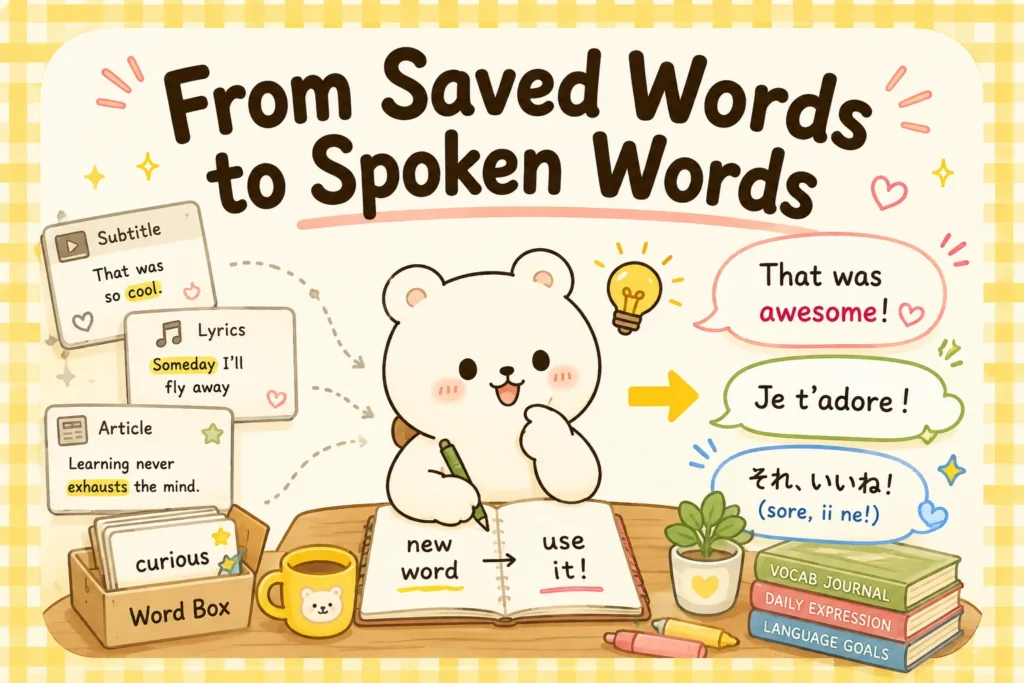
The Vocabulary Activation Loop
I learned Japanese because of a band I loved. I learned Korean because of a drama that completely wrecked me emotionally. Later, I started turning real situations into study material too, like collecting Japanese phrases I could actually use in restaurants, trains, shops, and hotels. If you enjoy learning through fixed expressions and cultural patterns, Japanese idioms are especially rewarding — once you know them, they appear everywhere. I put together a list of 50 Japanese idioms that are easier to remember than they look.
No classes. No tutors.
Just subtitles, screenshots, and a lot of confusion.
Along the way, I noticed something.
The words that actually stuck were rarely the ones I calmly copied from a vocabulary list.
They were the ones I met in a strange, funny, or emotional way.
モノクロ — I heard it in a song and assumed it was a Japanese word. Then I looked it up and realized it came from the English word “monochrome.” One second of surprise, and I never forgot it.
블랙헤드 — I saw it on a Korean skincare label and read it out loud. Blackhead. Spelled in Korean. I did not even need to look it up.
大丈夫 — I saw the characters and assumed it meant something about being a strong man, because that is what the characters suggest in Chinese. In Japanese, it actually means “are you okay” or “it’s fine.” I used it wrong twice before it finally clicked.
For English, I stopped trying to memorize GRE words from a list and started asking AI to break them down by roots.
Take denomination.
Once I understood that nomin comes from the Latin word for “name,” the meaning made sense faster. And I got nominate, nominal, and nominee almost for free.
None of these words stuck because they were sitting in a perfect vocabulary table.
They stuck because something happened when I met them.
That something is what I call the Vocabulary Activation Loop.
🧠 1. Notice the word
You meet it somewhere real: a drama, an article, a podcast, a skincare label.
You pause because it feels useful, strange, or funny.
🔍 2. Understand it in context
Do not just ask what it means.
Ask what is happening. What emotion is behind it? Why did this word appear here?
✍️ 3. Save one real example sentence
Not a random dictionary sentence.
Save the sentence where you actually found the word. That sentence carries the context.
🔁 4. Meet it again
One encounter is rarely enough.
You need to see the word again in another scene, article, topic, or review session.
🗣️ 5. Use it in your own sentence
Write one simple sentence.
It does not have to be perfect. Producing the word yourself is what starts moving it from passive to active.
✅ 6. Test yourself
Cover the meaning. Can you remember it?
Cover the word. Can you recall it from the meaning alone?
❤️ 7. Connect it to something real
A word connected to a strong emotion, a specific scene, or a personal memory is much harder to forget.
A word does not become yours when you save it. It becomes yours when you meet it again, use it, and connect it to something you actually care about.
Part 2: Collect Better Words from Real Contexts
Learn from What You Actually Watch: Dramas, Videos, Reels
The best vocabulary lesson is the one you did not plan. 🎬
Maybe you are watching a Korean drama, a Japanese variety show, or a random Reel. A character says something you do not understand, but the emotion is clear. You pause, rewind, and wonder what that word actually means.
That moment is worth more than an hour of flashcards.
The problem is what most people do next. They open a dictionary, find the Chinese or English meaning, close the dictionary, and keep watching. Three days later, the word is gone.
The issue is not that you looked it up. The issue is that you only got the meaning. You did not get the context, the emotion, the register, or a sentence you could actually use yourself.
Here is what to do instead: grab the line, paste it into AI, and ask better questions.
This is also how I study Korean slang from K-dramas and variety shows. A word can look simple in a dictionary, but the real meaning often depends on the scene, relationship, and tone. I wrote a separate guide to Korean slang words from K-dramas, K-pop, and real life if you want more examples.
📋 Copy this prompt:
I am learning [Korean / Japanese / English]. Here is a line from a drama: [paste line]. Break down any unfamiliar expressions. For each one: explain what it means in this context, tell me whether it is casual or formal, and give me one example sentence I can use myself.
What this gets you:
You learn not just what the word means, but when to use it, who uses it, and how it sounds in real life.
One reminder: For pronunciation and accuracy, always double-check with a proper dictionary.
Use Naver for Korean, Jisho for Japanese, and Cambridge Dictionary for English.
Learn from News Articles and Podcasts
Reading a news article and highlighting every unknown word is exhausting. 😮💨
And most of those words?
You will never see them again.
The smarter approach is to be selective.
Not every word in an article is worth your time.
The ones worth learning are expressions you can reuse in writing, in conversation, in the next article you read, or in your own analysis.
I tested this with an Economist article about delivery workers in China.
Instead of highlighting everything, I asked AI to extract only the expressions worth keeping.
Three that came out:
stack up against — structural conditions working against someone. Not just “unfair.” More like conditions piling up on top of each other.
the direction of travel — where things are heading, without saying they have arrived yet. Very useful for talking about trends.
fall well short of — did not meet expectations, and the gap was significant. Much stronger than “did not reach.”
These three expressions are not only useful in that article.
They work in business writing, academic essays, and everyday analysis.
That is the difference between words worth learning and words worth skipping.
📋 Copy this prompt:
Extract 10 vocabulary items from this text worth learning. For each one: the expression, the original sentence it appeared in, the meaning, and one new example sentence in a different context. Prioritize fixed phrases, verb collocations, and high-frequency expressions. Skip proper nouns and terms only useful in this one article. Text: [paste article]
One reminder: AI occasionally gets collocations slightly wrong.
If a phrase feels unnatural, check it against a corpus, a trusted dictionary, or real examples. ✅
Part 3: Turn Notes into Usable Vocabulary
Stop Making Pretty Vocabulary Lists You Never Review
Be honest. 😅
You have a Notion database somewhere.
It has columns for the word, the meaning, the example sentence, the pronunciation, the synonyms, and maybe even a color tag system.
You built it over three weeks.
You have opened it twice.
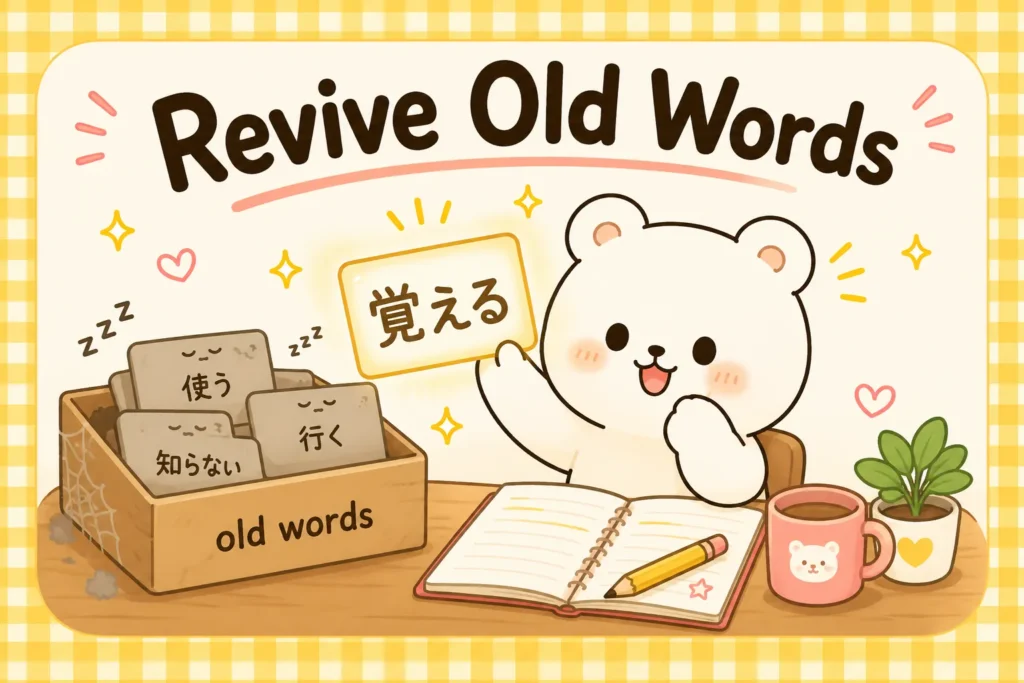
This is the vocabulary graveyard. 🪦
Words you saved, organized, and never saw again.
The problem is not that you took notes.
The problem is that pretty notes feel like studying.
They are not.
Building the system is not the same as using the system.
A vocabulary note only has value if it brings the word back to you at the right moment.
Here is what actually works:
| ❌ Vocabulary note that gets forgotten | ✅ Vocabulary note that gets used |
|---|---|
| Word + Chinese meaning | Word + one real sentence you found it in |
| 20 synonyms | 1 useful collocation |
| Dictionary definition | Where and when you first met it |
| Long grammar notes | One sentence you can say today |
Simple beats beautiful every time.
And for the words already buried in your graveyard, do not delete them.
Revive them. 💡
📋 Copy this prompt:
Here are 10 words I studied before but never really used: [list]. Help me revive them. For each word: one simple context where it fits naturally, one sentence I can say today, and one question I can answer to practice it.
Learn Word Partners, Not Just Word Meanings
Most vocabulary mistakes are not meaning mistakes.
They are usage mistakes.
You know what make means.
You know what decision means.
But do you instinctively say make a decision — not do a decision or take a decision?
That is a collocation.
A word partner.
And it is what separates vocabulary that sounds natural from vocabulary that sounds studied. 📚
Japanese and Korean have the same trap.
In Korean, you do not just learn 좋아하다 as “to like.”
You learn 음악을 좋아하다 and 커피를 좋아하다.
The verb needs its natural partner.
In Japanese, you do not just learn 気持ち as “feeling.”
You learn 気持ちがいい and 気持ちが悪い.
The nuance lives in the combination.
One word alone is half the story.
📋 Copy this prompt:
For the word [word], show me 10 natural collocations or word partners. Mark which ones are common, formal, casual, or unnatural. Give one example sentence for the 3 most useful ones.
Force Yourself to Use Words, Not Just Recognize Them
Recognition is easy. Production is hard.
You can recognize a word in a subtitle and feel like you know it, but the real test is whether you can reach for it yourself mid-sentence, mid-conversation, without looking anything up.
The only way to get there is output. 💬 Not perfect output. Just output.
This is why I like using AI for low-pressure practice. If English speaking is your main goal, vocabulary activation works even better when you practice full sentences out loud. I also wrote a guide with 12 AI prompts to improve English speaking skills if you want to turn AI into a speaking partner instead of a passive translation tool.
Here is a simple daily workflow that works:
The 5-Word Rule ✅
- Pick 5 words from something you actually watched or read today.
- Save one real sentence for each.
- Ask AI to write a short story using all 5.
- Write your own 5 sentences.
- Review them 2 days later.
- Use at least 1 word in speaking or writing before the day ends.
Five words done properly beats fifty words saved and forgotten.
📋 Copy this prompt:
Give me 5 sentences using [word]. Make 4 correct and 1 subtly wrong in context or collocation. Do not tell me which is wrong — let me find it.
This is one of the most effective drills I have found.
Finding the mistake forces your brain to understand the word’s boundaries, not just its meaning.
Play the Taboo Game to Test What You Really Know
Here is a simple test. 🎯
Pick a word you studied this week.
Now explain what it means without using the word itself, its translation, or any obvious synonym.
If you cannot do it, you do not really know the word yet.
This is called circumlocution.
It is the skill you need when you are mid-conversation and the word you want is not coming.
You have to work around it with what you already know.
AI makes this practice easy and actually fun.
📋 Copy this prompt:
Let’s play Taboo. I am trying to learn the word [word]. I will describe it to you in [Korean / Japanese / English] without using the word itself or its direct translation. You guess what I am describing. Then switch — you describe a word to me and I will guess.
The more you practice working around words, the more confident you become when real conversations do not go as planned. 😊
Part 4: Use the Right Tool for the Right Job
Use Dictionaries for Accuracy, AI for Practice
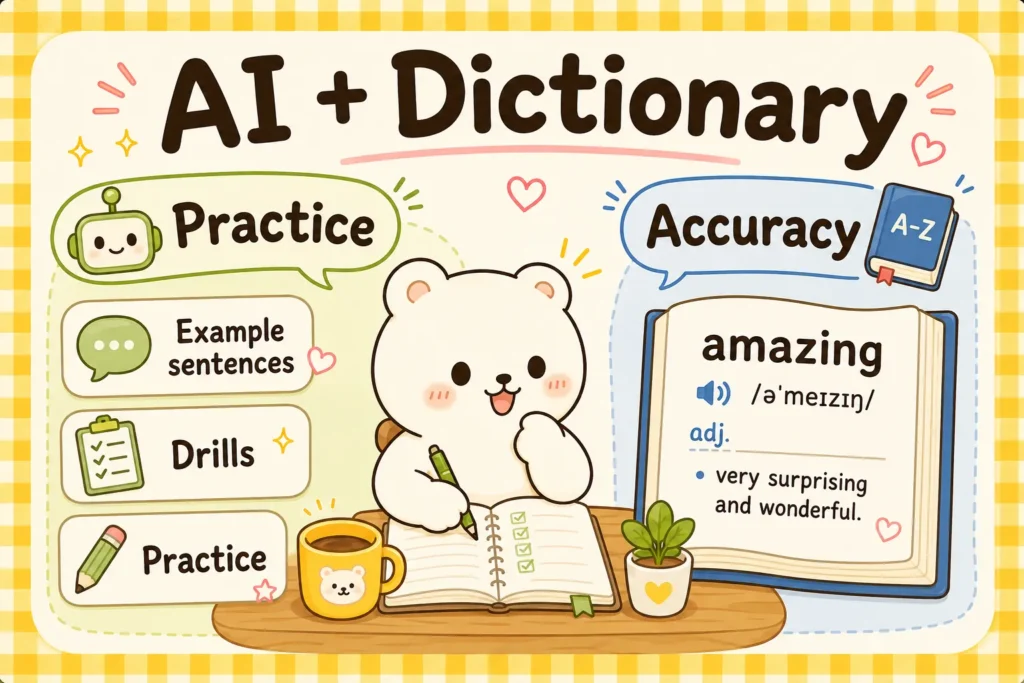
AI is not a replacement for your dictionary. 📖
It is a replacement for your boring practice worksheet.
After years of learning Korean and Japanese without a tutor, here is how I think about the two tools.
Use AI for:
- Generating context and example sentences
- Breaking down collocations and word partners
- Creating practice drills and output exercises
- Reviving forgotten vocabulary
- Making stories and games out of new words
Use a dictionary for:
- Checking pronunciation
- Verifying grammar rules
- Confirming word origins and etymology
- Checking whether a word form is common or rare
- Any time AI gives you an answer that feels slightly off
AI will occasionally give you a collocation that sounds almost right but is not quite natural.
A good dictionary catches that.
Use dictionaries for accuracy. Use AI for repetition, output, and practice.
Recommended dictionaries by language: 🔍
- English: Cambridge Dictionary
- Japanese: Jisho
- Korean: Naver Dictionary
These are free, reliable, and useful for serious self-learners.
Best Ways to Learn Vocabulary FAQs
Conclusion
If you are learning Korean, remember that passive watching is not the same as active study. I wrote more about this in my guide on how long it takes to learn Korean as a self-study learner.
You do not need another vocabulary list. You need a system that helps words come back when you actually need them.
Start with real input. Save one good sentence. Use AI to practice. Check accuracy with a proper dictionary.
The Vocabulary Activation Loop is simple: notice the word, understand it in context, use it, meet it again, and connect it to something real. 🚀