Learning a few Japanese phrases before your trip can make restaurants, train stations, hotels, convenience stores, and emergency situations much less stressful.
This guide gives you 100 essential Japanese phrases for travel, with Japanese text, romaji, English meanings, and simple notes on when to use each phrase. Start with the five core phrases below, then use the situation-based sections to find what you need quickly.
While putting this list together, I also checked Rakuten Travel’s 2024 guide, Japanese Phrases to Know, and Grasshopper Adventures’ guide, 23 Basic Japanese Phrases for Your Next Vacation to Japan. Both are useful references, but many phrase lists still put romaji first or stop at simple translations. I wanted this guide to feel more practical for real travel: Japanese text first, pronunciation support second, plus what staff may say back to you in Japan.
Travel habits change, and now you can also practice with AI by role-playing real scenes, like ordering at a restaurant, asking station staff for help, or checking in at a hotel.
Key Takeaways
- This guide covers 100 essential Japanese phrases for travel, organized by real situations like restaurants, trains, hotels, shopping, emergencies, and asking for clarification.
- Each phrase shows the Japanese text first, followed by romaji, English meaning, and a short note on when to use it.
- Start with the five core phrases below. They work in many everyday situations and can help you sound more natural even if you only know a little Japanese.
The 5 Japanese Phrases That Work in Almost Any Situation
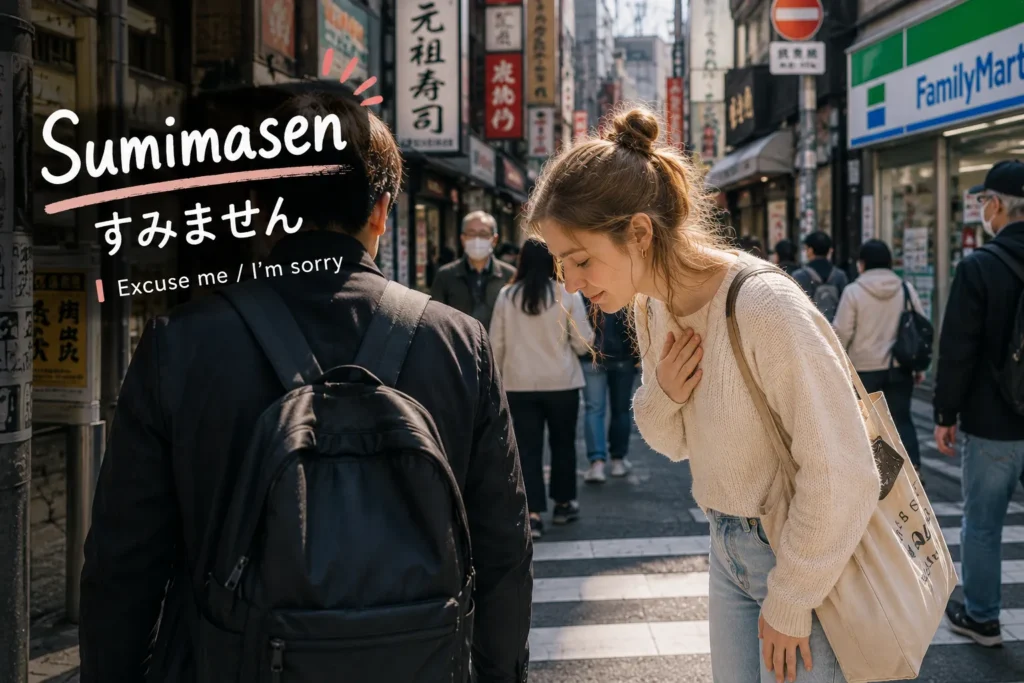
If you only remember five Japanese phrases before your trip, start with these. They are short, polite, and useful in many everyday situations, from asking for help to thanking staff.
| Japanese | Romaji | English | Use it when |
|---|---|---|---|
| すみません | Sumimasen | Excuse me / Sorry | Getting someone’s attention, apologizing, asking for help, or passing through a crowd. |
| ありがとうございます | Arigatou gozaimasu | Thank you | Thanking shop staff, hotel staff, restaurant servers, station staff, or anyone who helps you. |
| 大丈夫です | Daijoubu desu | I’m okay / No thank you | Politely declining a bag, help, a refill, a sample, or anything you do not need. |
| はい | Hai | Yes / I understand | Saying yes, showing you are listening, or acknowledging what someone said. |
| いいえ | Iie | No | Use this sparingly. In many daily situations, 大丈夫です sounds softer and more natural than a direct “no.” |
🍜 Japanese Phrases for Restaurants and Cafés
Restaurant Japanese phrases feel easy until the server walks over and asks something you did not expect. You may remember how to point at the menu, but when the reply comes back fast, your mind goes blank.
I learned this the hard way the first time I tried to order alone in Japan. The server asked me something three times, and I just stood there. The phrase was あたためますか? — would you like this warmed up? These are the phrases I wish I had practiced out loud before walking in.
Useful Japanese Restaurant Phrases
| Japanese | Romaji | English | Use it when |
|---|---|---|---|
| ひとりです | Hitori desu | Table for one | Hold up one finger as you say it. The gesture and phrase together are very clear. |
| ふたりです | Futari desu | Table for two | For larger groups, use the number plus にん, such as さんにん for three people or よにん for four people. |
| これをお願いします | Kore o onegaishimasu | This one, please | Point at the menu item as you say it. This phrase alone can get you through most casual meals. |
| おすすめはありますか? | Osusume wa arimasu ka? | Do you have any recommendations? | Use this when you want the staff’s suggestion or the shop’s popular item. |
| 英語のメニューはありますか? | Eigo no menyuu wa arimasu ka? | Do you have an English menu? | Useful in tourist areas, but smaller local restaurants may only have Japanese menus. |
| __アレルギーがあります | ___ arerugii ga arimasu | I have a ___ allergy | Fill in the blank with the ingredient, such as えび for shrimp, ナッツ for nuts, or 乳製品 for dairy. |
| __が食べられません | ___ ga taberaremasen | I cannot eat ___ | Use this for dietary restrictions or foods you need to avoid. |
| いただきます | Itadakimasu | Expression of gratitude before eating | Say this before your first bite. It is a cultural phrase, not just “let’s eat.” |
| ごちそうさまでした | Gochisousama deshita | Thank you for the meal | Say this after eating, especially when leaving a restaurant or thanking the staff. |
| お会計をお願いします | Okaikei o onegaishimasu | Check, please | Use this when you are ready to pay. In some restaurants, you may take the bill to the cashier. |
| カードは使えますか? | Kaado wa tsukaemasu ka? | Can I pay by card? | Useful in smaller restaurants or local cafés where cash may still be preferred. |
| 別々でお願いします | Betsubetsu de onegaishimasu | Separate bills, please | Ask this before paying. Splitting the bill after it arrives can sometimes cause confusion. |
| お水をお願いします | Omizu o onegaishimasu | Water, please | Tap water is usually free in Japanese restaurants. |
| 注文をお願いします | Chuumon o onegaishimasu | I’m ready to order | Use this to signal that you are ready, especially when the server has not come over yet. |
| もう一つお願いします | Mou hitotsu onegaishimasu | One more, please | Works for drinks, side dishes, desserts, or another serving of something. |
| 持ち帰りでお願いします | Mochikaeri de onegaishimasu | Takeout, please | Useful at cafés, bakeries, fast food places, and convenience stores. |
| フォークをもらえますか? | Fooku o moraemasu ka? | Can I have a fork? | Useful if chopsticks feel difficult or the food is easier to eat with a fork. |
| 肉なしでお願いします | Niku nashi de onegaishimasu | No meat, please | Helpful for vegetarians, but use the allergy phrase too if it is a strict dietary need. |
What Restaurant Staff May Say to You
| Japanese | Romaji | English | What it means |
|---|---|---|---|
| 何名様ですか? | Nanmei-sama desu ka? | How many people? | Staff may ask this when you enter. Answer with ひとりです, ふたりです, or your group size. |
| ご注文はお決まりですか? | Gochuumon wa okimari desu ka? | Are you ready to order? | If you are ready, you can answer with これをお願いします while pointing at the menu. |
| 少々お待ちください | Shoushou omachi kudasai | Please wait a moment | You may hear this when the restaurant is checking seats, preparing a table, or getting your order. |
| あたためますか? | Atatamemasu ka? | Would you like this warmed up? | Common at convenience stores, bakeries, and cafés with ready-made food. |
| 店内でお召し上がりですか? | Tennai de omeshiagari desu ka? | Will you eat here? | Common at cafés and fast food places. If you want takeout, say 持ち帰りでお願いします. |
| 袋はご利用ですか? | Fukuro wa goriyou desu ka? | Would you like a bag? | You may hear this for takeout, bakery items, or convenience store purchases. |
🚆 Japanese Phrases for Trains, Stations, and Getting Around
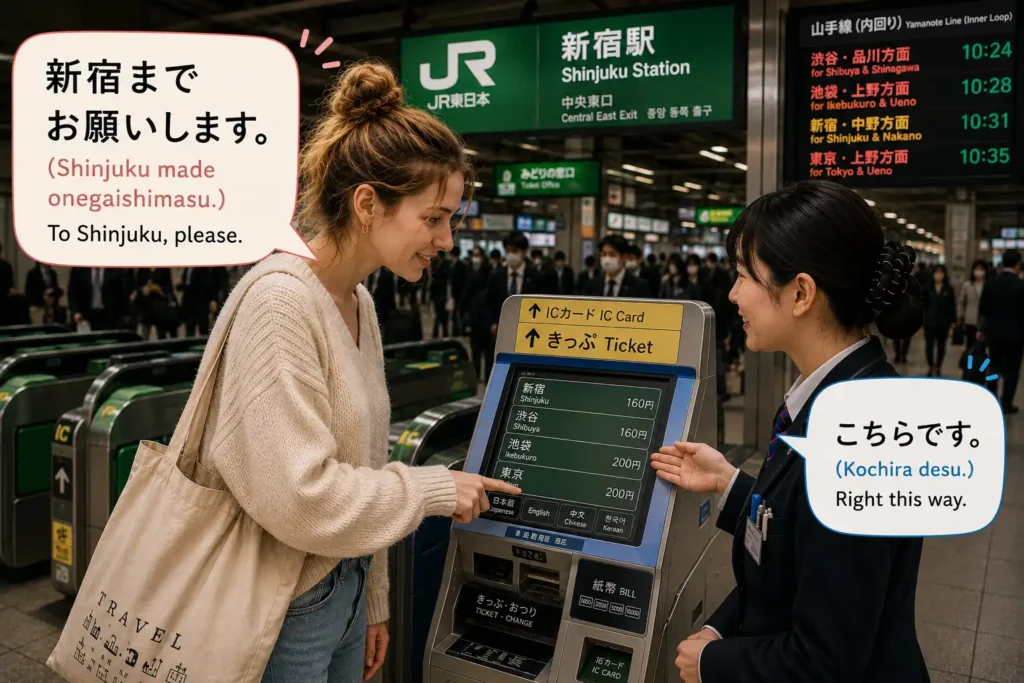
Japanese for Trains, Stations, and Getting Around
Train stations in Japan can feel overwhelming at first. There are ticket gates, platforms, transfers, train types, exits, and announcements everywhere. The good news is that you do not need long sentences. A few short Japanese phrases can help you ask where to go, which train to take, and when to get off.
Useful Japanese Train and Station Phrases
| Japanese | Romaji | English | Use it when |
|---|---|---|---|
| 駅はどこですか? | Eki wa doko desu ka? | Where is the station? | Use this when you are walking nearby and need to find the nearest train station. |
| __駅まで行きたいです | ___ eki made ikitai desu | I want to go to ___ Station | Say the station name first, such as Shinjuku eki made ikitai desu. |
| これは__に行きますか? | Kore wa ___ ni ikimasu ka? | Does this go to ___? | Use this before boarding if you are unsure whether the train, bus, or line goes to your destination. |
| __行きは何番線ですか? | ___ yuki wa nanban-sen desu ka? | Which platform is the train to ___? | Useful in larger stations with many platforms. |
| 次の電車は何時ですか? | Tsugi no densha wa nanji desu ka? | What time is the next train? | Use this when checking the next departure. |
| どこで乗り換えればいいですか? | Doko de norikaereba ii desu ka? | Where should I transfer? | Useful when the route has more than one train line. |
| 乗り換えはどこですか? | Norikae wa doko desu ka? | Where is the transfer? | Ask this when you are already inside a station and need to change lines. |
| 切符売り場はどこですか? | Kippu uriba wa doko desu ka? | Where is the ticket counter? | Useful if you need help buying a ticket or cannot use the machine. |
| __までの切符をください | ___ made no kippu o kudasai | A ticket to ___, please | Use this at a ticket counter. Say the destination before まで. |
| ICカードは使えますか? | IC kaado wa tsukaemasu ka? | Can I use an IC card? | Ask this when you want to use Suica, PASMO, ICOCA, or another transit card. |
| チャージしたいです | Chaaji shitai desu | I want to top up my card | Use this if you need to add money to your IC card. |
| 出口はどこですか? | Deguchi wa doko desu ka? | Where is the exit? | Helpful in big stations where exits can lead to very different streets. |
| __出口はどこですか? | ___ deguchi wa doko desu ka? | Where is Exit ___? | Use this when Google Maps or a hotel tells you to use a specific exit. |
| タクシー乗り場はどこですか? | Takushii noriba wa doko desu ka? | Where is the taxi stand? | Useful after arriving at a station with luggage. |
| バス停はどこですか? | Basutei wa doko desu ka? | Where is the bus stop? | Use this when transferring from train to bus. |
| ここで降りますか? | Koko de orimasu ka? | Do I get off here? | Ask this if you are unsure whether this is your stop. |
| 道に迷いました | Michi ni mayoimashita | I’m lost | A simple phrase to use when asking for help. |
| もう一度お願いします | Mou ichido onegaishimasu | One more time, please | Use this if someone explains the route too quickly. |
What Station Staff or Announcements May Say
| Japanese | Romaji | English | What it means |
|---|---|---|---|
| 次は__です | Tsugi wa ___ desu | Next stop is ___ | You will hear this on trains before arriving at the next station. |
| まもなく__に到着します | Mamonaku ___ ni touchaku shimasu | We will soon arrive at ___ | A common train announcement before arrival. |
| ドアが閉まります | Doa ga shimarimasu | The doors are closing | Step away from the doors and do not try to rush in. |
| 足元にご注意ください | Ashimoto ni gochuui kudasai | Please watch your step | You may hear this near platforms, stairs, escalators, or train doors. |
| この電車は__行きです | Kono densha wa ___ yuki desu | This train is bound for ___ | This tells you the final destination of the train. |
| 各駅停車です | Kakueki teisha desu | This is a local train | The train stops at every station. |
| 快速です | Kaisoku desu | This is a rapid train | The train skips some stations, so check whether it stops at yours. |
| 特急です | Tokkyuu desu | This is a limited express train | Some limited express trains require an extra ticket. |
| 乗り換えです | Norikae desu | Transfer here | You may hear this when the station connects to other lines. |
| 遅れています | Okurete imasu | It is delayed | The train, bus, or service is running late. |
| 運休です | Unkyuu desu | Service is suspended | The train or bus is not running. You may need another route. |
| こちらへどうぞ | Kochira e douzo | This way, please | Staff may say this while guiding you toward a gate, platform, or counter. |
🛍️ Japanese Phrases for Shopping and Convenience Stores
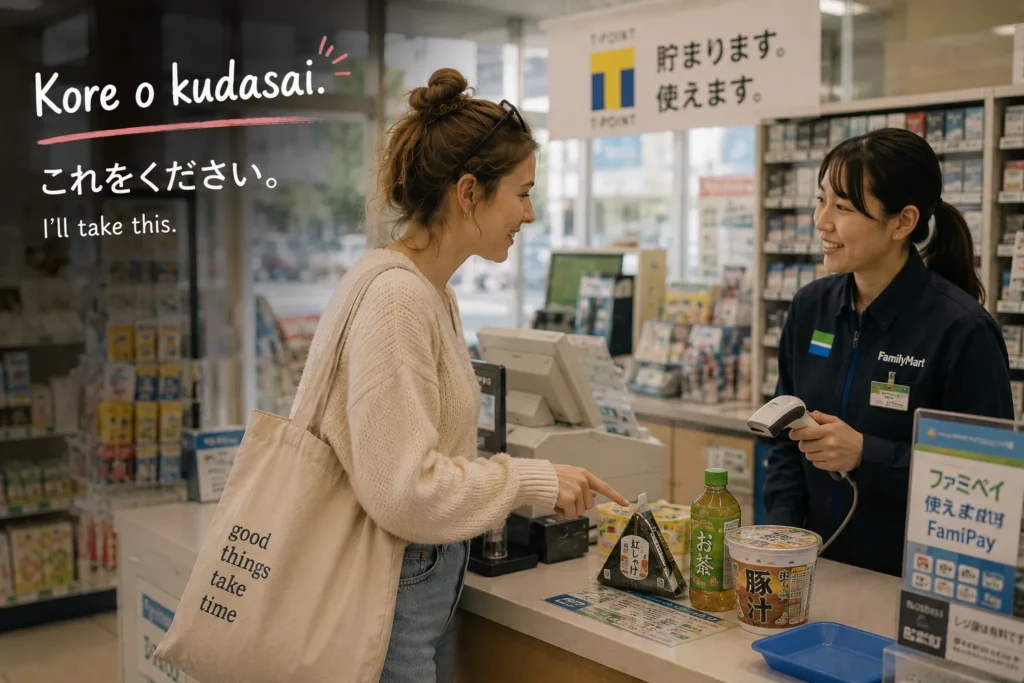
Shopping in Japan is usually easy, but convenience stores, drugstores, bakeries, and small shops can move very fast. Staff may ask about bags, payment, points, tax-free shopping, or whether you want food heated up. These short Japanese phrases will help you answer without freezing.
Useful Japanese Shopping Phrases
| Japanese | Romaji | English | Use it when |
|---|---|---|---|
| これはいくらですか? | Kore wa ikura desu ka? | How much is this? | Use this when the price is not clear or you want to confirm the cost. |
| これをください | Kore o kudasai | I’ll take this, please | Use this while pointing at the item you want to buy. |
| これをお願いします | Kore o onegaishimasu | This one, please | A softer and very common way to ask for an item. |
| 見るだけです | Miru dake desu | I’m just looking | Use this when staff approach you and you do not need help yet. |
| ちょっと考えます | Chotto kangaemasu | I’ll think about it | Use this when you want to politely pause or avoid buying immediately. |
| 他の色はありますか? | Hoka no iro wa arimasu ka? | Do you have other colors? | Useful when shopping for clothes, cosmetics, stationery, or gifts. |
| 他のサイズはありますか? | Hoka no saizu wa arimasu ka? | Do you have other sizes? | Useful for clothes, shoes, accessories, or packaged goods. |
| 試着してもいいですか? | Shichaku shite mo ii desu ka? | Can I try this on? | Use this in clothing stores before entering the fitting room. |
| 免税できますか? | Menzei dekimasu ka? | Can I buy this tax-free? | Useful in larger stores if you are a tourist and have your passport. |
| 袋をお願いします | Fukuro o onegaishimasu | A bag, please | Use this if you need a shopping bag. Bags may cost a small extra fee. |
| 袋はいりません | Fukuro wa irimasen | I do not need a bag | Use this when you have your own bag or only bought something small. |
| レシートをください | Reshiito o kudasai | Receipt, please | Use this if the receipt is not automatically given. |
| カードでお願いします | Kaado de onegaishimasu | By card, please | Use this when paying by credit card. |
| 現金でお願いします | Genkin de onegaishimasu | By cash, please | Use this when paying with cash. |
| 交通系ICカードでお願いします | Koutsuukei IC kaado de onegaishimasu | By transit IC card, please | Use this for Suica, PASMO, ICOCA, and other transit IC cards. |
| PayPayは使えますか? | PayPay wa tsukaemasu ka? | Can I use PayPay? | Useful in stores that accept mobile payments. Replace PayPay with another app name if needed. |
| あたためてください | Atatamete kudasai | Please heat it up | Use this for bento, rice balls, bread, or ready-made food at convenience stores. |
| そのままで大丈夫です | Sono mama de daijoubu desu | It is fine as it is | Use this when you do not need a bag, heating, wrapping, or anything extra. |
| お箸をください | Ohashi o kudasai | Chopsticks, please | Useful when buying bento, noodles, or other ready-to-eat food. |
| スプーンをください | Supuun o kudasai | Spoon, please | Useful for yogurt, pudding, curry, soup, or desserts. |
| 返品できますか? | Henpin dekimasu ka? | Can I return this? | Ask this before buying if you are unsure about the return policy. |
What Shop Staff May Say to You
| Japanese | Romaji | English | What it means |
|---|---|---|---|
| いらっしゃいませ | Irasshaimase | Welcome | You will hear this when entering shops, restaurants, and convenience stores. You do not need to reply. |
| 袋はご利用ですか? | Fukuro wa goriyou desu ka? | Would you like a bag? | Answer with 袋をお願いします if you need one, or 袋はいりません if you do not. |
| レジ袋は有料です | Reji-bukuro wa yuuryou desu | Plastic bags cost extra | The bag is not free. Staff may ask whether you still want one. |
| ポイントカードはお持ちですか? | Pointo kaado wa omochi desu ka? | Do you have a point card? | If you do not have one, 大丈夫です is a natural answer. |
| お支払いはどうされますか? | Oshiharai wa dou saremasu ka? | How would you like to pay? | Answer with カードでお願いします, 現金でお願いします, or your payment method. |
| カードを挿入してください | Kaado o sounyuu shite kudasai | Please insert your card | Follow the card machine instructions. |
| 暗証番号を入力してください | Anshou bangou o nyuuryoku shite kudasai | Please enter your PIN | You may hear this when paying by card. |
| タッチしてください | Tacchi shite kudasai | Please tap | Tap your card or phone on the payment terminal. |
| あたためますか? | Atatamemasu ka? | Would you like this heated up? | Common at convenience stores when buying bento, bread, or ready-made food. |
| お箸はご利用ですか? | Ohashi wa goriyou desu ka? | Would you like chopsticks? | You may hear this when buying food. |
| スプーンはご利用ですか? | Supuun wa goriyou desu ka? | Would you like a spoon? | Common when buying desserts, curry, soup, or yogurt. |
| シールでよろしいですか? | Shiiru de yoroshii desu ka? | Is a sticker okay? | Staff may put a small paid sticker on the item instead of giving you a bag. |
| 少々お待ちください | Shoushou omachi kudasai | Please wait a moment | Staff may say this while checking stock, payment, tax-free rules, or wrapping. |
| こちらでよろしいですか? | Kochira de yoroshii desu ka? | Is this okay? | Staff may confirm the item, size, color, amount, or payment method. |
| ありがとうございました | Arigatou gozaimashita | Thank you very much | You will hear this after paying. You can smile or say ありがとうございます back. |
🏨 Japanese Phrases for Hotels and Check-in
Hotel Japanese is usually polite and predictable, but check-in can still feel stressful when staff speak quickly. You may need to confirm your reservation, show your passport, ask about luggage, or explain a room problem. These phrases help you handle the most common hotel situations in simple Japanese.
Useful Japanese Hotel Phrases
| Japanese | Romaji | English | Use it when |
|---|---|---|---|
| 予約しています | Yoyaku shite imasu | I have a reservation | Say this when you arrive at the front desk. You can also show your booking confirmation. |
| チェックインをお願いします | Chekku-in o onegaishimasu | Check-in, please | Use this when you are ready to check in. |
| 名前は__です | Namae wa ___ desu | My name is ___ | Use this when staff ask for the name on the reservation. |
| パスポートはこちらです | Pasupooto wa kochira desu | Here is my passport | Useful because hotels in Japan often ask foreign guests to show a passport. |
| 予約番号はこちらです | Yoyaku bangou wa kochira desu | Here is my reservation number | Use this while showing your booking app or confirmation email. |
| 荷物を預けてもいいですか? | Nimotsu o azukete mo ii desu ka? | Can I leave my luggage here? | Useful before check-in or after check-out. |
| チェックイン前に荷物を預けられますか? | Chekku-in mae ni nimotsu o azukeraremasu ka? | Can I leave my luggage before check-in? | Use this if you arrive before your room is ready. |
| チェックアウト後に荷物を預けられますか? | Chekku-auto go ni nimotsu o azukeraremasu ka? | Can I leave my luggage after check-out? | Useful when you want to explore before going to the airport or station. |
| チェックアウトは何時ですか? | Chekku-auto wa nanji desu ka? | What time is check-out? | Ask this if the time is not clear in your booking details. |
| 朝食は何時からですか? | Choushoku wa nanji kara desu ka? | What time does breakfast start? | Use this at hotels, ryokan, or guesthouses with breakfast included. |
| 朝食はどこですか? | Choushoku wa doko desu ka? | Where is breakfast served? | Useful if the hotel has several floors, restaurants, or dining areas. |
| Wi-Fiのパスワードは何ですか? | Wai-fai no pasuwaado wa nan desu ka? | What is the Wi-Fi password? | Ask this at check-in if it is not written on a card or in the room. |
| 部屋は何階ですか? | Heya wa nangai desu ka? | What floor is the room on? | Useful if you are unsure after receiving your room key. |
| エレベーターはどこですか? | Erebētā wa doko desu ka? | Where is the elevator? | Helpful in larger hotels or buildings with multiple entrances. |
| カードキーをもう一枚もらえますか? | Kaado kii o mou ichimai moraemasu ka? | Can I have one more key card? | Useful if you are traveling with another person. |
| タオルをもう一枚お願いします | Taoru o mou ichimai onegaishimasu | One more towel, please | Use this when you need an extra towel. |
| 部屋を掃除してください | Heya o souji shite kudasai | Please clean the room | Use this if housekeeping was skipped or you need the room cleaned. |
| 掃除は大丈夫です | Souji wa daijoubu desu | No cleaning is needed | Use this if you do not need housekeeping that day. |
| エアコンが動きません | Eakon ga ugokimasen | The air conditioner is not working | Use this if the room is too hot or cold and the AC does not work. |
| お湯が出ません | Oyu ga demasen | There is no hot water | Use this if the shower or sink has no hot water. |
| 部屋を替えてもらえますか? | Heya o kaete moraemasu ka? | Could I change rooms? | Use this if there is a serious problem with the room. |
| タクシーを呼んでもらえますか? | Takushii o yonde moraemasu ka? | Could you call a taxi for me? | Useful when leaving for the station, airport, or a restaurant. |
| レイトチェックアウトはできますか? | Reito chekku-auto wa dekimasu ka? | Is late check-out possible? | Ask this at the front desk. It may cost extra or depend on availability. |
What Hotel Staff May Say to You
| Japanese | Romaji | English | What it means |
|---|---|---|---|
| ご予約のお名前をお願いします | Goyoyaku no onamae o onegaishimasu | May I have the name on the reservation? | Staff are asking for the name used when booking. |
| パスポートをお願いします | Pasupooto o onegaishimasu | Passport, please | Show your passport at the front desk. |
| こちらにご記入ください | Kochira ni gokinyuu kudasai | Please fill this out here | You may need to write your name, address, phone number, or signature. |
| チェックインは15時からです | Chekku-in wa juu-go-ji kara desu | Check-in starts at 3 p.m. | Your room may not be ready before this time. |
| お部屋の準備ができています | Oheya no junbi ga dekite imasu | Your room is ready | You can receive your key and go to your room. |
| お部屋は__階です | Oheya wa ___ kai desu | Your room is on the ___ floor | Staff are telling you which floor your room is on. |
| エレベーターはあちらです | Erebētā wa achira desu | The elevator is over there | Staff may point while saying this. |
| 朝食は__時から__時までです | Choushoku wa ___ ji kara ___ ji made desu | Breakfast is from ___ to ___ | Listen for the start and end time. |
| Wi-Fiのパスワードはこちらです | Wai-fai no pasuwaado wa kochira desu | Here is the Wi-Fi password | Staff may point to a card, paper, or screen. |
| チェックアウトは10時です | Chekku-auto wa juu-ji desu | Check-out is at 10 a.m. | This is the time you need to leave the room. |
| 荷物はこちらでお預かりします | Nimotsu wa kochira de oazukari shimasu | We can keep your luggage here | Staff will store your luggage at the front desk or luggage area. |
| 少々お待ちください | Shoushou omachi kudasai | Please wait a moment | Staff may say this while checking your booking, room, luggage, or payment. |
Japanese Phrases for Getting Clarification
Even if you memorize many Japanese phrases, real conversations can still feel fast. Staff may answer with words you have not learned yet, or they may use polite Japanese that sounds different from textbook examples. These clarification phrases help you slow the conversation down, ask someone to repeat, or confirm what you understood.
Useful Japanese Clarification Phrases
| Japanese | Romaji | English | Use it when |
|---|---|---|---|
| もう一度お願いします | Mou ichido onegaishimasu | One more time, please | Use this when you did not catch what someone said. |
| もう少しゆっくりお願いします | Mou sukoshi yukkuri onegaishimasu | A little more slowly, please | Useful when someone is speaking too fast. |
| すみません、わかりません | Sumimasen, wakarimasen | Sorry, I do not understand | A simple and polite way to say you are lost. |
| 日本語が少ししかわかりません | Nihongo ga sukoshi shika wakarimasen | I only understand a little Japanese | Use this early in the conversation to set expectations. |
| 英語で大丈夫ですか? | Eigo de daijoubu desu ka? | Is English okay? | Ask this if you want to switch to English. |
| 英語を話せますか? | Eigo o hanasemasu ka? | Do you speak English? | Useful at hotels, stations, tourist counters, and larger stores. |
| 書いてもらえますか? | Kaite moraemasu ka? | Could you write it down? | Helpful for addresses, prices, platform numbers, times, or names. |
| ここに書いてください | Koko ni kaite kudasai | Please write it here | Use this while showing your phone, notebook, or paper. |
| これはどういう意味ですか? | Kore wa dou iu imi desu ka? | What does this mean? | Use this when pointing to a sign, menu item, form, or message. |
| これは何ですか? | Kore wa nan desu ka? | What is this? | Simple and useful when pointing at an object, food item, or option. |
| どちらですか? | Dochira desu ka? | Which one is it? | Use this when you need someone to choose or point between options. |
| ここですか? | Koko desu ka? | Is it here? | Use this when confirming a place, seat, counter, platform, or meeting point. |
| これで大丈夫ですか? | Kore de daijoubu desu ka? | Is this okay? | Useful when confirming a ticket, form, payment method, item, or action. |
| 合っていますか? | Atte imasu ka? | Is this correct? | Use this to confirm an address, route, reservation, order, or written information. |
| どうすればいいですか? | Dou sureba ii desu ka? | What should I do? | Useful when you are confused about the next step. |
| どこに行けばいいですか? | Doko ni ikeba ii desu ka? | Where should I go? | Use this when staff tell you there is another counter, gate, line, or office. |
| もう一度見せてもらえますか? | Mou ichido misete moraemasu ka? | Could you show me again? | Useful with maps, machines, tickets, forms, or phone screens. |
| 翻訳アプリを使ってもいいですか? | Honyaku apuri o tsukatte mo ii desu ka? | Can I use a translation app? | Use this when the conversation is too complicated and you want to show your phone. |
Helpful Responses When You Understand
| Japanese | Romaji | English | What it means |
|---|---|---|---|
| わかりました | Wakarimashita | I understand | Use this after someone explains something clearly. |
| 大丈夫です | Daijoubu desu | It is okay / I am okay | Use this to confirm that there is no problem or that you do not need more help. |
| はい、大丈夫です | Hai, daijoubu desu | Yes, that is okay | A polite and natural way to confirm something. |
| ありがとうございます | Arigatou gozaimasu | Thank you | Use this after someone repeats, explains, writes something down, or helps you. |
🆘 Japanese Phrases for Emergencies
Emergency phrases are the ones you hope never to use, but they are the most important to know before you travel. In Japan, the ambulance number is 119 and the police number is 110.
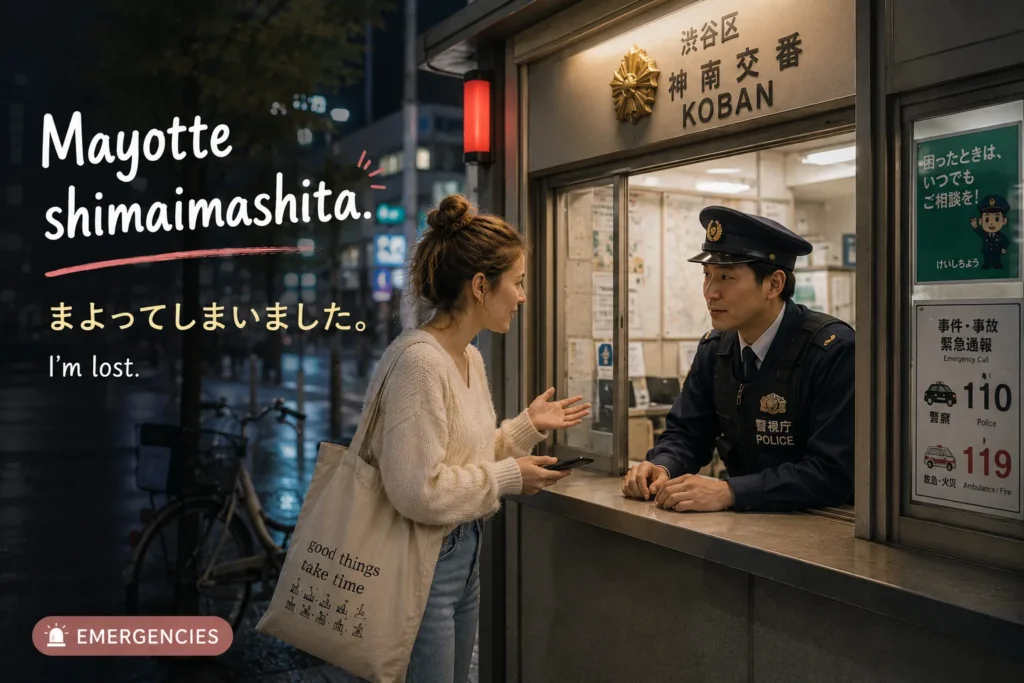
Useful Japanese Emergency Phrases
| Japanese | Romaji | English | Use it when |
|---|---|---|---|
| 助けてください | Tasukete kudasai | Please help me | Use this when you need urgent help from someone nearby. |
| 救急車を呼んでください | Kyuukyuusha o yonde kudasai | Please call an ambulance | Use this for serious illness, injury, fainting, or medical emergencies. |
| 警察を呼んでください | Keisatsu o yonde kudasai | Please call the police | Use this for theft, assault, threats, accidents, or unsafe situations. |
| 火事です | Kaji desu | There is a fire | Use this if you see a fire or need to report one. |
| けがをしました | Kega o shimashita | I am injured | Use this when you are hurt and need help. |
| 気分が悪いです | Kibun ga warui desu | I feel sick | Use this when you feel unwell, dizzy, nauseous, or faint. |
| 具合が悪いです | Guai ga warui desu | I am not feeling well | Similar to 気分が悪いです, but a little more general. |
| 胸が痛いです | Mune ga itai desu | My chest hurts | Use this for chest pain. This can be serious, so ask for medical help quickly. |
| 息が苦しいです | Iki ga kurushii desu | I am having trouble breathing | Use this if you cannot breathe well or feel short of breath. |
| アレルギーがあります | Arerugii ga arimasu | I have an allergy | Use this before eating, taking medicine, or receiving medical care. |
| __アレルギーがあります | ___ arerugii ga arimasu | I am allergic to ___ | Fill in the blank with the allergen, such as ナッツ for nuts or えび for shrimp. |
| 病院に行きたいです | Byouin ni ikitai desu | I want to go to a hospital | Use this when you need medical care. |
| 薬局はどこですか? | Yakkyoku wa doko desu ka? | Where is a pharmacy? | Use this for minor illness, medicine, or over-the-counter help. |
| 英語を話せる人はいますか? | Eigo o hanaseru hito wa imasu ka? | Is there someone who speaks English? | Useful at hospitals, police boxes, stations, hotels, and tourist centers. |
| ここに来てください | Koko ni kite kudasai | Please come here | Use this on the phone when asking for help to come to your location. |
| 住所はここです | Juusho wa koko desu | The address is here | Use this while showing your map, hotel card, or phone screen. |
| パスポートをなくしました | Pasupooto o nakushimashita | I lost my passport | Use this at a police box, hotel front desk, station, or embassy-related situation. |
| 財布をなくしました | Saifu o nakushimashita | I lost my wallet | Use this when reporting a lost wallet. |
| 携帯をなくしました | Keitai o nakushimashita | I lost my phone | Use this when asking for help with a lost phone. |
| 事故にあいました | Jiko ni aimashita | I was in an accident | Use this after a traffic accident, bicycle accident, or other accident. |
| 子どもが迷子です | Kodomo ga maigo desu | My child is lost | Use this if you are traveling with children and need urgent help. |
| 危ないです | Abunai desu | It is dangerous | Use this to warn someone or explain that a situation is unsafe. |
What Emergency Staff May Ask You
| Japanese | Romaji | English | What it means |
|---|---|---|---|
| どうしましたか? | Dou shimashita ka? | What happened? | Explain the problem as simply as possible, or show a translation app. |
| けが人はいますか? | Keganin wa imasu ka? | Is anyone injured? | They are asking whether someone is hurt. |
| 意識はありますか? | Ishiki wa arimasu ka? | Is the person conscious? | Common in medical emergencies. |
| 呼吸していますか? | Kokyuu shite imasu ka? | Is the person breathing? | Common in ambulance or emergency calls. |
| どこにいますか? | Doko ni imasu ka? | Where are you? | Give your location or show your map. |
| 住所を教えてください | Juusho o oshiete kudasai | Please tell me the address | If you do not know the address, show your phone screen or nearby landmark. |
| お名前をお願いします | Onamae o onegaishimasu | May I have your name? | They are asking for your name. |
| パスポートを見せてください | Pasupooto o misete kudasai | Please show your passport | You may hear this at a police box, hospital, hotel, or official counter. |
| 少々お待ちください | Shoushou omachi kudasai | Please wait a moment | They may be checking information, calling someone, or arranging help. |
| こちらへ来てください | Kochira e kite kudasai | Please come this way | Follow the staff, police officer, or medical worker. |
✨ Japanese Slang: Words You Will Hear Everywhere
Not every useful Japanese phrase is formal. In cafés, shops, train stations, anime, dramas, YouTube videos, and casual conversations, you will hear short casual words again and again. You do not need to use all of them yourself, but recognizing them can make real Japanese sound less confusing.
Use these words carefully. They are great with friends or in casual situations, but not all of them are suitable for hotel staff, restaurant servers, teachers, or formal conversations.
| Japanese | Romaji | English | Use it when |
|---|---|---|---|
| すごい | Sugoi | Amazing / Wow / Great | Very common when reacting to something impressive, beautiful, delicious, or surprising. |
| やばい | Yabai | Crazy / Amazing / Bad / Risky | A flexible slang word. It can mean something is very good, very bad, intense, or shocking depending on context. |
| まじ? | Maji? | Really? / Seriously? | Casual reaction when you are surprised. Use with friends, not in formal situations. |
| めっちゃ | Meccha | Very / Super | Casual intensifier, similar to “so” or “super,” as in めっちゃおいしい, “super delicious.” |
| かわいい | Kawaii | Cute | You will hear this everywhere in Japan, for animals, clothes, desserts, stationery, characters, and even people. |
| いいね | Ii ne | Nice / Sounds good | A casual way to agree, react positively, or say something looks good. |
| なるほど | Naruhodo | I see / That makes sense | Useful when someone explains something and you want to show you understand. |
| たしかに | Tashika ni | True / That’s true | Use this when you agree with what someone just said. |
| ちょっと | Chotto | A little / Hmm / Not really | This can soften a refusal. If someone says ちょっと…, it may mean “that is difficult” or “not really.” |
| 微妙 | Bimyou | Not great / Hard to say / Kind of awkward | Used when something is not clearly good or bad, or when you feel unsure about it. |
| うまい | Umai | Tasty / Good | Casual version of “delicious” or “skillful.” For polite travel situations, おいしい is safer. |
| おいしい | Oishii | Delicious | Not slang, but extremely common and safe to use when enjoying food. |
| ウケる | Ukeru | That’s funny | Casual slang for something funny or ridiculous. Mostly used with friends. |
| だるい | Darui | Tired / Annoying / Can’t be bothered | Casual word for feeling physically tired or mentally unmotivated. |
| 了解 | Ryoukai | Got it / Understood | Casual confirmation, often used in messages or with people you know. |
| おつかれ | Otsukare | Good work / Thanks for your work | Casual shortened form of おつかれさま. Common among coworkers, friends, or teammates. |
| へえ | Hee | Oh really? / Huh, interesting | A short reaction when you hear something new or surprising. |
| なんで? | Nande? | Why? | Casual way to ask why. In polite situations, use どうしてですか? instead. |
Slang You Can Safely Recognize, But Do Not Need to Use
Some Japanese slang is useful to understand but easy to misuse. やばい, まじ, ウケる, and だるい are common in casual speech, but they can sound too relaxed with strangers or staff. When you are traveling, it is usually safer to use polite phrases like すみません, ありがとうございます, 大丈夫です, and おいしいです.
A simple rule: listen for slang, but speak politely first.
What People May Say Back and How to Respond
Most travel phrase guides stop at what you should say. This section covers what you may hear back, because that is where many travelers freeze.
These are common phrases you may hear from staff in restaurants, shops, convenience stores, and hotels, with simple ways to respond.
| Japanese | Romaji | English | How to respond |
|---|---|---|---|
| いらっしゃいませ | Irasshaimase | Welcome | You do not need to reply. A small nod or smile is fine. |
| 何名様ですか? | Nanmei-sama desu ka? | How many people? | Hold up your fingers or say ひとりです, ふたりです, さんにんです, or よにんです. |
| ご注文はお決まりですか? | Gochuumon wa okimari desu ka? | Are you ready to order? | If you are ready, say はい、お願いします. You can also point at the menu and say これをお願いします. |
| こちらでよろしいですか? | Kochira de yoroshii desu ka? | Is this okay? | If it is okay, say はい、大丈夫です. |
| 現金のみとなっております | Genkin nomi to natte orimasu | Cash only, I’m afraid | This means cards or mobile payments may not be accepted. Use cash or look for an ATM. |
| お名前をお願いします | Onamae o onegaishimasu | Your name, please | Say your name followed by です, such as “Rachel desu.” |
| ポイントカードはお持ちですか? | Pointo kaado wa omochi desu ka? | Do you have a point card? | If you do not have one, 大丈夫です is the easiest reply. |
| 袋はご利用ですか? | Fukuro wa goriyou desu ka? | Would you like a bag? | Say 袋をお願いします if you need one, or 袋はいりません if you do not. |
| あたためますか? | Atatamemasu ka? | Would you like this heated up? | Say はい、お願いします if yes. Say そのままで大丈夫です if no. |
| 店内でお召し上がりですか? | Tennai de omeshiagari desu ka? | Will you eat here? | If eating in, say はい. For takeout, say 持ち帰りでお願いします. |
| お支払いはどうされますか? | Oshiharai wa dou saremasu ka? | How would you like to pay? | Say カードでお願いします, 現金でお願いします, or 交通系ICカードでお願いします. |
| 少々お待ちください | Shoushou omachi kudasai | Please wait a moment | You do not need to say much. A simple はい is enough. |
Want to Practice These Phrases Before Your Trip?
Knowing the Japanese phrases is one thing. Saying them out loud under pressure is another. The best way to prepare is to practice a real conversation before you go — not just read a list.
Whether you are at a convenience store or a local izakaya, the real panic hits when staff answer back in full-speed Japanese and your mind goes blank. The fix is not more vocabulary. It is practicing the back-and-forth until it feels normal.
💬 Speak this prompt out loud with an AI assistant:
“I’m preparing for a trip to Japan. Act as a restaurant server and speak only in Japanese, keeping it simple. Start by welcoming me and asking how many people are in my group. After I answer, take my order. Correct my Japanese gently if I make a mistake, and tell me what I said correctly.”
Paste this into ChatGPT or Claude and practice out loud before your flight. Repeat the same scenario a few times until the replies stop surprising you. If you want to go deeper into the language, this guide to Japanese quotes with meaning covers 100+ proverbs, anime lines, and Kanji sayings worth saving.
Japanese Phrases FAQs
What are the most important Japanese phrases for tourists?
The five most useful Japanese phrases for tourists are Sumimasen (excuse me), Arigatou gozaimasu (thank you), Daijoubu desu (I’m fine / no thank you), Kore onegaishimasu (this one, please), and Toire wa doko desu ka? (where is the bathroom?). These cover a wide range of everyday situations and are polite in almost every context.
Is sumimasen enough for most situations?
Sumimasen handles a surprisingly wide range of situations — getting someone’s attention, apologizing for a small mistake, asking for help, or signaling that you need service in a restaurant. It does not replace specific phrases for ordering food or navigating transit, but it is the single best word to know if you are only learning a few.
How do I ask for the bill in Japanese?
Say “Okaikei onegaishimasu” or cross your index fingers into an X shape — both are widely understood in Japanese restaurants. Some restaurants bring the bill automatically; others require you to go to the register to pay.
What should I say if I don’t understand the reply?
Say “Mou ichido onegaishimasu” (please say that again) or “Motto yukkuri hanashite kudasai” (please speak more slowly). You can also ask “Eigo wa wakarimasu ka?” to check if the person speaks any English. In most tourist-facing settings in major cities, basic English is common.
Is it rude to say Sayonara in everyday situations?
Using Sayonara when saying goodbye to a shop assistant or someone you have just met can sound overly final, since it implies a long or permanent farewell. For everyday goodbyes, “Ja, mata” (see you later) or simply “Arigatou gozaimasu” as you leave a shop is more natural.
Start with 5 Japanese Phrases First
You do not need to memorize all 100 Japanese phrases before your trip. Start with the five that solve the most awkward moments first: Sumimasen, Arigatou gozaimasu, Daijoubu desu, Kore onegaishimasu, plus the emergency numbers 119 and 110.
Before your flight, spend one evening practicing a few real scenarios out loud. Ask an AI assistant to act like a restaurant server, hotel receptionist, or station staff member, and practice until the replies stop surprising you. If you are thinking about using ChatGPT for trip prep, this ChatGPT Plus subscription guide can help you decide whether a paid plan is worth it.
Even a small effort with the local language makes a visible difference in Japan. It shows respect, and that tends to come back to you. After your trip, browse these Japanese idioms to understand the expressions you will start noticing in shows and conversations. 🚀