
- ❓ Why "Let's Practice English" Doesn't Work
- 🗣️ Start Easy: Daily Speaking Prompts
- 🔧 Sound More Natural: Error Correction Prompts
- 💼 Practice Real Situations: Meetings, Interviews, Travel
- 🎮 Make It Fun: Role-Play and Speaking Challenges
- ⏱️ Your 10-Minute Daily AI Speaking Routine
- 🔄 Turn Your Speaking Session Into a Personal Phrase Bank
- ⬆️ From Learner English to Natural Spoken English
- ❓ How to Improve English Speaking Skills FAQs
- Start With One Prompt
Key Takeaways
- Saying “Let’s practice English” usually fails because it gives the AI no job. Give it a role, a scenario, and correction rules instead.
- This guide gives you 12 copy-ready AI speaking prompts for daily conversation, fixing unnatural sentences, interviews, meetings, travel, and role-play.
- Start today: paste one prompt into ChatGPT or Claude, answer in simple English, then read the AI’s rewrite out loud three times.
Introduction
How to improve English speaking skills is not just about finding more study tips. There are a lot of ways to practice, but most of them require a tutor, a language partner, or a lot of patience while you wait for someone to correct you.
You open ChatGPT. You say: “Let’s practice English.” It replies: “How was your day?” You say: “Fine.” Then the conversation stops.
That is not always a language problem. It is often a prompt problem. When you give AI a real scenario, something shifts. You stop thinking about English. You start thinking about what you actually want to say. The goal is not to speak perfectly. It is to speak fluently enough to be understood.
If you keep forgetting the words you want to use, you can also turn your vocabulary list into AI-generated flashcards with this free Quizlet alternative workflow.
This guide is for English learners worldwide who can read basic English but freeze when they need to speak. These 12 prompts help you practice real conversations, get useful corrections, and keep speaking without waiting for a tutor.
Want to start right now? Speak it to your AI app:
Act as my friendly English speaking partner.
Ask me 5 simple questions about my day.
Use easy English.
After each answer, correct only my most important mistake.
Then say my answer back to me in a more natural spoken style.
Then keep reading for 11 more prompts.
Which AI to use: Any AI chat app that supports voice or text conversation works. ChatGPT is good for natural back-and-forth practice. Claude is good for longer, more detailed corrections.
Not sure which prompt to start with?
| If you want to… | Start with |
| Stop freezing mid-conversation | Prompt 1 |
| Sound less like a direct translation | Prompt 4 |
| Prepare for a job interview | Prompt 7 |
| Practice real-time spoken English | Prompt 12 |
One of the most practical ways to improve English speaking skills is to shift from typing to talking. If voice mode is available in your AI app, use it. Open the app, tap the voice or sound wave icon, and speak the prompt out loud. It makes the practice feel much closer to a real speaking session than typing alone. You can learn more about how ChatGPT voice works on the OpenAI Help Center.
The strange thing about AI voice conversations is this: after a few minutes, your brain stops feeling like it is studying English. It starts feeling like you are just trying to explain something. That is usually when real speaking practice begins.
A tip from real practice: Try not looking at the screen while you speak. The AI already has a response ready before it starts talking, but your brain may still go blank. That is normal. Glance at the screen when you need to, then look away again. After the session ends, you can scroll back to see the full conversation and use a review prompt to turn it into vocabulary upgrades, grammar fixes, and memorable sentences.
Not comfortable with English prompts yet? You can paste these prompts in your own language. Just add one line at the end: “Please reply to me in English only.” The AI will follow your rules and keep the conversation in English.
❓ Why “Let’s Practice English” Doesn’t Work
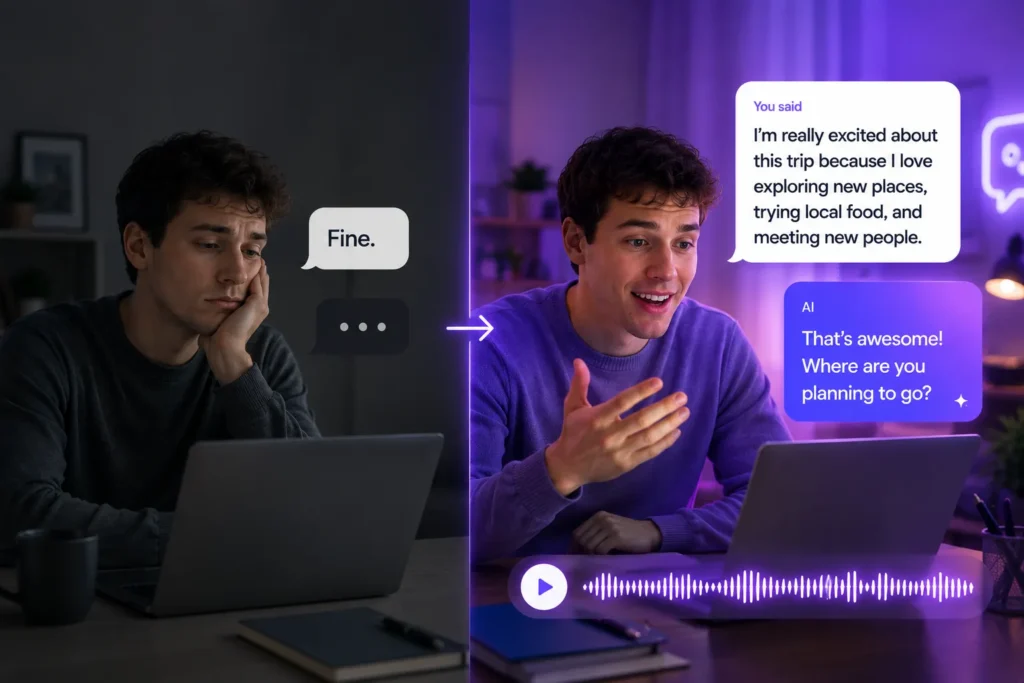
Every time you say it, the conversation dies after three exchanges. The AI has no role, no task, and no idea what you need.
A good prompt gives the AI three things:
- A role: friendly partner, strict interviewer, hotel receptionist
- A scenario: daily chat, job interview, travel problem
- Feedback rules: correct every mistake, or only the biggest one, or give a natural version
Every prompt in this guide follows that structure.
🗣️ Start Easy: Daily Speaking Prompts
Daily speaking prompts give you a low-pressure way to practice English conversation with AI, even on days when you have no topic and no energy. The goal is not perfect English. The goal is to start talking.
Prompt 1: Talk About Your Day
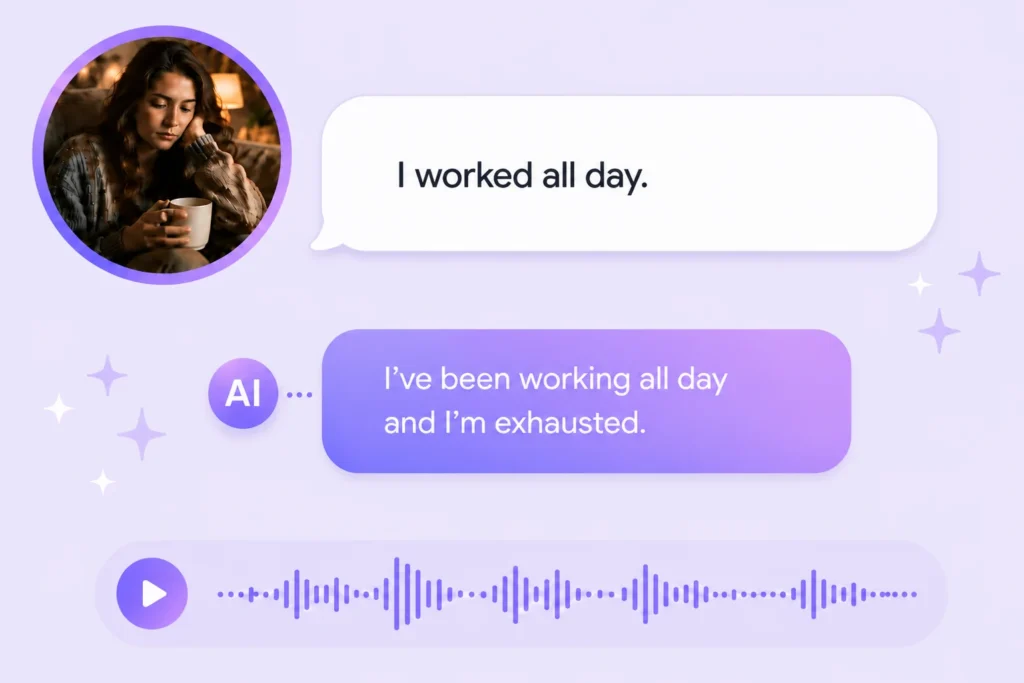
Most people freeze because they don’t know what topic to start with. This prompt gives the AI a clear job: ask you simple questions and rewrite your answers in a more natural style each time.
Best for: Complete beginners, anyone who hasn’t spoken English in a while, or days when you just want a low-pressure warm-up.
💬 Speak this prompt:
Act as my friendly English speaking partner.
Ask me 5 simple questions about my day.
Use easy English.
After each answer, correct only my most important mistake.
Then say my answer back to me in a more natural spoken style.
Do not make the conversation difficult. Help me speak more, even if my English is simple.
🗣️ Say this:
- I’m kind of tired today.
- I worked all day and didn’t do anything special.
- I just want to relax tonight.
AI might rewrite your answer as: “I’m a little tired today because I worked all day. Nothing special happened. I just want to relax tonight.” That rewrite is your shadow material. Read it back three times.
Prompt 2: One-Minute Speaking Practice
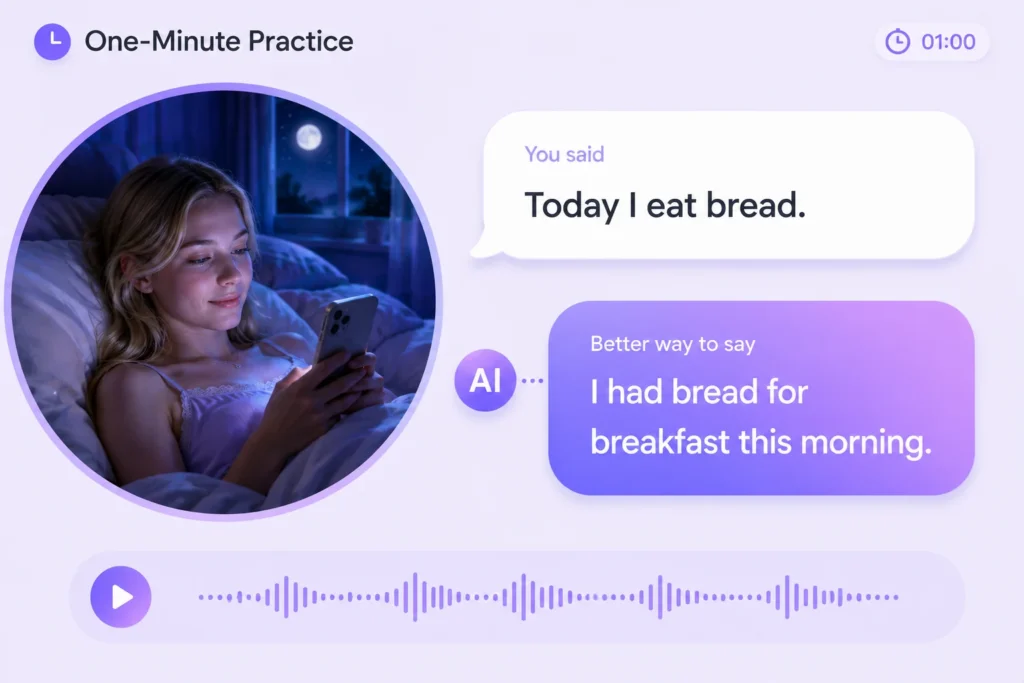
If you have no idea where to begin, let the AI pick the topic for you. This prompt works well before bed, during a commute, or any time you have five spare minutes.
Best for: People who overthink before speaking, or anyone who wants a quick daily habit without planning ahead.
💬 Speak this prompt:
I want to practice speaking English for one minute.
Give me one very simple topic, such as what I ate today, what I did this morning, one thing I like, or one thing I want to do tomorrow.
After I finish, rewrite my answer in natural spoken English.
Then give me 3 useful phrases from my answer.
🗣️ Say this:
- Today I had coffee and bread for breakfast.
- Then I worked for a few hours.
- In the evening I watched some videos and relaxed.
- It was a pretty normal day.
Prompt 3: Simple English Only
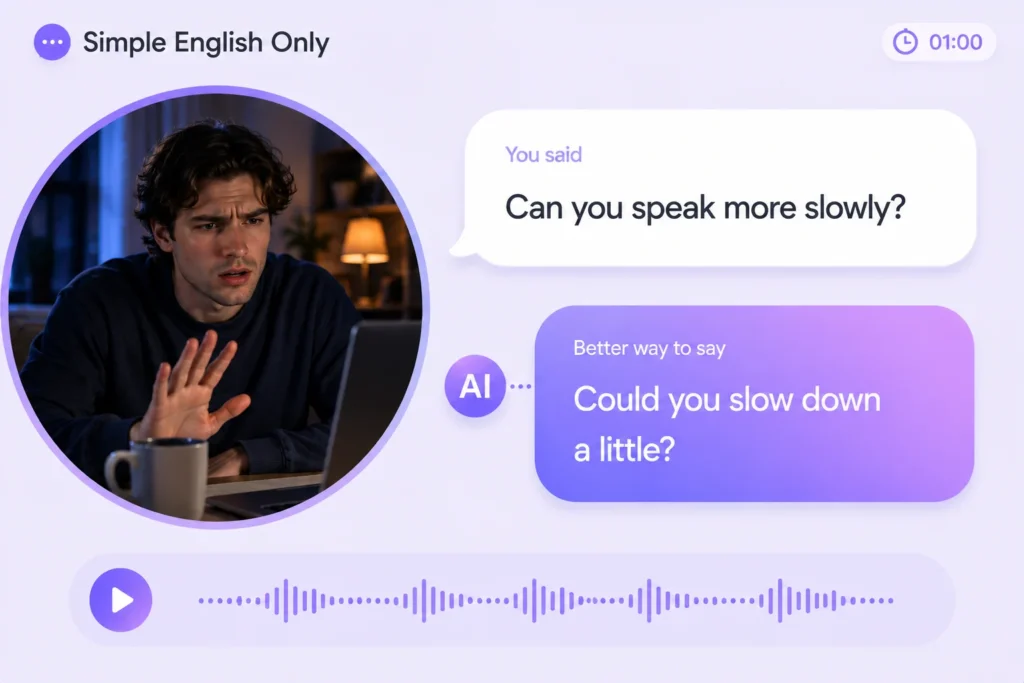
Some AI responses feel overwhelming: long sentences, advanced vocabulary, and you end up more confused than when you started. This prompt keeps everything simple so you can actually follow and respond.
Best for: Beginners who get intimidated by complex AI replies, or anyone building confidence before moving to harder prompts.
💬 Speak this prompt:
Talk with me in very simple English.
Rules:
1. Ask one short question at a time.
2. Use only common daily words.
3. Correct my mistakes gently.
4. Do not use difficult vocabulary.
5. Keep the conversation going for 10 turns.
Start with an easy question.
🗣️ Say this when you get stuck:
- What about you?
- Can you ask me another question?
- Can you help me say this more naturally?
- I don’t know how to say it in English. Can you help?
🔧 Sound More Natural: Error Correction Prompts
Most learners are not bad at English. They are bad at retrieving English fast enough.
Unnatural English is not a vocabulary problem. It is a translation interference problem, and it requires a specific kind of practice to fix.
If no one tells you a phrase sounds off, you will keep saying it. Every repetition makes it harder to unlearn. These prompts put the AI in correction mode, so you catch problems before they become habits.
Prompt 4: Spot and Fix Unnatural English
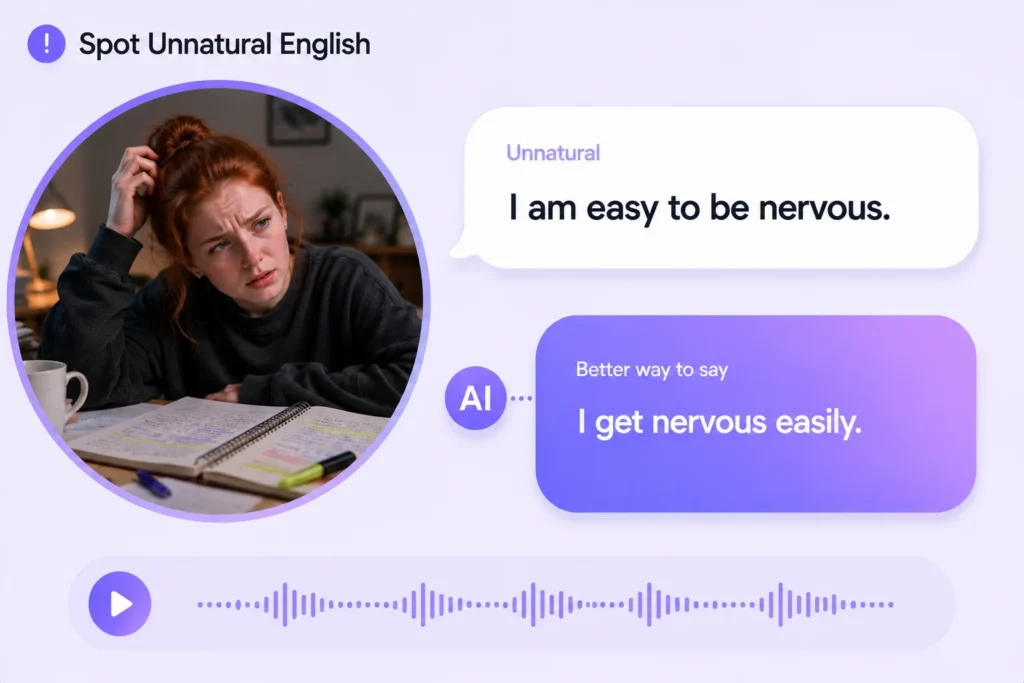
If you can understand English videos but panic when speaking, your problem is probably retrieval speed, not grammar.
You already know what you want to say. The problem is that the way you say it sounds slightly off to a native ear. This prompt gives you five versions of every sentence so you can find the one that fits best.
Best for: Intermediate learners who feel stuck and can’t figure out why their English sounds unnatural despite years of study.
💬 Speak this prompt:
Act as my English speaking coach.
I will say sentences that may sound unnatural or like a direct translation from my native language.
For each sentence, explain:
1. What sounds unnatural.
2. Why non-native speakers often say it this way.
3. A natural spoken English version.
4. A casual version.
5. A professional version.
🗣️ Say these out loud:
- I very like it.
- I have 25 years.
- I am agree with you.
- I don’t know how to explain it clearly.
- I get nervous when I have to speak English.
Prompt 5: Make It Sound More Natural
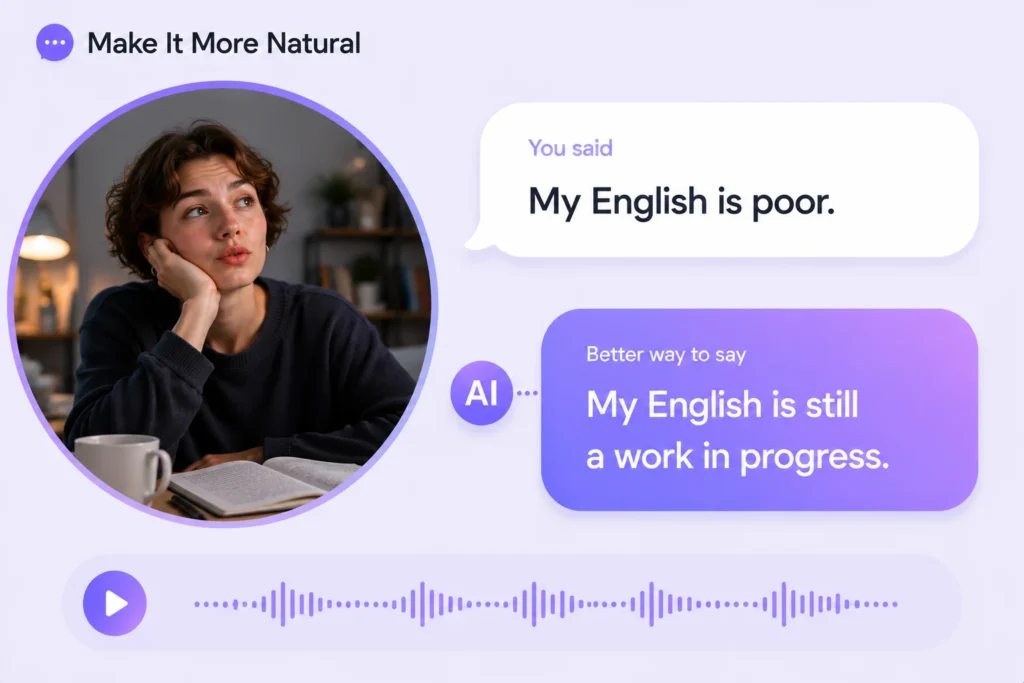
Sometimes you know your sentence is correct but it still feels stiff or formal. This prompt rewrites what you wrote into five different spoken styles so you can find the version that fits how you actually want to sound.
Best for: Learners at B1–B2 level who want to close the gap between textbook English and how real people speak.
💬 Speak this prompt:
I’ll say one sentence in English.

Please tell me:
1. Would a native speaker actually say this?
2. What sounds unnatural, if anything?
3. Give me 5 natural ways to express the same idea:
   - Simple and clear
   - Casual and friendly
   - Natural everyday English
   - Professional
   - Short and natural
4. Tell me which version is best for daily conversation.
5. Give me one sentence worth memorizing.
Try this input:I want to improve my English speaking.
AI might give you:
- I want to get better at speaking English.
- I’m working on my spoken English.
- I want to feel more confident when I speak.
Read each one out loud. These are your shadow sentences.
Prompt 6: Shadowing Practice
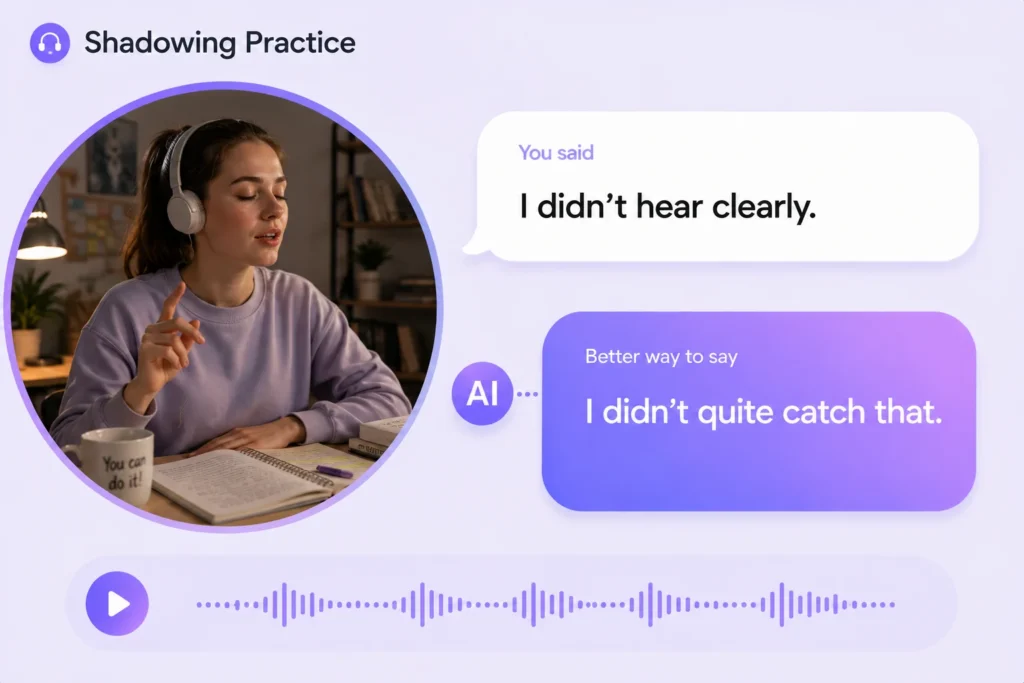
Shadowing helps your mouth get used to English rhythm. You listen, repeat, pause, and copy the stress until the sentence feels easier to say. It is a well-documented language learning technique — the Cambridge Dictionary defines shadowing as repeating what someone says immediately after they say it, as a way of learning a language.
Best for: Anyone whose reading and writing are solid but whose spoken English still sounds stiff or disconnected.
💬 Speak this prompt:
Give me a short spoken English paragraph about [topic].

Make it sound like something a native speaker would actually say in everyday conversation.

Keep it natural, conversational, and easy to speak aloud.

Then:

1. Break it into short shadowing chunks.
2. Mark where I should pause.
3. Highlight the words I should stress.
4. Explain the rhythm briefly.
5. Give me one connected native-speed version for final practice.
Replace [topic] with:
- working from home
- feeling tired after work
- learning English with AI
- my weekend plans
💼 Practice Real Situations: Meetings, Interviews, Travel
Rehearsing a conversation before it happens is one of the most underused strategies for improving English speaking under pressure.
Most people only practice the smooth version. But what actually causes panic is the unexpected: the follow-up question you didn’t prepare for, the hotel problem you didn’t anticipate. These prompts let you rehearse the messy version too.
Prompt 7: English Job Interview
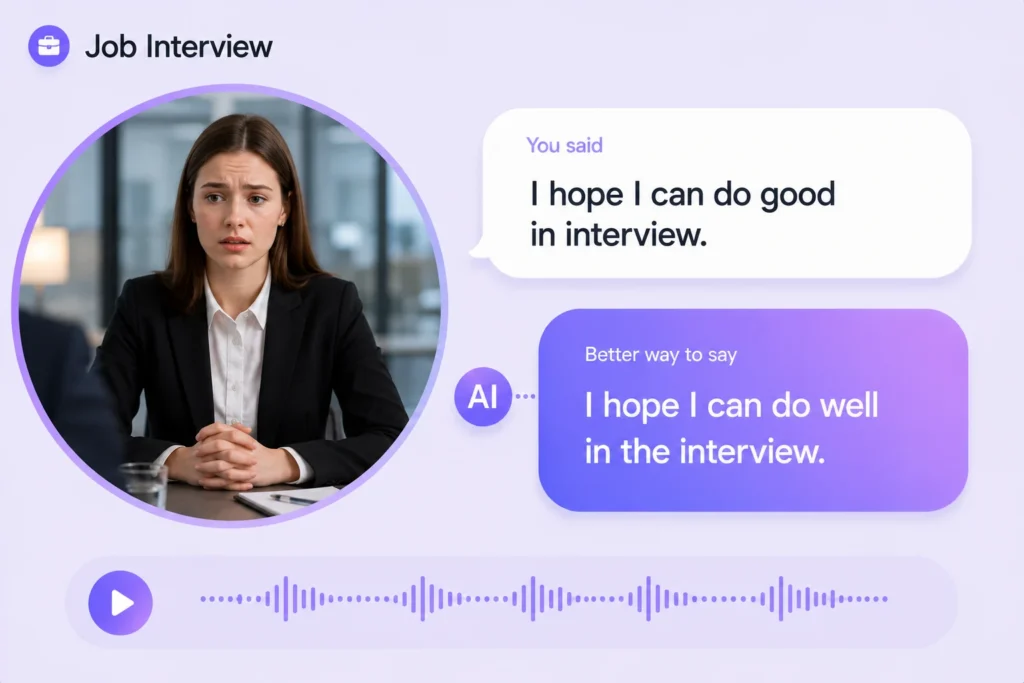
Real interviews are hard because the interviewer keeps asking follow-up questions based on your answers. This prompt forces you to go deeper every time exactly like the real thing.
Best for: Job seekers preparing for English-language interviews, or anyone who needs to speak professionally under pressure.
💬 Speak this prompt:
Act as a strict but supportive English interviewer.

I am preparing for a [job title] interview.

Ask me one interview question at a time.

After I answer:

1. Tell me what was strong.
2. Tell me what sounded weak, vague, or unclear.
3. Show me a stronger version of my answer.
4. Teach me one phrase I can reuse in future interviews.
5. Ask one follow-up question based on my answer.

Keep the interview realistic and challenging.
Do not move to a new topic too quickly.
🗣️ Say this to start:
- Sure. I’d be happy to share more about that.
- In my previous role, I worked on…
- One example that comes to mind is…
- The result was…
Prompt 8: Workplace Meeting
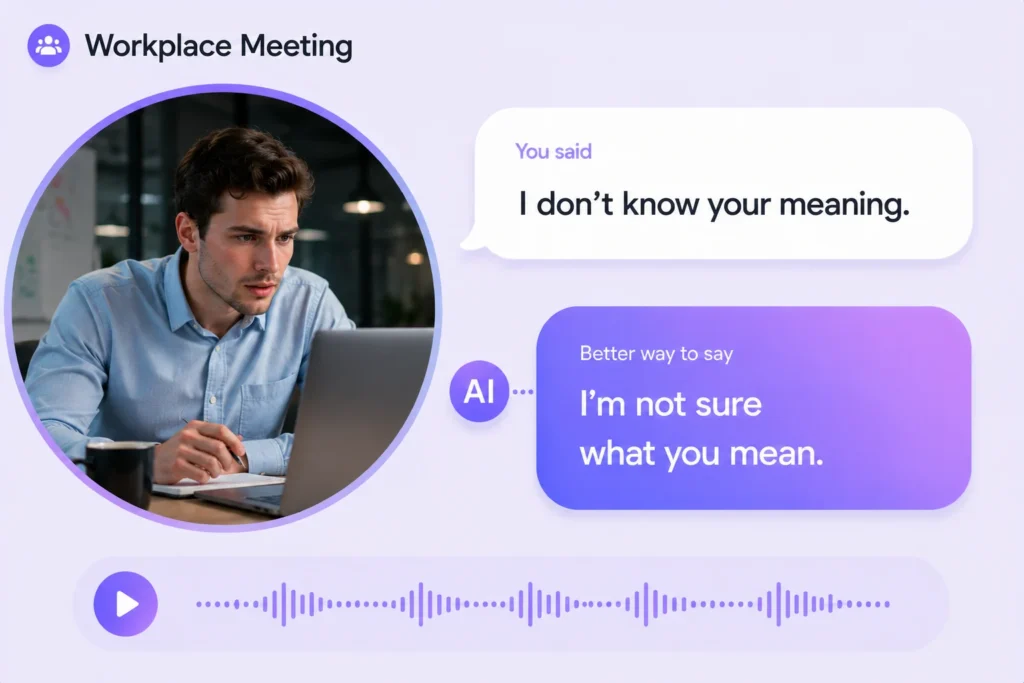
Meetings are stressful because you need to respond quickly and sound professional at the same time. This prompt helps you practice realistic questions and walk away with phrases you can reuse.
Best for: Professionals who attend English meetings but often go silent because they can’t find the right words fast enough.
💬 Speak this prompt:
Act as my coworker in a project update meeting.

Ask me one realistic question at a time.

After I answer:
1. Correct my biggest mistake.
2. Give me a more natural workplace version.
3. Teach me one useful meeting phrase.
4. Ask a follow-up question.

Keep it natural, like a real teammate.
🗣️ Say this when your mind goes blank:
- Can I add one thing here?
- I have a quick question.
- I see your point, but I’m a little concerned about the timeline.
- From my side, the main issue is communication.
- So the next step would be to confirm the deadline.
Prompt 9: Hotel Check-In and Travel Problems
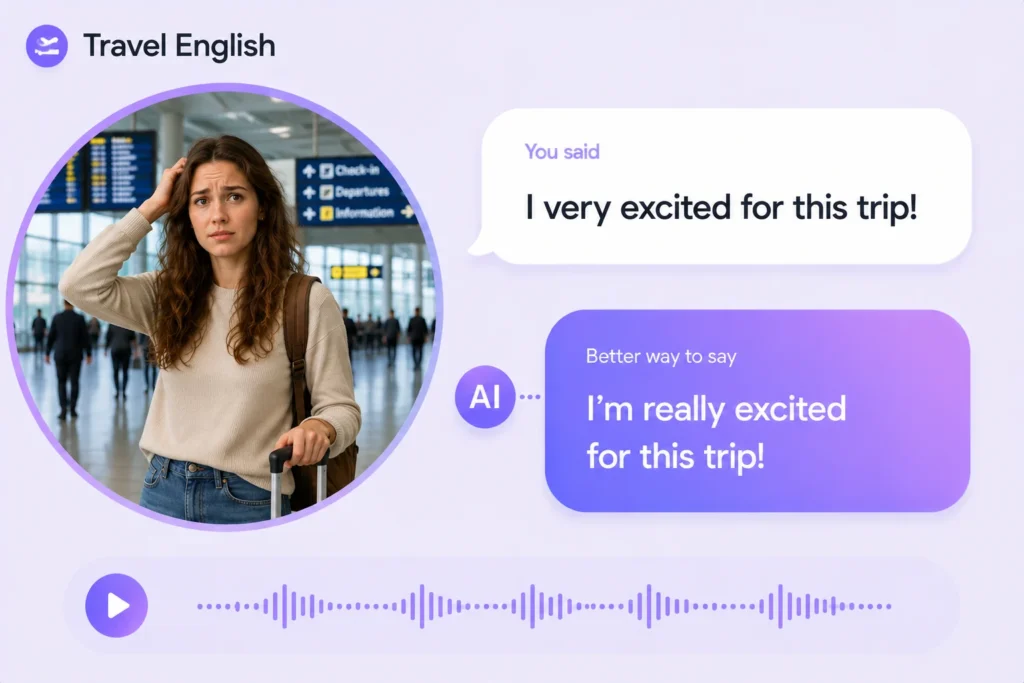
Travel conversations are easy until something goes wrong. This prompt puts the unexpected in front of you before it happens so your brain already has a reference point when it does.
Best for: Anyone planning a trip to an English-speaking country, or travelers who freeze when something unexpected happens.
💬 Speak this prompt:
Act as a hotel receptionist.

Start with a normal check-in.

Then give me one small problem:
reservation not found, room not ready, extra charge, or room change.

After I answer:
1. Correct my biggest mistake.
2. Give me a natural version.
3. Teach me one useful travel phrase.

Keep the conversation realistic.
🗣️ Say this before your trip:
- I have a reservation under the name [your name].
- Could you check again, please?
- Is there any other room available?
- I’m sorry, I didn’t quite catch that. Could you say it again?
- Could you help me with this?
🎮 Make It Fun: Role-Play and Speaking Challenges
Predictable practice gets boring, and boredom is the number one reason people quit. These prompts treat English practice like a game: unpredictable, low-stakes, and harder to put down.
Prompt 10: Random Speaking Challenge
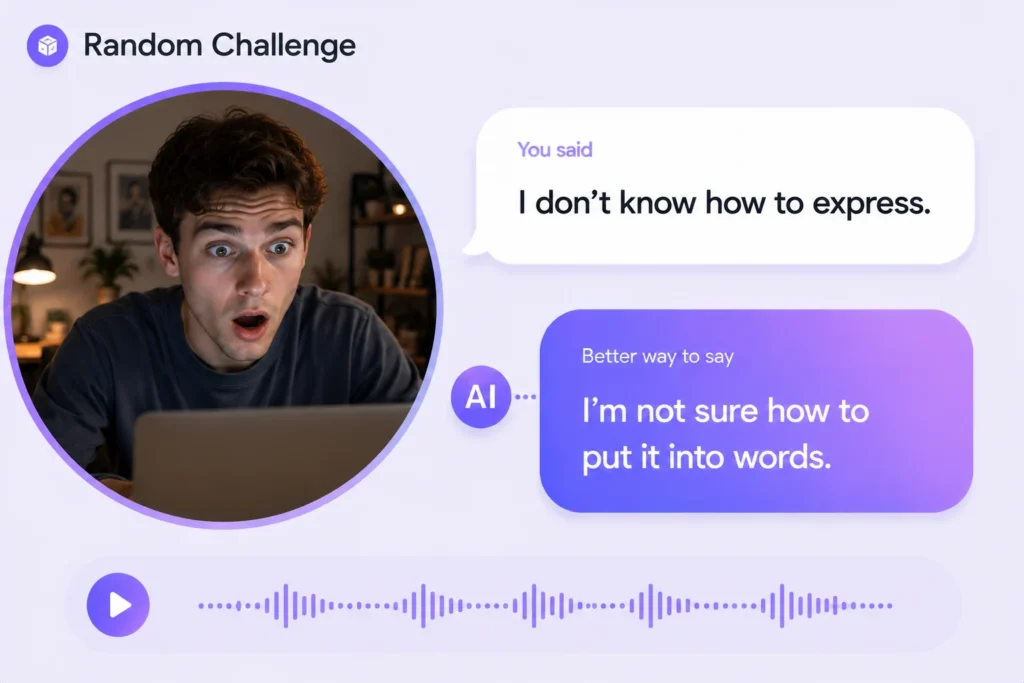
This prompt gives you a different scenario every time so there is no way to prepare in advance. That trains exactly the skill that real conversations require.
Best for: Learners who get bored quickly, or anyone who wants to practice responding to the unexpected.
💬 Speak this prompt:
Give me a random English speaking challenge.

Choose one:
- daily life
- funny question
- travel problem
- workplace situation
- opinion question
- storytelling

I will answer in English.

After I answer:
1. Correct my biggest mistake.
2. Give me a more natural version.
3. Ask one follow-up question.

Make it fun and slightly surprising.
You might get something like: “You are late to a meeting. Your excuse must be funny. Explain what happened.”
Prompt 11: Role-Play Game
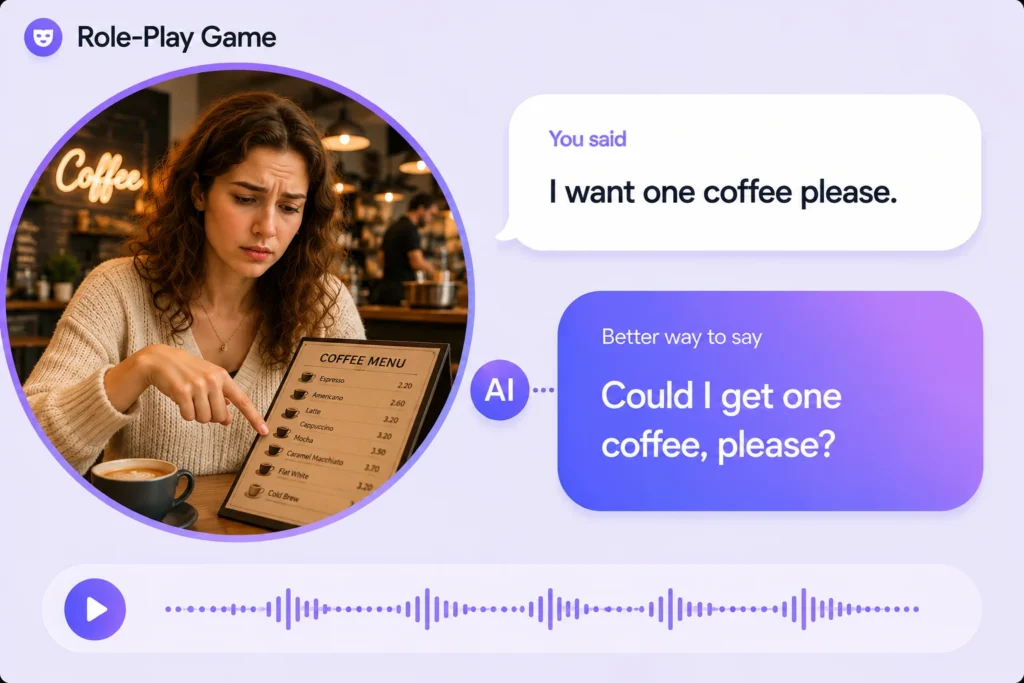
This prompt turns AI into a scene partner. You pick a scenario, play a character, and practice real-life English without it feeling like a drill.
Best for: Anyone who learns better through stories and interaction than through vocabulary lists or grammar exercises.
💬 Speak this prompt:
Let's do a real-life English role-play.

Put me in a realistic situation.

Start the conversation immediately.

I will respond in English.

Correct my English after every 3 turns.

Keep it practical and natural.
🗣️ Say this when you get stuck:
- Hi, I need some help.
- I’m not sure what to choose.
- Can you explain that to me?
- Let me think for a second.
- That sounds interesting. Tell me more.
Prompt 12: 30-Second Opinion Challenge
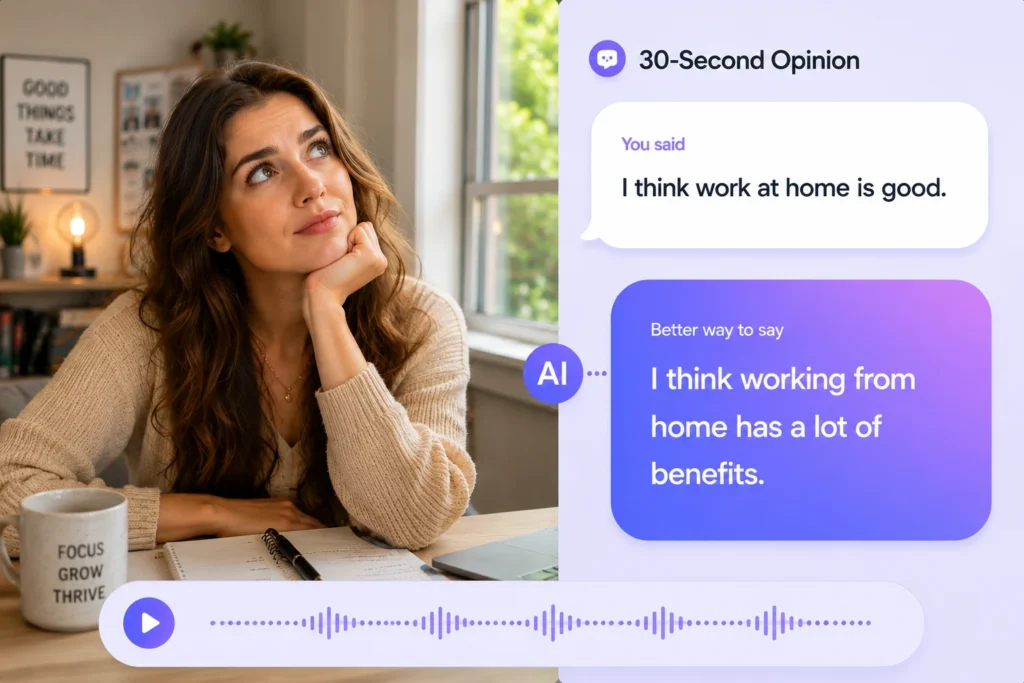
Giving opinions under time pressure is one of the hardest English speaking skills to build. You have to think, organize, and speak at the same time.
Best for: Upper-intermediate learners who want to sound more confident and convincing when sharing views in English.
💬 Speak this prompt:
Give me a simple opinion question.

I will answer in English for 30 seconds.

After I answer:

1. Improve my fluency.
2. Fix important mistakes.
3. Upgrade my vocabulary.
4. Make my answer sound more natural.
5. Give me a better version to shadow.

Then ask another question.
🗣️ Practice questions:
- Do you prefer working from home or in an office?
- Should people learn English with AI?
- What makes a good conversation?
- What is one habit you want to build this year?
🗣️ Say this when you freeze:
- I think…
- In my opinion…
- For me, the biggest reason is…
- One example is…
- That’s why I feel this way.
⏱️ Your 10-Minute Daily AI Speaking Routine
You do not need more vocabulary. You need faster access to the vocabulary you already have.
You do not need to use all 12 prompts every day. One small loop is enough to build a real habit. Unlike most language learning apps, this routine adapts to exactly what you need on any given day.
| Time | What to do | Which prompt |
| 2 minutes | Warm-up conversation | Prompt 1 or 2 |
| 3 minutes | Fix one unnatural sentence | Prompt 4 |
| 3 minutes | Simulate one real situation | Prompt 7, 8, or 9 |
| 2 minutes | Shadow the AI’s rewrite | Prompt 5 or 6 |
On busy days, do just this: say one sentence in English, let the AI rewrite it, read the rewrite out loud three times. That is a complete practice loop in 90 seconds.
If you want to go deeper, check the ChatGPT Plus pricing guide to see whether a paid plan makes sense for your practice schedule.
🔄 Turn Your Speaking Session Into a Personal Phrase Bank
Practicing is only half the loop. The other half is turning what you said into something you can actually learn from. If you are looking for how to improve English speaking skills with AI, the real secret lies in creating a personal feedback loop.
When your conversation ends, the full transcript is right there on your screen. One review prompt turns the whole session into vocabulary upgrades, grammar corrections, and sentences worth memorizing.
I used this after a session where I spoke about something I genuinely care about. One sentence came back in the Native-Level Version that I could not have said on my own:
“Like a lighthouse standing ahead of you in the dark, quietly saying — keep going.”
That came from my own ideas. I just did not know how to say it in English yet.
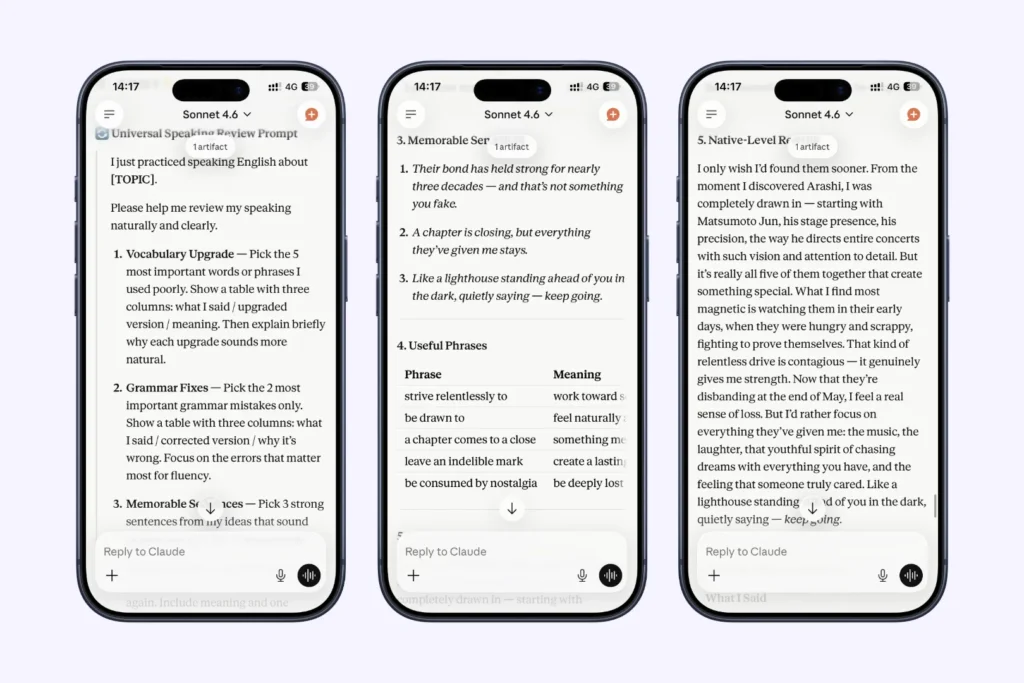
Best for: Anyone who wants to do more than just practice. Run this after any session to turn your own words into a personal phrase bank.
📋 Copy this prompt:
I just finished an English speaking practice session.
Please review our conversation above and give me:

1. Vocabulary Upgrade — 5 words or phrases I used poorly. Show a table: what I said / upgraded version / meaning. Explain briefly why each upgrade sounds more natural.
2. Grammar Fixes — 2 most important mistakes only. Show a table: what I said / corrected version / why it matters.
3. Memorable Sentences — 3 strong sentences from my ideas that sound natural and are worth memorizing.
4. Useful Phrases — 5 phrases I can use again. Include meaning and one example sentence for each.
5. Native-Level Version — Say my core ideas in smoother spoken English, keeping my original tone and meaning.
6. Side-by-Side — 3 examples of what I said vs. a more natural version, with a brief note on why it sounds better.
7. Quick Practice — 3 short exercises to immediately use what I just learned.
⬆️ From Learner English to Natural Spoken English
You do not need a prompt for this section. These are the small phrasing shifts that separate English that sounds translated from English that sounds natural. They work for speakers of any first language.
Read through the table, pick three phrases that feel relevant to you, and use them in your next practice session.
| ❌ What you might say | ✅ What sounds natural | When to use it |
| I have 25 years. | I am 25 years old. | Introductions |
| I am agree with you. | I agree with you. | Opinions |
| I very like it. | I really like it. | Anytime |
| I need to improve my speaking. | I need to get better at speaking English. | Study goals |
| I don’t know how to explain. | I am not sure how to explain it. | Any conversation |
| I am afraid to make mistakes. | I am afraid I will make mistakes. | Speaking anxiety |
| My mind is blank. | My mind just went blank. | Meetings, exams |
| Could you repeat again? | Could you say that again? | Asking for help |
| I have a doubt. | I have a question. | Classes, meetings |
| I suggest you to go. | I suggest that you go. | Giving advice |
| You speak too fast. | Could you slow down a little? | Asking for help |
| I didn’t hear clearly. | I didn’t quite catch that. | Conversations |
| I get stuck when I speak English. | I freeze up when I try to speak English. | Self-description |
| I’m afraid to say wrong. | I’m afraid I’ll say something wrong. | Before speaking |
| I don’t know your meaning. | I’m not sure what you mean. | Clarification |
❓ How to Improve English Speaking Skills FAQs
Can I really improve English speaking skills for free with AI?
Many AI chat apps offer free access that is enough for short speaking practice sessions. Usage limits can change, so keep your routine simple: one prompt, one answer, one correction, and one shadowing round. Generative AI for language practice is available at any hour, with no scheduling required. Ten minutes a day may start to feel more comfortable within a few weeks.
How is this different from just chatting with ChatGPT?
The difference is structure. When you just chat, the AI tries to be helpful and polite. It rarely corrects your mistakes unless you ask. These prompts give the AI a specific correction job. That is what turns casual conversation into deliberate speaking practice.
My English sounds like a direct translation from my native language. How do I fix it?
This is called translation interference. It happens when your first language shapes the way you build English sentences. The words are often correct, but the structure sounds off to a native speaker. It affects learners from every language background: Spanish, Japanese, Arabic, Indonesian, Korean, and many others. Prompt 4 in this guide is specifically designed to catch those patterns and replace them with natural spoken English.
How many prompts should I use per session?
One is enough. Pick the prompt that matches your situation today: tired and want something easy, or preparing for something specific. Finish one complete loop before moving to the next. Depth beats variety every time.
How do I speak English more fluently and stop feeling so nervous?
Both come from the same place: practicing the situations that make you anxious until they feel routine. Use Prompt 7 for interviews, Prompt 8 for meetings, and Prompt 9 for travel. After each session, run the review prompt. Seeing your own ideas expressed in natural English shows you the thoughts were already there.
Start With One Prompt
You do not need to finish this article before starting.
Before you go — want all 12 prompts in one handy place?
🆓 Download the free PDF version and use it as your daily AI speaking practice sheet.⬇️
Try one prompt today. Say one sentence. Read the AI rewrite out loud three times. That is your first speaking loop. 🚀