

How Long Does It Take to Learn Korean? The real answer depends on your goal, but also on where you are stuck.
Most timelines will tell you “2,200 hours for full fluency” or “6 months for basic conversation.” Those numbers can be useful, but they do not explain why so many self-taught learners study for months and still feel stuck.
The gap is usually not effort. It is that you are repeating the same study method at the wrong stage. Once you know your stuck point, the timeline becomes much easier to understand.
Key Takeaways
- Most self-taught learners need 12 to 18 months to follow familiar K-drama scenes with less subtitle help.
- Korean progress slows when you only watch, listen, or memorize without turning input into sentences you can use.
- The fastest fix is to identify your stuck point: no output, weak grammar framework, or the month 6 to 12 plateau.
How Long It Takes to Learn Korean: A Realistic Timeline

The honest answer depends on what you actually want to do with the language.
| Your goal | Realistic self-study timeline |
|---|---|
| Read Hangul | 1 to 2 weeks |
| Basic travel phrases | 2 to 3 months |
| Simple daily sentences | 3 to 6 months |
| Catch repeated drama phrases before the subtitle loads | 6 to 12 months |
| Follow familiar daily-life scenes with less subtitle help | 12 to 18 months |
| Handle fast speech, variety shows, slang, natural conversation | Several years |
Passive watching counts for less than most learners expect. This is why so many people study for a year and still feel behind. The section below explains the real reason progress slows down.
Why Most Self-Taught Learners Take Longer Than They Should
Self-taught Korean learners are usually motivated. The problem is not a lack of time or effort. It is that most learners hit one of three stuck points and keep doing the same thing, expecting different results.
Use this table to find yours in one minute.
| If this sounds like you | Your stuck point | What to fix first |
|---|---|---|
| You watch dramas and recognize words, but freeze when speaking | Input without output | Add 10 minutes of speaking or writing to every session |
| You know words, but full sentences still blur together | Weak grammar framework | Study core sentence patterns with audio examples |
| You have studied for months but progress feels invisible | Month 6 to 12 plateau | Track “almost understood” moments and turn them into output |
Once you know your stuck point, you have a next step. Here is what to do about each one.
Stuck Point 1: You Watch a Lot but Cannot Speak
This is the most common stuck point for learners who started because of K-dramas or Korean music.
You watch episodes. You listen to songs on repeat. You recognize 진짜 and 대박 and 괜찮아 before the subtitle loads. But when you try to say something in Korean, your mind goes blank.
This is not a sign that you are bad at Korean. It is a sign that almost all of your study time is passive input with almost no output. Listening and reading are recognition skills. Speaking is active recall under pressure. Your brain has learned to receive Korean. It has not learned to produce it.
The fix is not to watch less. It is to add output to what you already do.
Save this 30-minute Korean routine
10 minutes: Learn one small grammar pattern or 5 useful words.
10 minutes: Listen to one short clip, not a full episode.
10 minutes: Produce Korean from what you just heard.
Rule: never end a study session without saying or writing at least one sentence.
Do this today
- Pick one Korean line you already know.
- Say it out loud 3 times.
- Change one word.
- Write 2 new sentences using the same pattern.
- Ask AI to correct them.
Examples to start with:
You know 괜찮아? — Practice: 나 괜찮아. / 너 괜찮아? / 우리 괜찮아.
You know 보고 싶어 — Practice: 보고 싶었어. / 많이 보고 싶어. / 너무 보고 싶었어.
You know 내가 할게 — Change the verb: 내가 볼게. / 내가 갈게. / 내가 도와줄게.
One line becomes a usable pattern in five minutes.
Stuck Point 2: You Understand Words but Miss Full Sentences
You know vocabulary. You recognize individual words when you hear them. But full sentences still blur together, especially when speakers talk fast or use casual speech.
This stuck point usually means one thing: your grammar framework has gaps.
Korean grammar is not something you absorb naturally from listening the way you might pick up vocabulary from a song. The particle system, verb endings, and sentence structure need to be learned deliberately, even once. You do not need a full course or a classroom. But you do need to work through the core patterns systematically, not just pick them up when they happen to appear.
Once the framework is in place, your listening improves quickly. Sentences that used to blur start to separate into recognizable parts.
Do this today
Pick one grammar pattern you keep seeing but do not fully understand. Search it on Talk To Me In Korean or paste a sentence using it into AI and ask for a full explanation. Then write three of your own sentences using the same pattern before your session ends. To build vocabulary alongside grammar, a free Quizlet alternative can help you review new words with spaced repetition without paying for a subscription.
Stuck Point 3: You Have Been Studying for Months and Progress Feels Invisible

You have been studying consistently. You know you know more Korean than you did six months ago. But you still cannot follow a full drama scene without subtitles. You still freeze when you try to speak. Progress feels invisible.
This stuck point is real, but it is also normal. It even has a name: the intermediate plateau.
What is actually happening is that your passive recognition has outpaced your active production. You understand more than you can say. That gap feels like failure, but it is actually a sign that your input foundation is solid enough to start building output on top of.
The problem is that most learners measure progress by asking “can I understand everything?” The answer at this stage is always no, which makes every session feel like proof of failure.
A better question is: what did I almost understand?
If you caught 괜찮아? but missed the sentence around it, you caught the emotional center of the line. If you understood 힘들어 in context but could not produce it, that is your next practice target. The shift from “I need to understand more” to “I need to produce more of what I already understand” is what breaks the plateau.
Do this today
After your next study session, write down three things you almost understood. One drama line. One lyric fragment. One reaction word in context. Then turn each one into two sentences you can say out loud. That is your output for the day.
Your 7-Day Korean Reset Plan
If you are not sure where to start, or you have been stuck for a while and want to reset, use this plan. One small action per day.
| Day | What to do |
|---|---|
| Day 1 | Use the stuck point table above to identify where you are |
| Day 2 | Study one grammar pattern you keep seeing but do not fully understand |
| Day 3 | Pick one drama line and break it down using AI Prompt 1 below |
| Day 4 | Turn that line into 3 new sentences using the same pattern |
| Day 5 | Do one AI speaking session using Prompt 2 below |
| Day 6 | Listen to one 60-second clip and write down every word you caught |
| Day 7 | Review your week: what did you almost understand? Turn one of those into output. |
You do not need a perfect study plan. You need seven small actions that prove Korean is moving.
How to Use K-Dramas and Korean Music as Real Study Material
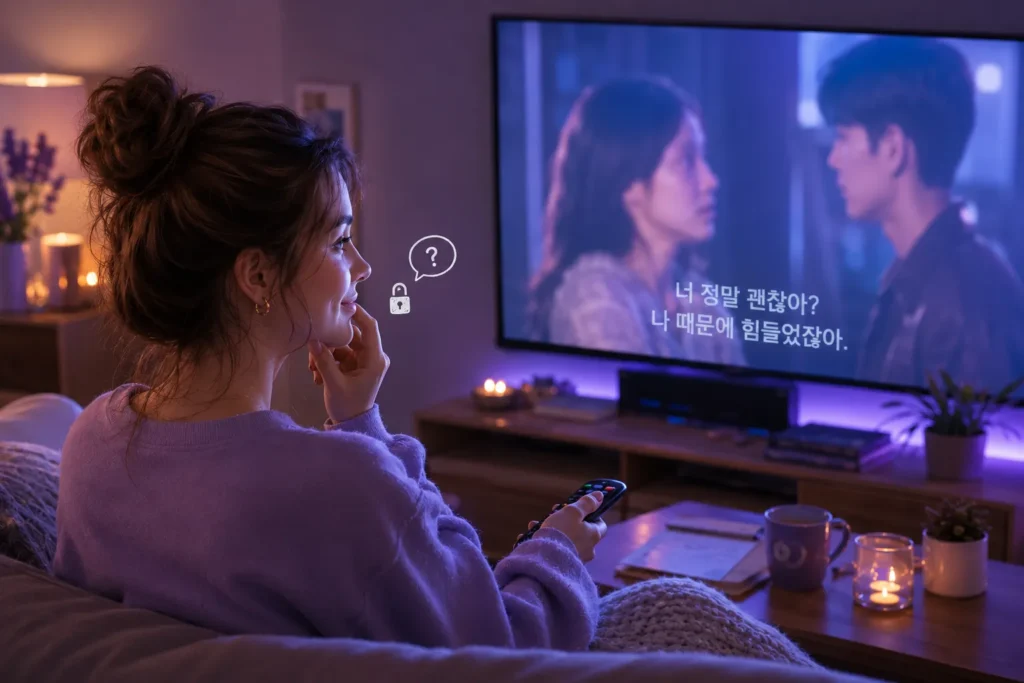
Watching K-dramas and listening to Korean music is a genuine learning method. The key is knowing what to do with the content beyond passive watching.
Using a drama scene: Pick one scene with 3 to 5 lines of dialogue. Listen once without subtitles and write down every word or fragment you catch. Watch again with subtitles. Pick one line you want to keep and practice it with two variations.
Using a song lyric: Pick one verse. Look up every word you do not know. Try to understand the literal meaning before the poetic meaning. Then use the vocabulary in your own sentences. One verse done properly is worth more than ten songs played in the background.
Using a variety show or interview clip: These are harder because speech is fast and unscripted. Use clips of 60 to 90 seconds. The goal is not to understand everything. The goal is to catch two or three words and work from those.
The content you love is not just motivation. It is material. The difference between passive watching and active study is what you do in the five minutes after the clip ends.
4 AI Prompts for Korean Self-Study
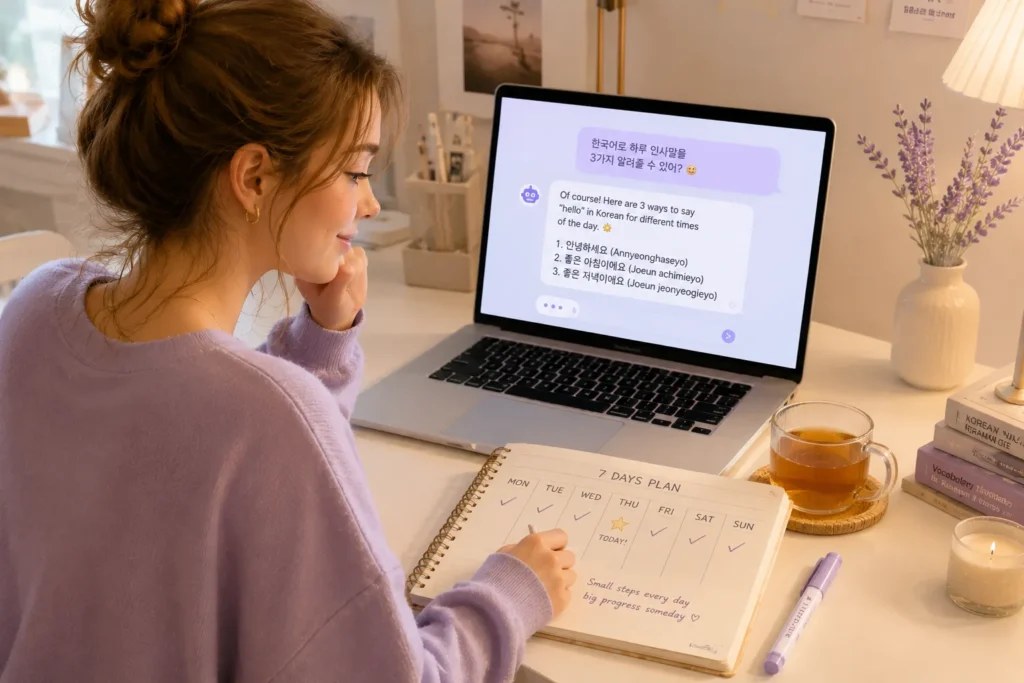
These prompts work with any AI chat tool. If you want to use ChatGPT for your Korean study sessions, check the ChatGPT Plus pricing guide for ways to get a paid plan at a lower price.
Prompt 1: Break down a drama line
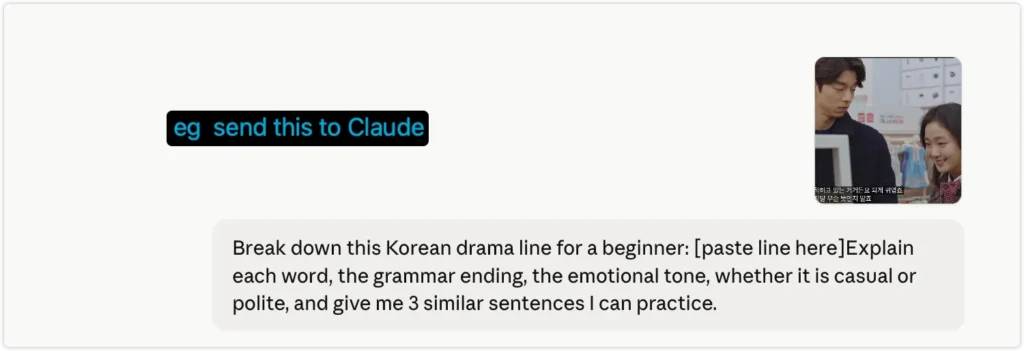
I found this line in a Korean drama: [paste line here]

1. Give me the full natural English translation.
2. List each word with its meaning and part of speech.
3. Explain the grammar endings used and what they do.
4. Tell me the emotional tone and whether it is casual or polite.
5. Give me 3 similar sentences I can practice using the same patterns.
Prompt 2: Speaking practice session
Act as a friendly Korean language partner. Ask me simple beginner questions about my day in Korean. Keep the sentences short. After I answer, correct my Korean and give me a more natural version. Show me both the casual and polite versions.
Prompt 3: Listening recovery
I listened to a Korean clip and caught these words: [list the words you caught]
Help me guess what the scene was about. Then teach me the most useful vocabulary from that topic and give me 3 beginner sentences I can practice.
Prompt 4: Grammar correction with nuance
Correct my Korean sentence: [your sentence]
Tell me what sounds unnatural and why. Give me 3 versions: very simple, casual, and polite.
Save this page to copy these prompts whenever you sit down to study.
How Long Does It Take to Learn Korean: FAQs
How long does it take to learn Korean fluently?
Full fluency, meaning natural conversation, fast speech, slang, and variety shows, takes most self-taught learners several years of consistent study. Useful milestones come much earlier. Most learners can follow familiar daily-life K-drama scenes after 12 to 18 months of active self-study.
Can I learn Korean by watching K-dramas?
K-dramas are genuinely useful input, especially for vocabulary, listening, and motivation. But passive watching alone is not enough. You need to combine it with active output practice and some structured grammar study. Used correctly, dramas can significantly speed up your progress.
How many hours a day do I need to study Korean?
30 minutes of active study is enough for steady progress. The key word is active. If your 30 minutes include real output, speaking, writing, or asking AI to correct you, that is a productive session. Passive watching does not count the same way.
Why do I understand Korean but freeze when I speak?
This is Stuck Point 1 above, and it is extremely common. You have built strong recognition skills through input, but you have not practiced active recall under pressure. The fix is adding small output practice to your routine, starting with single sentences or patterns from content you already know.
How long does it take to learn Korean with Duolingo?
Duolingo can help you build a daily habit and pick up basic vocabulary, but it works best as a warm-up tool, not your whole method. If your goal is to follow K-dramas or hold a real conversation, you will need to add output practice, grammar study, and listening from real Korean content alongside any app you use.
Conclusion
How long it takes to learn Korean is a real question, but the more useful question is where you are stuck right now.
If you cannot speak even though you watch a lot, add output. If sentences blur even though you know words, fill the grammar gaps. If progress feels invisible after months of study, shift from measuring what you understand to practicing what you almost understand.
Korean does not have to feel like a closed door. Identify your stuck point and you have a next step. 🚀