Japanese i adjectives, also written as i-adjectives or Japanese い adjectives, are adjectives that usually end in the hiragana い. You learn おいしい and 高い first. They look simple enough.
Then one day, you see おいしくない, 高かった, or よくなかった in a textbook, anime line, or song lyric. The word still looks familiar, but the ending has changed.
That is usually the moment Japanese i adjectives stop feeling like simple vocabulary and start feeling like grammar.
In this guide, you will learn what Japanese i adjectives are, how they conjugate, how to avoid common beginner mistakes, and how to practice them with AI prompts and a simple Notion flashcard system. This way, the pattern does not stay as another grammar chart you forget tomorrow.
Quick Answer: What Are Japanese I Adjectives?
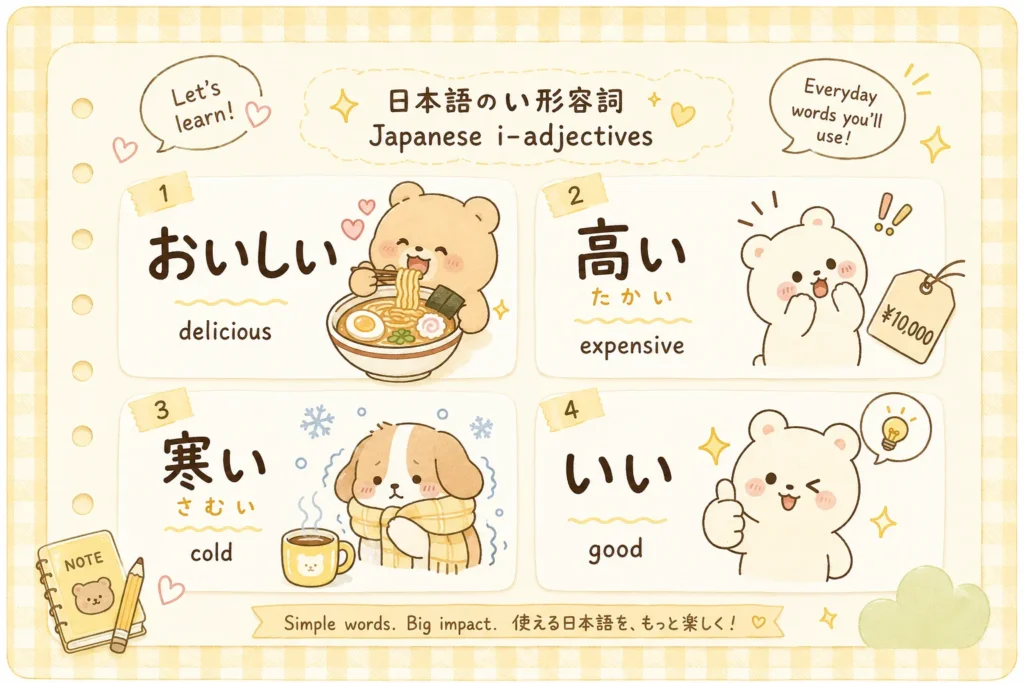
Japanese i adjectives are adjectives that usually end in the hiragana い. They can describe nouns directly, and they can also stand at the end of a sentence.
For example:
| Word | Reading | English |
|---|---|---|
| おいしい | おいしい | delicious |
| 高い | たかい | expensive / tall |
| 寒い | さむい | cold |
| 楽しい | たのしい | fun |
| 忙しい | いそがしい | busy |
The most important thing to know:
Japanese i adjectives change their own endings.
That means 高い can become:
| Form | Japanese | English |
|---|---|---|
| Present | 高い | is expensive |
| Negative | 高くない | is not expensive |
| Past | 高かった | was expensive |
| Past Negative | 高くなかった | was not expensive |
Once you understand that pattern, every i adjective you encounter becomes easier to read, use, and remember.
Japanese I Adjective Cheat Sheet
Here is the pattern you need most often:
| Meaning | Rule | Example |
|---|---|---|
| is not | drop い + くない | 高い → 高くない |
| was | drop い + かった | 高い → 高かった |
| was not | drop い + くなかった | 高い → 高くなかった |
| and / because | drop い + くて | 高い → 高くて |
Use this table whenever an i adjective looks different from the dictionary form.
What Are Japanese I Adjectives?
Japanese has two main adjective types:
| Type | Example | Reading | Basic Meaning |
|---|---|---|---|
| I adjective | おいしい | おいしい | delicious |
| Na adjective | 静か | しずか | quiet |
I adjectives are called i adjectives because their dictionary form usually ends in い.
Examples:
| Word | Reading | English |
|---|---|---|
| おいしい | おいしい | delicious |
| 高い | たかい | expensive / tall |
| 寒い | さむい | cold |
| 新しい | あたらしい | new |
| 面白い | おもしろい | interesting / funny |
They can do two things.
First, they can describe a noun directly:
| Japanese | Reading | English |
|---|---|---|
| おいしいラーメン | おいしいらーめん | delicious ramen |
| 高いバッグ | たかいばっぐ | an expensive bag |
| 寒い日 | さむいひ | a cold day |
| 楽しい旅行 | たのしいりょこう | a fun trip |
Second, they can finish a sentence:
このラーメンはおいしいです。
This ramen is delicious.

今日は寒いです。
Today is cold.

この映画は面白いです。
This movie is interesting.
This is where i adjectives feel different from English adjectives.
In English, you need a verb to show tense. You say “It was cold” or “It is not cold.” In Japanese, the adjective changes its own ending.
寒い means “is cold.” 寒かった means “was cold.”
No extra verb is needed in the plain form. This is why learning the conjugation pattern once unlocks many adjectives you will meet later.
How to Recognize Japanese I Adjectives
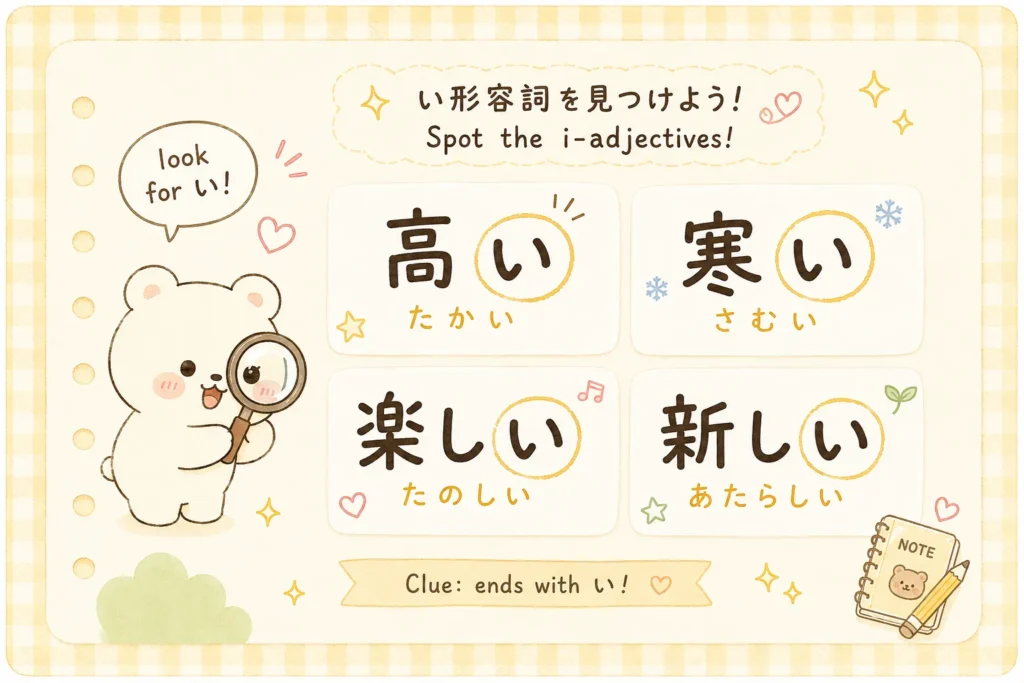
The basic clue is simple: many Japanese i adjectives end in hiragana い.
| Word | Reading | English |
|---|---|---|
| おいしい | おいしい | delicious |
| 高い | たかい | expensive / tall |
| 寒い | さむい | cold |
| 楽しい | たのしい | fun |
| 新しい | あたらしい | new |
| 古い | ふるい | old |
| 眠い | ねむい | sleepy |
| 忙しい | いそがしい | busy |
But this is only a clue. It is not a perfect rule.
Some na adjectives also end with an い sound. These words behave like na adjectives, so you need to memorize them separately.
| Word | Reading | Type | Meaning |
|---|---|---|---|
| きれい | きれい | na adjective | pretty / clean |
| 嫌い | きらい | na adjective | disliked |
| 有名 | ゆうめい | na adjective | famous |
A helpful beginner test is to check how the word modifies a noun.
True i adjectives go directly before a noun:
高いバッグ
an expensive bag

寒い日
a cold day
Na adjectives need な before a noun:
きれいな部屋
a clean room

嫌いな食べ物
food I dislike
So when you learn a new adjective, learn its type together with the word.
Japanese I Adjective Conjugation
To conjugate a Japanese i adjective, find the stem first.
The stem is the part that stays when you remove the final い.
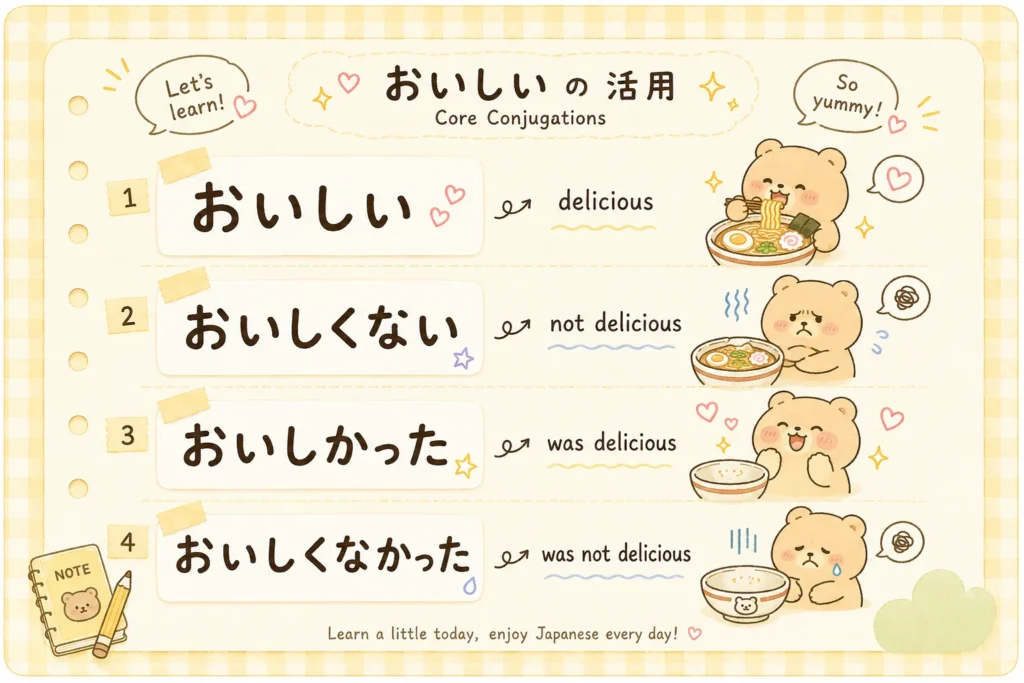
高い → 高
おいしい → おいし
寒い → 寒
Then attach the new ending.
| Form | Formula | Example |
|---|---|---|
| Negative | stem + くない | 高 → 高くない |
| Past | stem + かった | 高 → 高かった |
| Past Negative | stem + くなかった | 高 → 高くなかった |
These four forms cover a lot of daily Japanese.
Use the present form when you describe what something is like now. Use the negative form when something does not match your expectation. Use the past form when you talk about an experience you already had. Use the past negative form when something did not feel that way before.
Real conversations use all four constantly.
You say 高い when something costs more than you want to pay. You say 高くなかった when the bill was actually fine. You say おいしかった after a meal you enjoyed. You say おいしくなかった when the food let you down.
Present Form
The present form is the dictionary form. No change is needed.
| Plain | Polite | English |
|---|---|---|
| おいしい | おいしいです | is delicious |
| 高い | 高いです | is expensive / tall |
| 寒い | 寒いです | is cold |
このケーキはおいしいです。
This cake is delicious.

今日は寒いです。
Today is cold.
Negative Form
Drop い, add くない.
おいしい → おいし → おいしくない
高い → 高 → 高くない
寒い → 寒 → 寒くない
| Word | Negative Form | Reading | English |
|---|---|---|---|
| おいしい | おいしくない | おいしくない | is not delicious |
| 高い | 高くない | たかくない | is not expensive |
| 寒い | 寒くない | さむくない | is not cold |
| 楽しい | 楽しくない | たのしくない | is not fun |
このラーメンはおいしくないです。
This ramen is not delicious.

このバッグは高くないです。
This bag is not expensive.
Past Form
Drop い, add かった.
おいしい → おいし → おいしかった
高い → 高 → 高かった
寒い → 寒 → 寒かった
| Word | Past Form | Reading | English |
|---|---|---|---|
| おいしい | おいしかった | おいしかった | was delicious |
| 高い | 高かった | たかかった | was expensive |
| 寒い | 寒かった | さむかった | was cold |
| 楽しい | 楽しかった | たのしかった | was fun |
昨日のケーキはおいしかったです。
Yesterday's cake was delicious.

旅行は楽しかったです。
The trip was fun.
Past Negative Form
Drop い, add くなかった.
おいしい → おいし → おいしくなかった
高い → 高 → 高くなかった
寒い → 寒 → 寒くなかった
| Word | Past Negative Form | Reading | English |
|---|---|---|---|
| おいしい | おいしくなかった | おいしくなかった | was not delicious |
| 高い | 高くなかった | たかくなかった | was not expensive |
| 寒い | 寒くなかった | さむくなかった | was not cold |
| 楽しい | 楽しくなかった | たのしくなかった | was not fun |
昨日のラーメンはおいしくなかったです。
Yesterday's ramen was not delicious.

ホテルは高くなかったです。
The hotel was not expensive.
Complete Japanese I Adjective Conjugation Table
Three common i adjectives side by side.
| Form | おいしい | 高い | 寒い |
|---|---|---|---|
| Present | おいしい | 高い | 寒い |
| Negative | おいしくない | 高くない | 寒くない |
| Past | おいしかった | 高かった | 寒かった |
| Past Negative | おいしくなかった | 高くなかった | 寒くなかった |
| Polite Present | おいしいです | 高いです | 寒いです |
| Polite Negative | おいしくないです | 高くないです | 寒くないです |
| Polite Past | おいしかったです | 高かったです | 寒かったです |
| Polite Past Negative | おいしくなかったです | 高くなかったです | 寒くなかったです |
To see the pattern in the past negative, break it into steps:
高い
高くない
高くなかった
Once this chain feels natural, the longer forms become much less scary.
Want to keep this pattern handy while you study?
Download the free Japanese i adjective PDF below. It includes the main conjugation chart, common beginner adjectives, tricky words like いい and きれい, and a quick practice section you can use for review.
The Irregular I Adjective: いい
Most i adjectives follow the same pattern. One very common adjective does not.
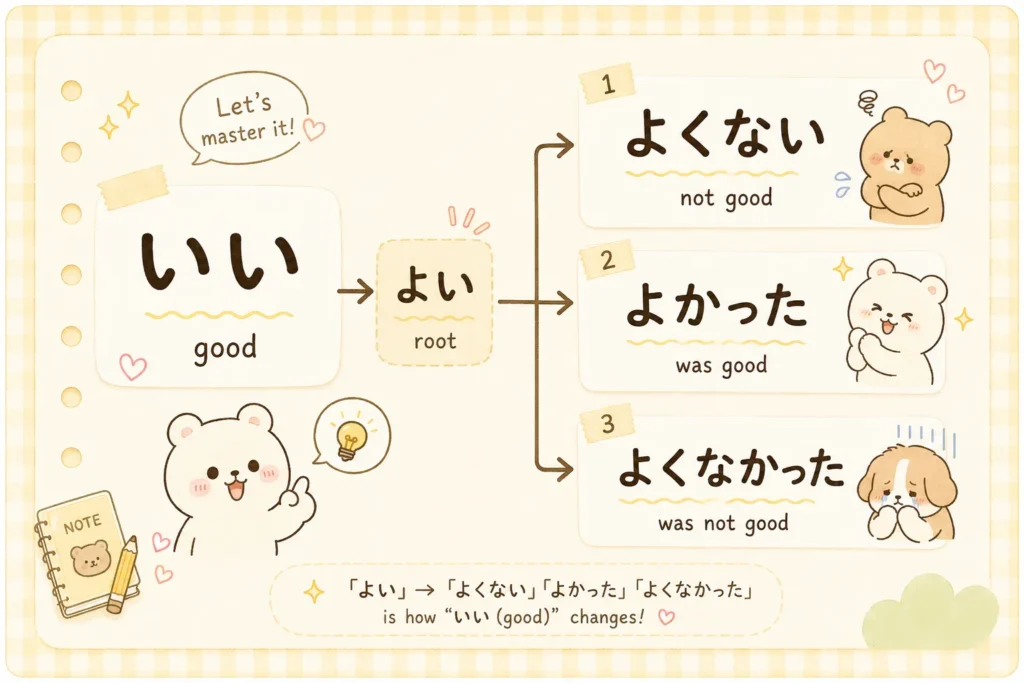
いい means good. Its kanji form is 良い, and 良い can also be read as よい. When you conjugate いい, the stem becomes よ.
いい → よくない / よかった / よくなかった
| Form | Japanese | Reading | English |
|---|---|---|---|
| Present | いい | いい | good |
| Negative | よくない | よくない | not good |
| Past | よかった | よかった | was good |
| Past Negative | よくなかった | よくなかった | was not good |
この本はいいです。
This book is good.

昨日の映画はよかったです。
Yesterday's movie was good.

この方法はよくないです。
This method is not good.
Do not conjugate いい like this:
いくない ❌
いかった ❌
いくなかった ❌
Use the よ forms instead:
よくない ✅
よかった ✅
よくなかった ✅
What About かっこいい?
かっこいい means cool or good-looking. It contains いい, so it follows the same irregular pattern.
かっこいい → かっこよくない / かっこよかった / かっこよくなかった
| Form | Japanese | Reading | English |
|---|---|---|---|
| Present | かっこいい | かっこいい | cool / good-looking |
| Negative | かっこよくない | かっこよくない | not cool |
| Past | かっこよかった | かっこよかった | was cool |
| Past Negative | かっこよくなかった | かっこよくなかった | was not cool |
彼はかっこいいです。
He is cool.

昨日の服はかっこよかったです。
Yesterday's outfit looked cool.
A simple way to remember it:
いい → よい → よくない
かっこいい → かっこよい → かっこよくない
What About かわいい?
かわいい means cute. It looks similar to かっこいい, but it conjugates like a regular i adjective.
The final い is the ending you drop when you conjugate it.
かわいい → かわい → かわいくない
かわいい → かわい → かわいかった
かわいい → かわい → かわいくなかった
| Form | Japanese | Reading | English |
|---|---|---|---|
| Present | かわいい | かわいい | cute |
| Negative | かわいくない | かわいくない | not cute |
| Past | かわいかった | かわいかった | was cute |
| Past Negative | かわいくなかった | かわいくなかった | was not cute |
この猫はかわいいです。
This cat is cute.

子どもの頃の写真はかわいかったです。
Photos from when I was a child were cute.
So the beginner rule is:
| Word | Pattern |
|---|---|
| いい | irregular: よくない / よかった |
| かっこいい | irregular because it contains いい |
| かわいい | regular: かわいくない / かわいかった |
Do not judge only by how many い sounds you hear. Learn the conjugation pattern with the word.
The Na Adjective Trap: Words That Look Like I Adjectives
This is where many learners get confused.
You may see きれい and think it must be an i adjective because it ends with an い sound. But きれい is a na adjective.
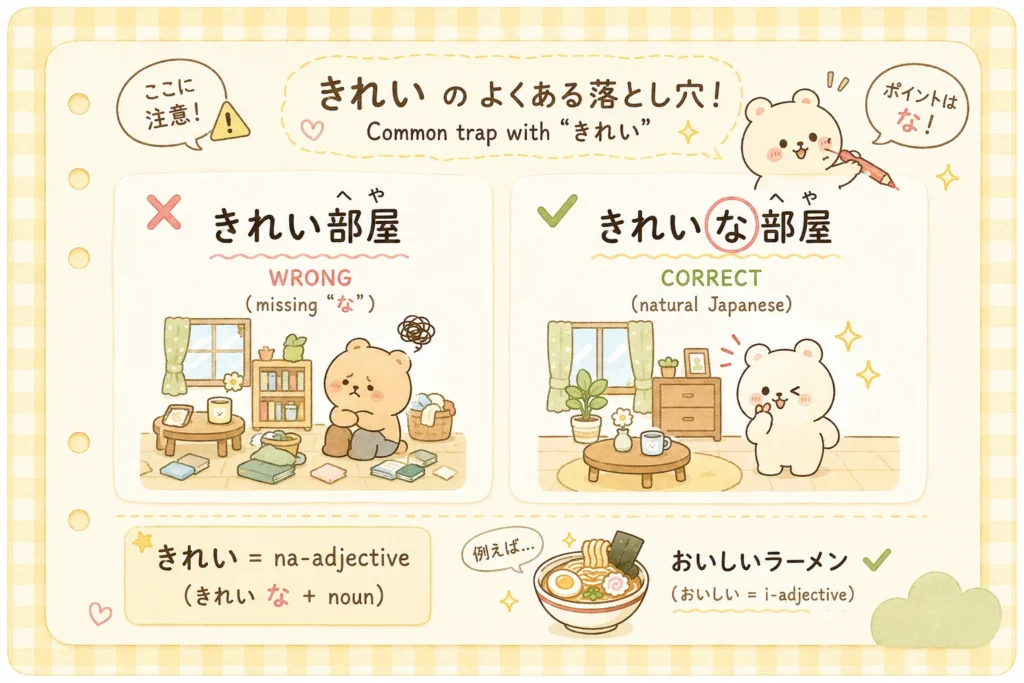
That means you say:
きれいな部屋
a clean room
Not:
きれい部屋 ❌
Here are common na adjectives that confuse beginners:
| Word | Reading | Type | Before a Noun |
|---|---|---|---|
| きれい | きれい | na adjective | きれいな部屋 |
| 嫌い | きらい | na adjective | 嫌いな食べ物 |
| 有名 | ゆうめい | na adjective | 有名な人 |
| 静か | しずか | na adjective | 静かな場所 |
| 親切 | しんせつ | na adjective | 親切な人 |
The safest beginner habit is simple. When you learn an adjective, learn three things together:
| Field | Example |
|---|---|
| Word | きれい |
| Type | na adjective |
| Before a noun | きれいな部屋 |
For many true i adjectives, the final い changes during conjugation:
高い → 高くない
寒い → 寒かった
新しい → 新しくなかった
For common na adjectives like きれい and 嫌い, use な before a noun and follow na adjective grammar.
きれいな部屋
a clean room

嫌いな食べ物
food I dislike
Two Types of I Adjectives: い Endings and しい Endings
Not all i adjectives feel the same. There is a pattern worth knowing.
I adjectives ending in plain い tend to describe physical things you can observe from the outside:
- 暑い (あつい), hot
- 高い (たかい), expensive or tall
- 青い (あおい), blue
- 古い (ふるい), old
I adjectives ending in しい tend to describe feelings and inner states:
- 楽しい (たのしい), fun
- 悲しい (かなしい), sad
- 苦しい (くるしい), painful
- 嬉しい (うれしい), happy
This matters for one practical reason.
しい adjectives usually describe your own feelings, not someone else’s.
You can say:
楽しい!
This is fun!
But if you want to say someone else is having fun, Japanese uses a different form:
マミさんは楽しそうです。
Mami looks like she is having fun.
You do not need to master this right away. But knowing the い vs しい split helps you understand why some adjectives feel more personal than others.
I Adjectives vs Na Adjectives
| Feature | I Adjective | Na Adjective |
|---|---|---|
| Common ending | Usually い | Many different endings |
| Before a noun | Directly before the noun | Add な before the noun |
| Sentence ending | Can stand alone in plain form | Often uses だ / です |
| Example before noun | おいしいラーメン | 静かな部屋 |
| Example sentence | ラーメンはおいしいです。 | 部屋は静かです。 |
The biggest difference is how they behave before nouns.
おいしいラーメン
delicious ramen

静かな部屋
a quiet room
Avoid these:
おいしいなラーメン ❌
静か部屋 ❌
Use these:
おいしいラーメン ✅
静かな部屋 ✅
I adjectives carry their own ending. Na adjectives need な before nouns.
How to Use I Adjectives Before Nouns

Place the i adjective directly before the noun. No particle is needed between them.
| Japanese | Reading | English |
|---|---|---|
| おいしいラーメン | おいしいらーめん | delicious ramen |
| 高いバッグ | たかいばっぐ | expensive bag |
| 楽しい旅行 | たのしいりょこう | fun trip |
| 寒い日 | さむいひ | a cold day |
| 新しいスマホ | あたらしいすまほ | a new smartphone |
| 古い写真 | ふるいしゃしん | an old photo |
おいしいラーメンを食べました。
I ate delicious ramen.

高いバッグは買いません。
I will not buy an expensive bag.

楽しい旅行でした。
It was a fun trip.
This pattern is useful because it lets you build simple Japanese phrases quickly. Pairing these adjectives with common Japanese phrases helps you build full sentences faster.
How to Use I Adjectives at the End of a Sentence
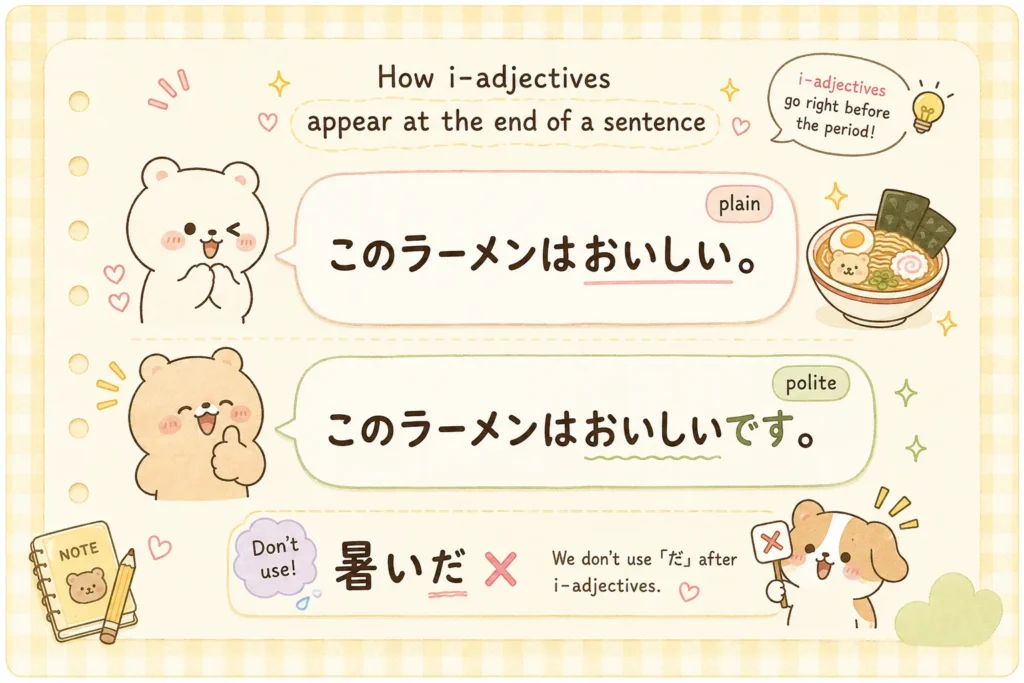
I adjectives can also appear at the end of a sentence.
このラーメンはおいしい。     (casual)
このラーメンはおいしいです。  (polite)
です makes the sentence polite. It does not change the adjective meaning.
| Plain | Polite | English |
|---|---|---|
| 今日は寒い。 | 今日は寒いです。 | Today is cold. |
| この映画は面白い。 | この映画は面白いです。 | This movie is interesting. |
| 仕事は忙しい。 | 仕事は忙しいです。 | Work is busy. |
| この服は可愛い。 | この服は可愛いです。 | This outfit is cute. |
Can You Use だ with I Adjectives?
Do not attach plain だ directly after an i adjective.
今日は暑いだ。  ❌
今日は暑い。   ✅
今日は暑いです。 ✅
Use です for politeness. Use the plain adjective form for casual speech.
How to Connect I Adjectives with the Te Form
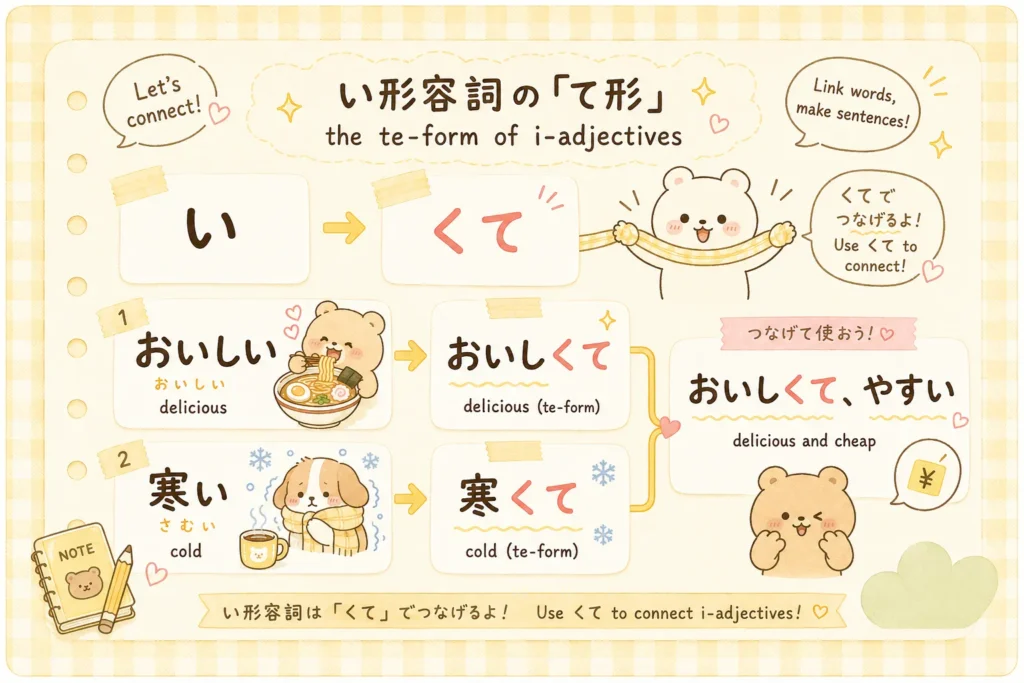
To connect an i adjective to another description, drop い and add くて.
おいしい → おいしくて
高い → 高くて
寒い → 寒くて
楽しい → 楽しくて
| Word | Te Form | Reading | English |
|---|---|---|---|
| おいしい | おいしくて | おいしくて | delicious and |
| 高い | 高くて | たかくて | expensive and |
| 寒い | 寒くて | さむくて | cold and |
| 楽しい | 楽しくて | たのしくて | fun and |
このラーメンはおいしくて、安いです。
This ramen is delicious and cheap.

今日は寒くて、眠いです。
Today is cold, and I am sleepy.

旅行は楽しくて、忘れられません。
The trip was fun, and I cannot forget it.
The くて form can connect two descriptions. It can also show a reason, depending on the sentence.
高くて、買えません。
It is expensive, so I cannot buy it.
Common Japanese I Adjectives List
Here are common Japanese i adjectives grouped by real use case.
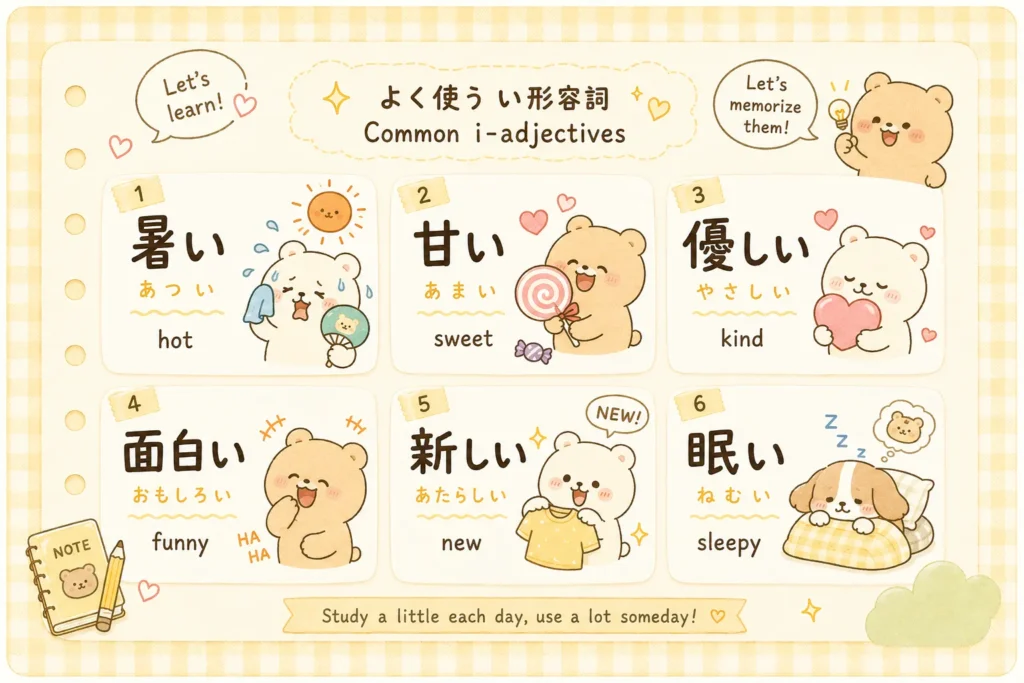
For a full list with kana, example sentences, and printable study cards, see the complete [50 Japanese I Adjectives for Beginners] guide.
🌤️ Weather and Temperature
| Word | Reading | English | Example |
|---|---|---|---|
| 暑い | あつい | hot | 今日は暑いです。 |
| 寒い | さむい | cold | 今日は寒いです。 |
| 涼しい | すずしい | cool | 夜は涼しいです。 |
| 暖かい | あたたかい | warm | 春は暖かいです。 |
🍜 Food and Taste
| Word | Reading | English | Example |
|---|---|---|---|
| おいしい | おいしい | delicious | このケーキはおいしいです。 |
| まずい | まずい | bad-tasting | この料理はまずいです。 |
| 辛い | からい | spicy | カレーは辛いです。 |
| 甘い | あまい | sweet | チョコは甘いです。 |
| 苦い | にがい | bitter | コーヒーは苦いです。 |
😊 Feelings and Moods
| Word | Reading | English | Example |
|---|---|---|---|
| 楽しい | たのしい | fun | パーティーは楽しいです。 |
| 嬉しい | うれしい | happy / glad | とても嬉しいです。 |
| 悲しい | かなしい | sad | 悲しい映画です。 |
| 寂しい | さびしい | lonely | 一人で寂しいです。 |
| 眠い | ねむい | sleepy | 今、眠いです。 |
| 忙しい | いそがしい | busy | 今週は忙しいです。 |
💰 Price, Size, and Appearance
| Word | Reading | English | Example |
|---|---|---|---|
| 高い | たかい | expensive / tall | このバッグは高いです。 |
| 安い | やすい | cheap | このシャツは安いです。 |
| 大きい | おおきい | big | 大きい家です。 |
| 小さい | ちいさい | small | 小さい猫です。 |
| 新しい | あたらしい | new | 新しいスマホです。 |
| 古い | ふるい | old | 古い写真です。 |
👤 Describing People
| Word | Reading | English | Example |
|---|---|---|---|
| 優しい | やさしい | kind | 彼は優しいです。 |
| 面白い | おもしろい | interesting / funny | 彼女は面白いです。 |
| 明るい | あかるい | cheerful / bright | 友達は明るいです。 |
| 可愛い | かわいい | cute | 妹は可愛いです。 |
| かっこいい | かっこいい | cool / good-looking | 彼はかっこいいです。 |
| 怖い | こわい | scary | あの先生は少し怖いです。 |
| 厳しい | きびしい | strict | 父は厳しいです。 |
Not every personality adjective is an i adjective. 親切 (しんせつ) means kind, but it is a na adjective. So you say 親切な人, a kind person. Always check the adjective type when you learn a new word.
Common Mistakes with Japanese I Adjectives
Mistake 1: Adding だ After an I Adjective
今日は暑いだ。  ❌
今日は暑い。   ✅
今日は暑いです。 ✅
I adjectives can end a plain sentence by themselves. Use です when you want to sound polite.
Mistake 2: Treating きれい as an I Adjective
きれい部屋  ❌
きれいな部屋 ✅
Even though きれい ends with an い sound, it is a na adjective.
Mistake 3: Treating 嫌い as an I Adjective
嫌い食べ物  ❌
嫌いな食べ物 ✅
嫌い also behaves like a na adjective.
Mistake 4: Conjugating いい Like a Regular I Adjective
いくない ❌
いかった ❌
Use:
よくない ✅
よかった ✅
Mistake 5: Mixing Up Past and Past Negative
| Japanese | Reading | English |
|---|---|---|
| 高かった | たかかった | was expensive |
| 高くなかった | たかくなかった | was not expensive |
昨日は寒かったです。
Yesterday was cold.

昨日は寒くなかったです。
Yesterday was not cold.
The difference is small in form but big in meaning.
Mistake 6: Learning Only with Romaji
Romaji hides important grammar patterns. For example, kirei looks like it ends in i. But in Japanese grammar, きれい behaves as a na adjective. Japanese writing makes patterns easier to notice, but you still need to learn the adjective type.
You can also practice by collecting short lines you actually like. For example, Japanese quotes and simple sayings are useful because they show adjectives inside real, memorable sentences instead of isolated grammar forms.
Practice Japanese I Adjectives with AI
Most grammar pages give you a chart. A chart helps you understand the pattern once. Practice helps you remember it later.

Copy these prompts into the latest version of ChatGPT, Claude, or any AI language tutor and use them as study drills.
💬 Prompt 1: Conjugation Drill
Act as a Japanese teacher. Give me one Japanese i adjective at a time. Ask me to change it into negative, past, and past negative forms. Correct my answer gently and explain the rule in simple English.
💬 Prompt 2: Sentence Correction
Act as a Japanese tutor. I will write Japanese sentences using i adjectives. Correct my grammar, explain the mistake, and give me a more natural version. Please include English translation.
💬 Prompt 3: I Adjective vs Na Adjective Quiz
Quiz me on Japanese i adjectives and na adjectives. Give me one adjective at a time and ask whether it is an i adjective or a na adjective. Include tricky words like きれい, 嫌い, 有名, おいしい, 高い, and 静か.
💬 Prompt 4: Diary Sentence Practice
Give me five simple diary prompts using Japanese i adjectives. Help me write one sentence about food, weather, feelings, price, and a person. Correct my sentences and explain each correction.
💬 Prompt 5: Describe a Person in Japanese
Help me describe a friend in Japanese using beginner-friendly adjectives. Use both i adjectives and na adjectives. Show me which type each adjective is, and give one natural example sentence for each word.
Repeat these prompts every few days with new adjectives. The goal is not to memorize one table. The goal is to train your brain to see the pattern quickly.
Build a Notion Flashcard System for Japanese I Adjectives
A grammar chart is useful when you are reading. A flashcard system is useful when you want to remember the pattern next week.
| Field | Example |
|---|---|
| Word | 高い |
| Reading | たかい |
| Meaning | expensive / tall |
| Type | i adjective |
| Stem | 高 |
| Negative | 高くない |
| Past | 高かった |
| Past Negative | 高くなかった |
| Te Form | 高くて |
| Example Sentence | このバッグは高いです。 |
| My Sentence | 昨日のランチは高かったです。 |
| Review Status | New / Learning / Mastered |
| Review Date | Friday |
Simple study workflow:
- Add five new i adjectives.
- Fill in the reading, stem, negative, past, and past negative forms.
- Write one personal sentence for each word.
- Ask AI to correct your sentences.
- Review the same cards again in three days.
The personal sentence is the most important part.
このバッグは高いです。
This bag is expensive.

昨日のランチは高かったです。
Yesterday's lunch was expensive.
Grammar becomes easier when it lives inside a sentence from your own life.
Quick Practice Quiz
Questions
- Change 高い into the negative form.
- Change 寒い into the past form.
- Change おいしい into the past negative form.
- Is きれい an i adjective or a na adjective?
- Is 嫌い an i adjective or a na adjective?
- Change いい into the negative form.
- Fill in the blank: この映画は ______ です。(Use 面白い)
- Correct the mistake: 今日は暑いだ。
- Translate: This cake was delicious.
- Translate: That bag is not expensive.
- Change かわいい into the past form.
- Change かっこいい into the negative form.
Answers
- 高くない
- 寒かった
- おいしくなかった
- きれい is a na adjective.
- 嫌い is a na adjective.
- よくない
- この映画は面白いです。
- 今日は暑い。 / 今日は暑いです。
- このケーキはおいしかったです。
- あのバッグは高くないです。
- かわいかった
- かっこよくない
If you got the past negative forms wrong, go back to the conjugation section and try the stem method again.
FAQ About Japanese I Adjectives
What are Japanese i adjectives?
Japanese i adjectives are adjectives that usually end in the hiragana い. They can describe nouns directly and change their own endings to express negative and past meanings. Examples include おいしい, 高い, 寒い, 楽しい, and 忙しい.
How do you conjugate Japanese i adjectives?
Find the stem by removing the final い. Then attach the correct ending.
高い → 高 → 高くない / 高かった / 高くなかった
Use くない for negative, かった for past, and くなかった for past negative.
Why is きれい not an i adjective?
きれい is a na adjective, even though it ends with an い sound. You use な before a noun:
きれいな部屋
a clean room
The ending is a clue, but adjective type decides the grammar.
Why is 嫌い a na adjective?
嫌い behaves as a na adjective in Japanese grammar. Before a noun, use な:
嫌いな食べ物
food I dislike
This is why you should memorize tricky adjectives with their type.
How do you conjugate いい in Japanese?
いい is irregular. Its conjugated forms use よ.
| Form | Japanese | Reading |
|---|---|---|
| Present | いい | いい |
| Negative | よくない | よくない |
| Past | よかった | よかった |
| Past Negative | よくなかった | よくなかった |
Does かわいい conjugate like いい?
No. かわいい conjugates like a regular i adjective.
かわいい → かわいくない
かわいい → かわいかった
かっこいい contains いい, so it uses the irregular よ pattern:
かっこいい → かっこよくない
かっこいい → かっこよかった
What is the difference between i adjectives and na adjectives?
I adjectives usually end in い and can directly modify nouns. Na adjectives need な before nouns.
おいしいラーメン  (i adjective, no particle)
静かな部屋  (na adjective, な required)
Can you use だ with Japanese i adjectives?
No. Do not attach plain だ after an i adjective. 今日は暑いだ is incorrect. The plain form is 今日は暑い. Use です for the polite form: 今日は暑いです。
How do you use i adjectives to describe a person in Japanese?
Place the i adjective before the noun or at the end of a sentence. Common options include 優しい, 面白い, 明るい, 可愛い, and かっこいい.
彼は優しいです。
He is kind.
Some personality words, such as 親切, are na adjectives.
親切な人
a kind person
How do you connect two i adjectives in Japanese?
Use the te form: drop い and add くて.
おいしくて、安いです。
It is delicious and cheap.
Final Takeaway
Japanese i adjectives become easier once you stop treating every form as a new word.
おいしい
おいしくない
おいしかった
おいしくなかった
They are connected. The stem stays, and the ending changes.
Start with the stem method:
高い → 高 → 高くない / 高かった / 高くなかった
Then remember the common traps:
いい → よくない / よかった
かっこいい → かっこよくない / かっこよかった
かわいい → かわいくない / かわいかった
きれい → きれいな部屋
嫌い → 嫌いな食べ物
Practice in real sentences. Copy one AI prompt, build a small Notion flashcard table, and review five i adjectives this week. Once the pattern clicks, Japanese descriptions start to feel much more natural.
Ready to keep going? Next up is Japanese na adjectives, where you will learn why words like きれい and 静か need な before nouns and how their conjugation works differently from i adjectives.