Chinese vs Japanese writing looks similar enough that people often assume the two languages share more than they actually do. They share thousands of characters, but the readings, the grammar, and sometimes even the meanings don’t match up.
My first impression of Japanese was that it just looked like Chinese with a few extra symbols thrown in, so I assumed I had a head start on kanji. Then I read 手紙 in a sentence and got the meaning completely wrong, because in Chinese, those same two characters mean something else entirely.
Key Takeaways
- Chinese and Japanese writing share a historical root, but centuries of separate development mean the same character can carry two unrelated meanings today.
- This guide walks through real kanji and hanzi that look the same in both languages but mean something different, so you stop guessing meaning from Chinese alone.
- You’ll also see how to use AI to find more of these traps yourself, and turn them into a quiz instead of just rereading a list.
Chinese vs Japanese Writing at a Glance
Before getting into specific characters, it helps to see how the two systems actually differ structurally.
| Feature | Chinese Writing | Japanese Writing |
|---|---|---|
| Script | Hanzi only | Kanji plus hiragana and katakana |
| Phonetic script | None | Hiragana and katakana |
| Grammar markers | Word order and context | Particles and verb endings |
| Reading of characters | Mandarin pronunciation | On’yomi and kun’yomi readings |
Japanese borrowed its writing system from China more than a thousand years ago. Early Japanese had no native script, so scholars adapted Chinese characters, known as kanji in Japanese, to write down a language that had almost nothing in common with Chinese grammatically. Chinese is SVO with no verb conjugation. Japanese is SOV, and verbs change form depending on tense, politeness, and function.
Because the grammar didn’t match, Japan eventually developed hiragana and katakana to handle grammar particles, verb endings, and foreign loanwords, something Chinese writing never needed since Chinese doesn’t inflect the same way. Chinese vs Japanese writing today looks related on the surface but functions as two separate systems that happened to start from the same set of symbols.
How to Tell Chinese and Japanese Writing Apart at a Glance
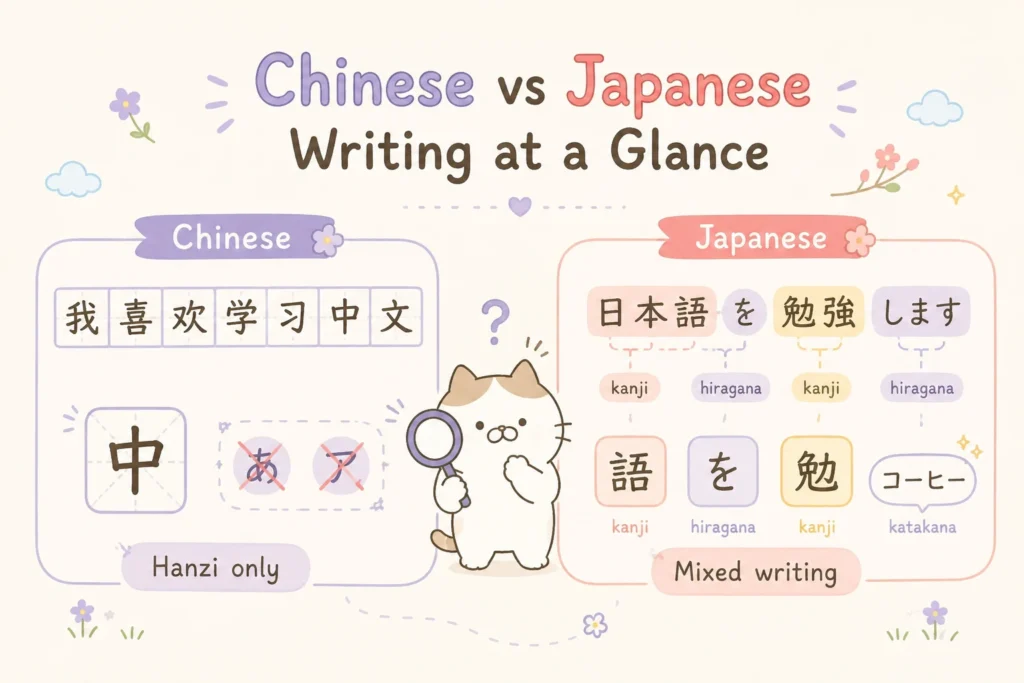
- If a sentence is made up entirely of block-style characters with no other marks, it’s most likely Chinese.
- If you see kanji mixed in with curvy characters like の, は, を, です, or ます, that’s hiragana, and the text is Japanese.
- Angular characters like ア, カ, or シ are katakana, usually used for foreign names, loanwords, or emphasis, and they only appear in Japanese.
That shared starting point is exactly why the next section matters. A shared symbol doesn’t guarantee a shared meaning.
Same-Looking Chinese and Japanese Characters with Different Meanings
Once you can tell the two writing systems apart, the next trap is more subtle: some characters look familiar enough that Chinese speakers assume they already know them.
| Characters | Japanese Meaning | Common Chinese Meaning | Learner Trap |
|---|---|---|---|
| 手紙 | letter | toilet paper (手纸) | Looks familiar, means something else entirely |
| 勉強 | to study | reluctant, forced | Everyday Japanese word, opposite feel in Chinese |
| 丈夫 | sturdy, strong, healthy | husband | 大丈夫 means “okay,” but 丈夫 alone does not mean husband |
| 湯 | hot water | soup | Ordering by the Chinese meaning gets you the wrong dish |
| 床 | floor | bed | Same character, different furniture entirely |
| 娘 | daughter | mother (colloquial) | Flips a family relationship |
| 先生 | teacher, doctor, expert | Mr., general polite title | The overlap is real, but the default everyday use is different |
| 愛人 | mistress, lover | spouse (mainland Chinese usage) | Can cause a genuinely awkward mix-up |
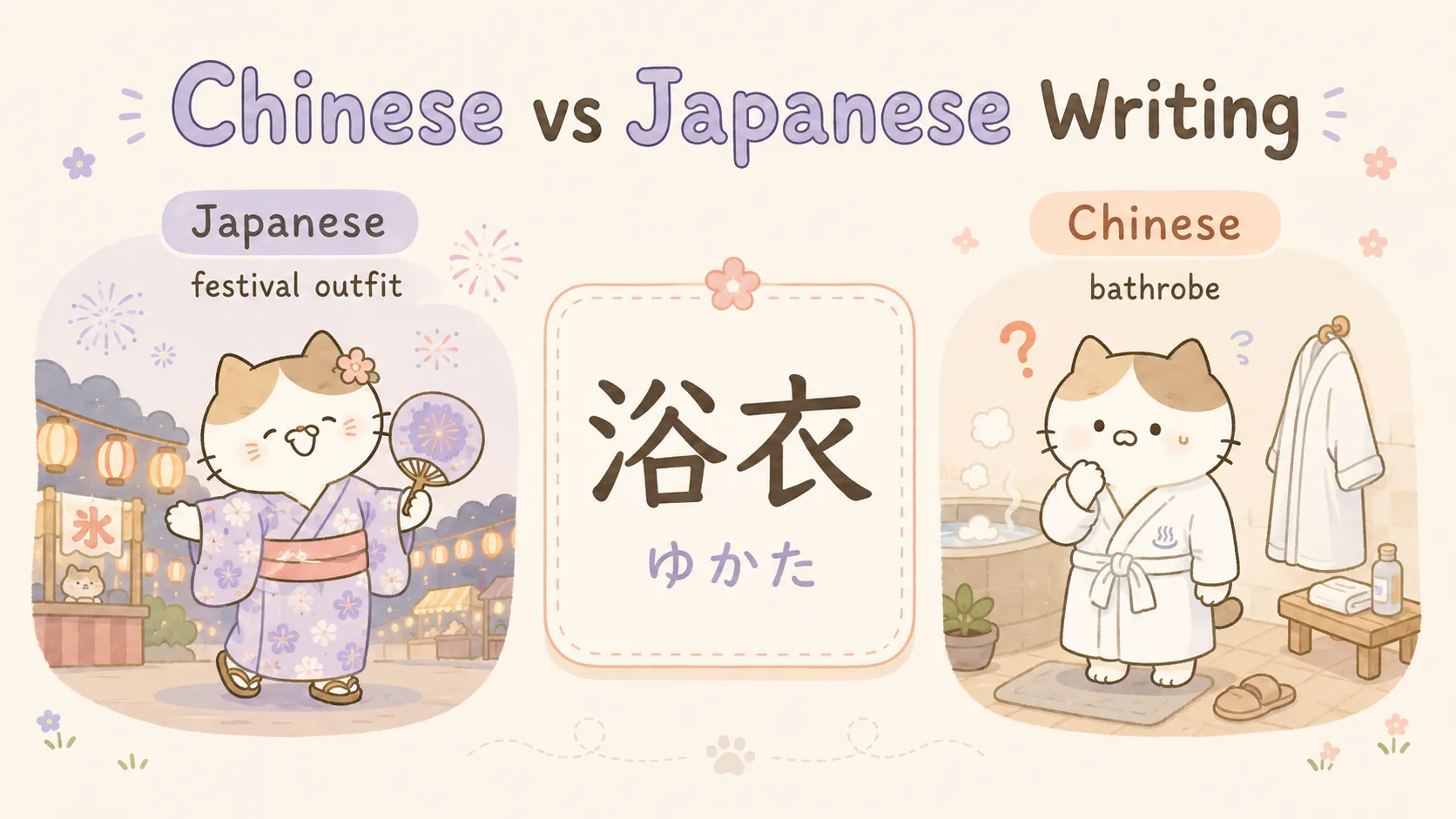
| 浴衣 | a light cotton kimono worn in summer, festivals, and fireworks displays | bathrobe | Same characters, one is festival wear and the other is loungewear |
手紙(てがみ, tegami) Japanese meaning: letter, as in something you write and mail to someone. Common Chinese meaning: toilet paper, usually written 手纸 in simplified Chinese, since the Japanese version uses the traditional character form. This is the one that got me. I read 手紙 in a Japanese text expecting the same meaning it has in Chinese, and the sentence made no sense until I looked it up.
勉強(べんきょう, benkyou) Japanese meaning: to study. Common Chinese meaning: reluctant, forced, or barely enough. A Japanese student who says 勉強します is saying “I’m going to study.” The same two characters in Chinese describe doing something against your will.
丈夫(じょうぶ, joubu) Japanese meaning: sturdy, strong, or healthy. In the phrase 大丈夫です, it means “it’s okay.” Common Chinese meaning: husband. A Chinese speaker seeing 丈夫 alone often pictures a completely different subject, even though the meaning “okay” actually comes from the full phrase 大丈夫, not from 丈夫 by itself.
湯(ゆ, yu) Japanese meaning: hot water, the character you’ll see on public bathhouses. Common Chinese meaning: soup. Ordering based on the Chinese meaning gets you a fairly disappointing bowl of hot water instead of soup.
床(ゆか, yuka) Japanese meaning: floor. Common Chinese meaning: bed. Two words for two very different pieces of furniture, from the same character.
娘(むすめ, musume) Japanese meaning: daughter. Common Chinese meaning: mother in colloquial or older usage, and it still appears in words related to women, like 姑娘. This one can flip a family relationship depending on which language you’re reading in.
先生(せんせい, sensei) Japanese meaning: teacher, doctor, or another respected professional. Common Chinese meaning: Mr., though it can also mean teacher or a respected person depending on context. The overlap is real, but the default everyday use is different in each language.
愛人(あいじん, aijin) Japanese meaning: mistress or lover, usually implying an affair. Common Chinese meaning: in mainland Chinese, 爱人 can mean spouse, a fairly neutral word for husband or wife. This is the most famous example for a reason. Using it in the wrong language can cause a genuinely awkward conversation.
浴衣(ゆかた, yukata) Japanese meaning: a light, casual kimono worn in summer, especially to festivals and fireworks displays. Common Chinese meaning: bathrobe, the kind you’d wear right after a shower. Picture someone showing up to a summer festival in a bathrobe instead of a yukata, and you’ll never mix these two up again.
More Kanji Traps to Know
| Kanji | Kana | Japanese Meaning | Common Chinese Meaning |
|---|---|---|---|
| 汽車 | きしゃ | train | car in traditional Chinese usage |
| 新聞 | しんぶん | newspaper | news |
| 人参 | にんじん | carrot | ginseng |
| 大家 | おおや | landlord, landlady | everyone |
| 老婆 | ろうば | old woman | wife (informal) |
| 得意 | とくい | good at, proud | smug, self-satisfied |
Why Do Chinese Hanzi and Japanese Kanji Drift Apart in Meaning?
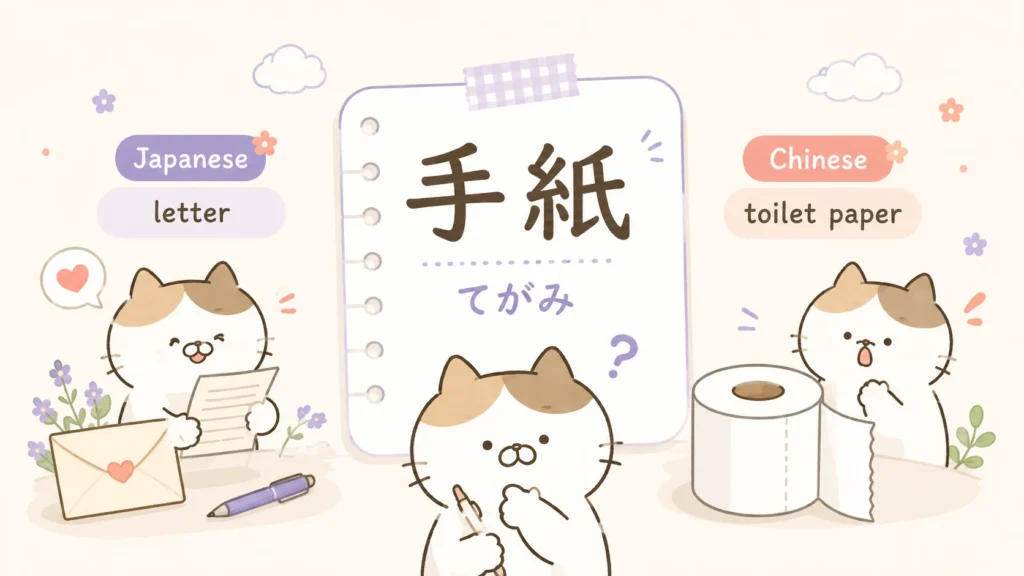
Chinese hanzi and Japanese kanji started from the same character tradition, but meaning isn’t fixed once a character crosses into a new language. Japan imported characters over several centuries, and Japanese speakers attached them to existing native words, a process called kun’yomi reading, alongside the borrowed Chinese-based pronunciation, called on’yomi. Once a character was tied to a native Japanese word, its meaning could shift toward whatever that native word already meant.
Meanwhile, spoken Chinese kept changing on its own timeline. Words that meant one thing in classical Chinese, the era when Japan was borrowing characters, sometimes shifted to a different meaning in modern Mandarin. Japanese kept the older meaning. Chinese moved on. 手紙 is a good example of exactly this kind of drift. If you want a longer list to study from, I put together a downloadable PDF of Chinese-Japanese kanji that changed meaning you can save for reference.
Some Shared Kanji Words Still Mean the Same Thing
Drift isn’t the only outcome. Many modern kanji compounds moved in the other direction too. During the Meiji period, Japanese scholars coined, modernized, or popularized Chinese-character words for Western concepts. Some of those words were later adopted into modern Chinese, so they now feel familiar in both languages.
| Kanji | Kana | Meaning |
|---|---|---|
| 科学 | かがく | Science |
| 社会 | しゃかい | Society |
| 経済 | けいざい | Economy |
| 哲学 | てつがく | Philosophy |
| 電話 | でんわ | Telephone |
| 銀行 | ぎんこう | Bank |
Chinese hanzi and Japanese kanji don’t always drift apart. Sometimes the borrowing goes the other direction entirely.
Use AI to Find More of These Kanji Traps
Nine examples are a good start, but Chinese and Japanese share thousands of characters, which means there are more traps like this out there. Instead of hunting for them one by one, you can have AI generate a study set for you, then quiz yourself on it.
Prompt 1: Find More Kanji Traps
Use this to generate a fresh batch of shared-character traps to add to your list.
Best for: building your own running list beyond the examples in this article
📋 Copy this prompt:
I'm a Chinese speaker learning Japanese. Give me 10 kanji or kanji compounds that look identical in Chinese and Japanese but have a different meaning in each language. For each one, give the kanji, the Japanese reading, the Japanese meaning, and the Common Chinese meaning. Skip any example you're not confident is accurate.
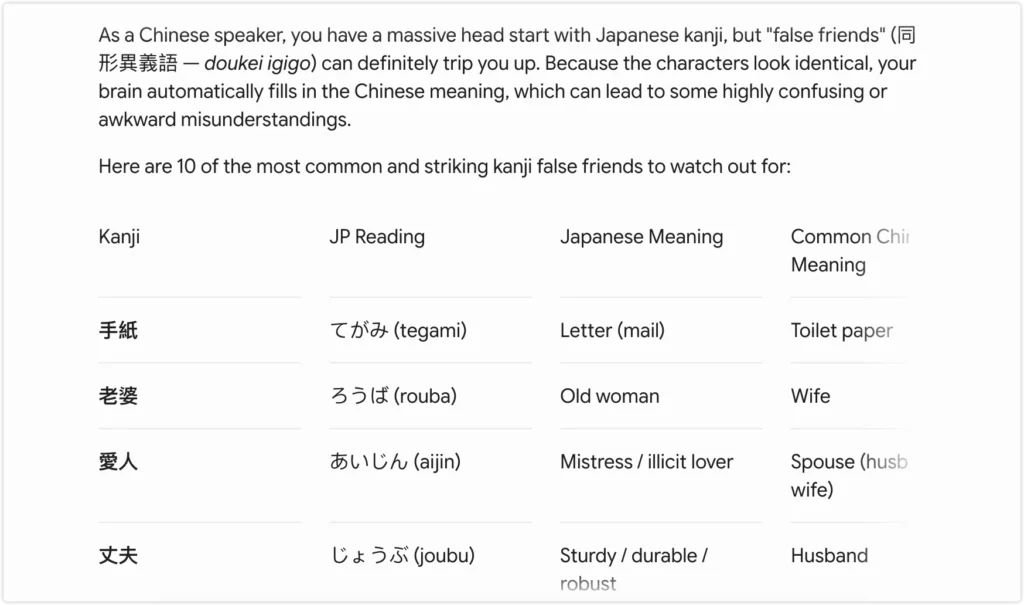
Treat these as candidates, not confirmed facts. Cross-check anything unfamiliar with a dictionary before you trust it and add it to your list.
Prompt 2: Turn Your List into a Quiz
Once you’ve built up a list of your own, this prompt turns it into a self-test instead of something you just reread. Gemini works well for this, since it can turn the quiz into an interactive flashcard set you can click through instead of just reading plain text answers.
Best for: checking whether you actually remember the meanings, not just recognize them
📋 Copy this prompt:
Here is a list of kanji that look the same in Chinese and Japanese but mean different things: [paste your list]. Turn this into a 10-question quiz that shows me the kanji and asks me to recall the Japanese meaning and the Chinese meaning separately. Give me the answers only after I respond.
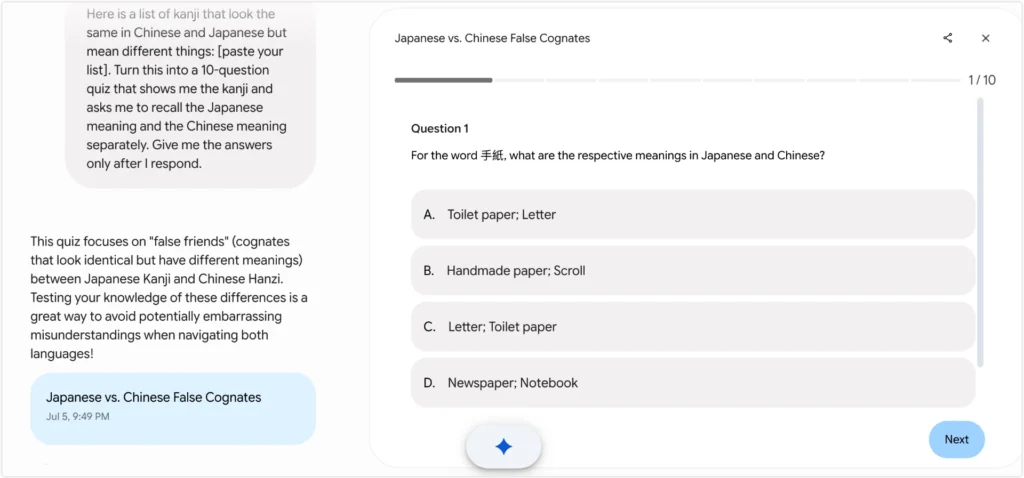
Answer from memory before you check the answer key. If you want a version you can replay and track your score on, drop the same list into the free Quizlet alternative instead.
How to Avoid These Kanji Mistakes When Learning Japanese
The safest habit is to treat a shared character as a starting point, not a confirmed answer. If a kanji word looks exactly like a Chinese word you already know, check the reading and the context before assuming the meaning carries over. Most of the time it will. The exceptions are rare enough that they’re memorable once you’ve seen them: collect the exceptions as you run into them, the way I did with 手紙.
Reading native Japanese material, like short NHK News articles, is one of the more reliable ways to catch these differences naturally, since you see the word used in a real sentence instead of as an isolated flashcard.
Chinese vs Japanese Writing FAQs
Are Japanese kanji and Chinese hanzi the same characters?
Many are visually identical or nearly identical, since Japanese kanji originated from Chinese hanzi. But pronunciation, grammar function, and in some cases meaning have diverged over centuries of separate use.
Can I read Japanese if I already know Chinese characters?
You’ll be able to guess the general topic of a lot of Japanese text, since many kanji keep a similar core meaning. You won’t be able to read it fluently, since Japanese grammar, particles, and verb conjugation work completely differently from Chinese, and a handful of shared characters mean something else entirely.
Do Chinese and Japanese use the same letters?
Chinese writing uses only hanzi. Japanese writing uses kanji alongside hiragana and katakana, two phonetic scripts that Chinese doesn’t have at all.
Why do some kanji mean something different in Chinese and Japanese?
Japan borrowed characters from classical Chinese and attached them to existing native Japanese words. Modern Mandarin kept evolving independently after that point, so some words settled into different meanings in each language.
Chinese vs Japanese writing will always share a visible family resemblance, but that resemblance can trick you if you rely on it too heavily. Keep an eye out for the exceptions above, and you’ll read Japanese kanji with a lot more confidence. If you want to build that reading habit further, check out the Japanese phrases guide next.