Key Takeaways
- Japanese idioms include 慣用句 (everyday idiomatic expressions), ことわざ (proverbs), and 四字熟語 (four-character idioms). This guide covers all three with kana, examples, and usage notes.
- Body-part idioms like 頭に来る, 目から鱗が落ちる, and 胸がいっぱい are some of the easiest Japanese idioms to notice in shows, subtitles, and daily conversation.
- The best way to learn Japanese idioms is not to memorize a long list. Connect the literal image, the natural meaning, and one sentence from your own life.
When I first started learning Japanese, idioms were not something I learned from a textbook.
I noticed them in shows, subtitles, songs, and lines that sounded strange but stayed with me. One that stuck early was 急がば回れ. I first noticed it in a drama scene, and the image of “taking the long way because rushing can backfire” made the phrase impossible to forget.
Japanese idioms are not just fixed phrases. They carry situations, emotions, and timing that a dictionary definition alone cannot capture. I am not the only learner who feels this way. In Japanese-learning communities, learners often ask for idioms that make no sense unless you already know the expression, which is exactly why context matters. You can see this kind of learner question in this Reddit discussion about favorite Japanese idioms.
If you are still building your foundation, reviewing Japanese i-adjectives first can help before moving into fixed expressions. But once you start noticing idioms in real input, Japanese becomes much more visual and memorable.
This guide covers 50 Japanese idioms worth learning first. Each card includes kana, a clear meaning, a natural example sentence, a literal image, and a usage note.
Table of Contents
Japanese Idioms vs Proverbs vs Yojijukugo
In English, people often use Japanese idioms as a broad term. But in Japanese, these expressions can belong to different groups.
| Japanese Term | Reading | What It Means | Example |
|---|---|---|---|
| 慣用句 | かんようく | everyday idiomatic expression | 頭に来る |
| ことわざ | ことわざ | proverb or saying | 猿も木から落ちる |
| 四字熟語 | よじじゅくご | four-character compound, sometimes idiomatic | 一石二鳥 |
慣用句 are everyday idiomatic expressions. They often use body parts, animals, or simple images. For example, 頭に来る means “to get angry,” even though it literally sounds like something comes to your head.
ことわざ are proverbs. They often teach a lesson or express a cultural idea. 猿も木から落ちる means “even monkeys fall from trees,” or “even experts make mistakes.” The categories can overlap, but not every idiom or yojijukugo is a proverb. For a broader explanation, see this overview of Japanese proverbs.
四字熟語 are four-character expressions made of kanji, such as 一石二鳥 and 十人十色. Some are common in daily life, while others sound more formal, literary, or academic. Yojijukugo can broadly mean four-kanji compounds, while the stricter meaning refers to expressions with idiomatic meanings. You can read more in this explanation of yojijukugo.
This guide mixes all three because English learners usually search for them together as “Japanese idioms.” I will mark the type and the real usage scene under each expression.
Idioms are different from grammar rules, but both become easier when you see them in real sentences. If na-adjectives still feel confusing, my guide to Japanese na-adjectives explains another pattern that often feels less direct than English.
Best Japanese Idioms to Learn First
You do not need to memorize every Japanese idiom at once. Start with the ones that are common, reusable, and easy to connect to real situations.
| Idiom | Kana | Why Learn It First |
|---|---|---|
| 頭に来る | あたまにくる | Common in emotional conversation |
| 気を使う | きをつかう | Useful for Japanese social situations |
| 手を貸す | てをかす | Easy to use when asking for help |
| 胸を張る | むねをはる | Common in encouragement and speeches |
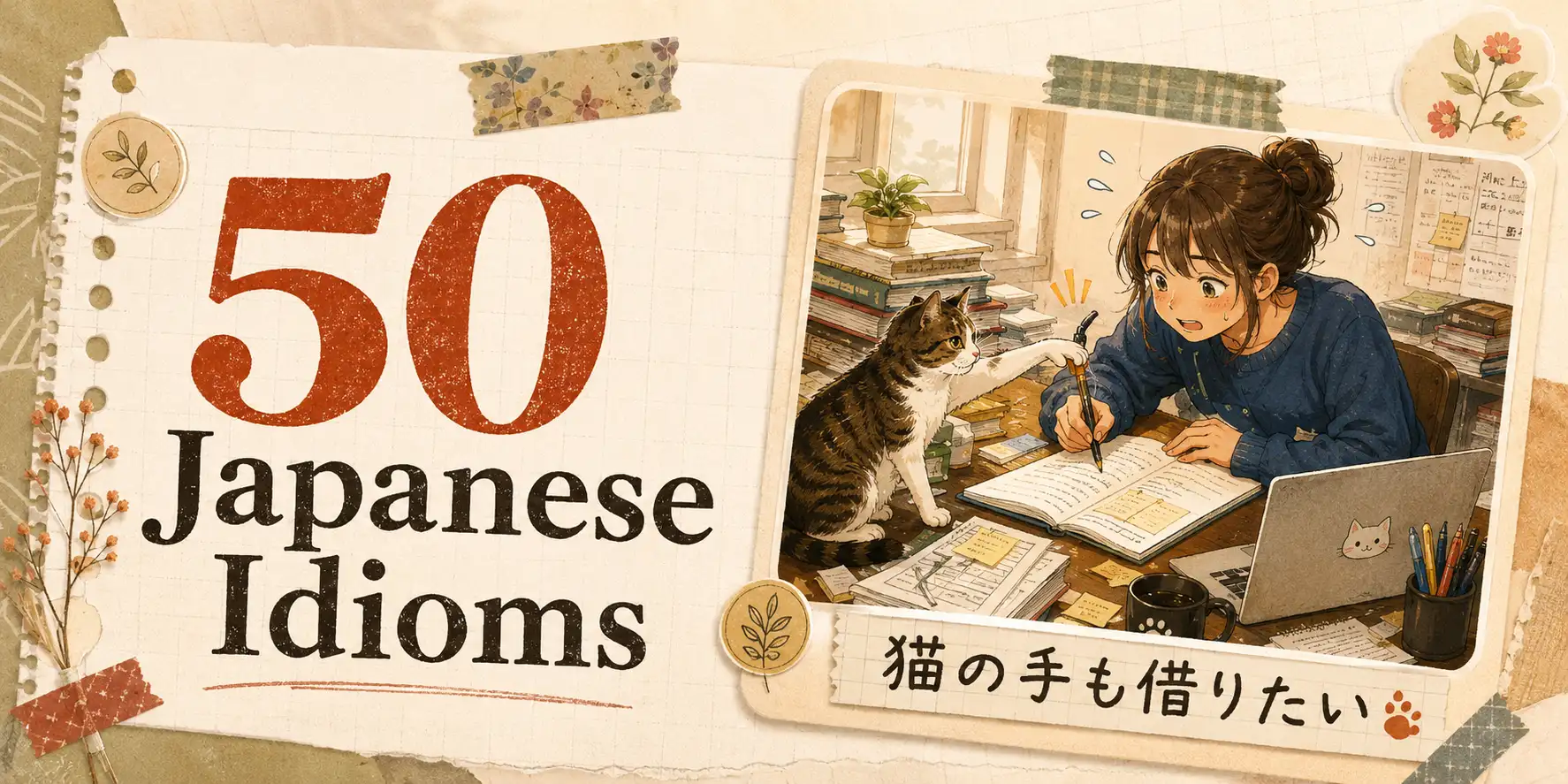
| 猫の手も借りたい | ねこのてもかりたい | Memorable and useful for busy days |
| 一石二鳥 | いっせきにちょう | Easy English match |
| 水に流す | みずにながす | Useful for conflict repair |
| 目から鱗が落ちる | めからうろこがおちる | Great for learning moments |
If you only have time to learn a few idioms today, start with these. They are easier to understand, easier to remember, and more likely to appear in shows, conversations, or learning materials.
Which Japanese Idioms Are Safe to Use?
Not every idiom should be used the same way. Some are safe in daily conversation. Some are better for writing. Some can sound critical if you use them about another person.
| Use Level | What It Means | Examples |
|---|---|---|
| Use actively | Safe and useful in daily conversation | 手を貸す, 気を使う, 馬が合う |
| Recognize first | Useful to understand, but not always easy to use naturally | 出る杭は打たれる, 口は災いの元 |
| Use with care | Can sound critical, harsh, or too direct | 口が軽い, 顔をつぶす, 自業自得 |
| Save for writing | Better for essays, speeches, or reflective posts | 温故知新, 一期一会 |
This is why usage notes matter. A Japanese idiom is not only about meaning. It is also about timing, tone, and relationship.
This is also why I do not treat every phrase from songs, dramas, or online lists as something you should immediately use in conversation. Learners often ask which Japanese idioms they should actually be aware of, as in this Reddit thread about Japanese idioms to know. The better question is not only “What does it mean?” but also “Can I use it naturally?”
How to Read These Idiom Cards?
Each card follows the same structure.
Japanese idiom
Kana · Type · Real usage sceneMeaning: the natural meaning in English.
✍️ Example
Japanese sentence
Kana sentence
English translation🖼️ Literal image: the strange or memorable picture behind the phrase.
💡 Usage note: when it sounds natural, when it sounds too strong, or what to say instead.
I use kana instead of romaji because kana helps you read Japanese more naturally. If you are still new to Japanese, you can read the kana line slowly before looking at the English translation.
Download the Free PDF: 100 Japanese Idiom Study Cards
Want to study offline or save the full list for later? I also made a printable PDF with 100 Japanese idiom study cards, including kana, meanings, literal images, usage notes, and review pages.
Body Idioms for Feelings and Reactions
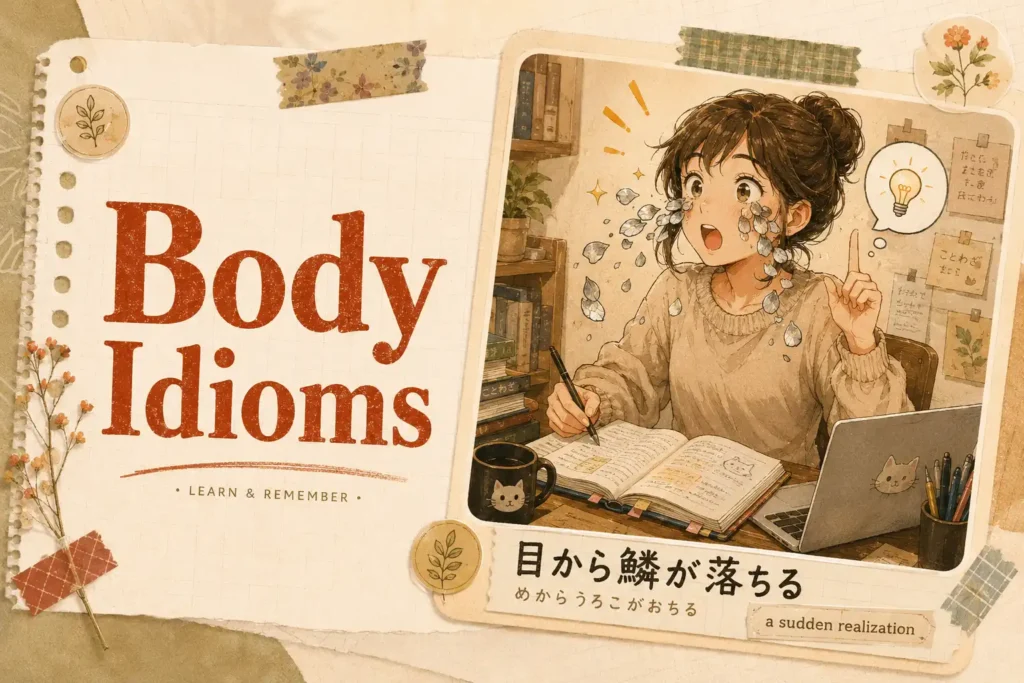
Some of the most memorable body parts in Japanese show up in idioms. I notice these expressions often in shows, subtitles, and emotional conversations because they turn anger, surprise, embarrassment, desire, and realization into body images.
1. 頭に来る
あたまにくる · 🧍 Body idiom · Casual frustration
Meaning: to get really angry or annoyed.
✍️ Example
彼の言い方には本当に頭に来た。
かれの いいかたには ほんとうに あたまにきた。
The way he said it really got on my nerves.
🖼️ Literal image: anger rushes straight to your head.
💡 Usage note: Common in casual speech. In a formal complaint, use 不快に感じました instead.
2. 腹が立つ
はらがたつ · 🧍 Body idiom · Emotional reaction
Meaning: to feel angry.
✍️ Example
あんなことを言われて、腹が立った。
あんなことを いわれて、はらがたった。
I got angry after being told something like that.
🖼️ Literal image: your stomach stands up in anger.
💡 Usage note: Use it when describing your own feelings. It can sound direct if you say it while blaming someone.
3. 顔に出る
かおにでる · 🧍 Body idiom · Everyday reactions
Meaning: to show on your face.
✍️ Example
うれしい気持ちが顔に出ているよ。
うれしい きもちが かおにでているよ。
Your happiness is written all over your face.
🖼️ Literal image: your feelings walk out onto your face.
💡 Usage note: Easy to use in daily conversation. It can sound warm, playful, or teasing depending on tone.
4. 目がない
めがない · 🧍 Body idiom · Likes and cravings
Meaning: to have a weakness for something.
✍️ Example
私は甘いものには目がない。
わたしは あまいものには めがない。
I have a weakness for sweets.
🖼️ Literal image: your eyes disappear when you love something too much.
💡 Usage note: Natural for food, hobbies, idols, animals, and anything you cannot resist.
5. 目から鱗が落ちる
めからうろこがおちる · 🧍 Body idiom · Learning moment
Meaning: to suddenly understand something.
✍️ Example
先生の説明を聞いて、目から鱗が落ちた。
せんせいの せつめいをきいて、めから うろこが おちた。
The teacher’s explanation suddenly made everything click.
🖼️ Literal image: scales fall from your eyes, and the world becomes clear.
💡 Usage note: Useful when you finally understand grammar, culture, or someone’s real meaning.
6. 耳が痛い
みみがいたい · 🧍 Body idiom · Honest feedback
Meaning: to feel uncomfortable because something is true.
✍️ Example
その指摘は耳が痛いけど、正しいと思う。
その してきは みみがいたいけど、ただしいとおもう。
That comment hurts to hear, but I think it is right.
🖼️ Literal image: the truth hurts your ears.
💡 Usage note: A good phrase for self-reflection. It sounds less defensive than saying you do not want to hear something.
7. 胸がいっぱい
むねがいっぱい · 🧍 Body idiom · Emotional scenes
Meaning: to be overwhelmed with emotion.
✍️ Example
みんなの優しさに胸がいっぱいになった。
みんなの やさしさに むねがいっぱいになった。
I was overwhelmed by everyone’s kindness.
🖼️ Literal image: your chest becomes full of feelings.
💡 Usage note: Warm and emotional. It often appears in speeches, interviews, letters, and touching scenes.
8. 息をのむ
いきをのむ · 🧍 Body idiom · Dramatic moments
Meaning: to gasp or hold your breath in surprise.
✍️ Example
その景色の美しさに息をのんだ。
その けしきの うつくしさに いきをのんだ。
The beauty of the view took my breath away.
🖼️ Literal image: you swallow your own breath.
💡 Usage note: Good for beautiful, shocking, tense, or dramatic moments.
9. 肩を落とす
かたをおとす · 🧍 Body idiom · Disappointment
Meaning: to look disappointed or discouraged.
✍️ Example
試合に負けて、彼は肩を落としていた。
しあいに まけて、かれは かたをおとしていた。
He looked discouraged after losing the game.
🖼️ Literal image: your shoulders drop when your heart sinks.
💡 Usage note: Natural in narration, drama summaries, and emotional descriptions.
10. 喉から手が出る
のどからてがでる · 🧍 Body idiom · Strong desire
Meaning: to want something desperately.
✍️ Example
あのチケットが喉から手が出るほど欲しい。
あの チケットが のどから てがでるほど ほしい。
I want that ticket so badly.
🖼️ Literal image: a hand reaches out from your throat.
💡 Usage note: Vivid and dramatic. Use it for things you really want, not small preferences.
11. 耳を澄ます
みみをすます · 🧍 Body idiom · Careful listening
Meaning: to listen carefully, to prick up your ears.
✍️ Example
森の中で耳を澄ますと、鳥の声が聞こえた。
もりの なかで みみをすますと、とりの こえが きこえた。
When I listened carefully in the forest, I could hear birds singing.
🖼️ Literal image: your ears become still and clear.
💡 Usage note: Natural in quiet, emotional, or reflective moments. You may also notice it in Japanese songs and dramas.
12. 胸を張る
むねをはる · 🧍 Body idiom · Confidence
Meaning: to hold your head high, to feel proud and confident.
✍️ Example
自分の努力に胸を張っていい。
じぶんの どりょくに むねをはっていい。
You can be proud of your own effort.
🖼️ Literal image: you push your chest forward with confidence.
💡 Usage note: Positive and encouraging. Often used in speeches, advice, and motivational moments.
Mini Check: Can You Use These Body Idioms?
Choose the best idiom for each situation.
- You finally understand a grammar point that used to confuse you.
A. 目から鱗が落ちる
B. 肩を落とす
C. 喉から手が出る - You want to tell someone they can feel proud of their effort.
A. 耳が痛い
B. 胸を張る
C. 腹が立つ
Answers: 1-A, 2-B
Social Idioms for Relationships and Group Harmony
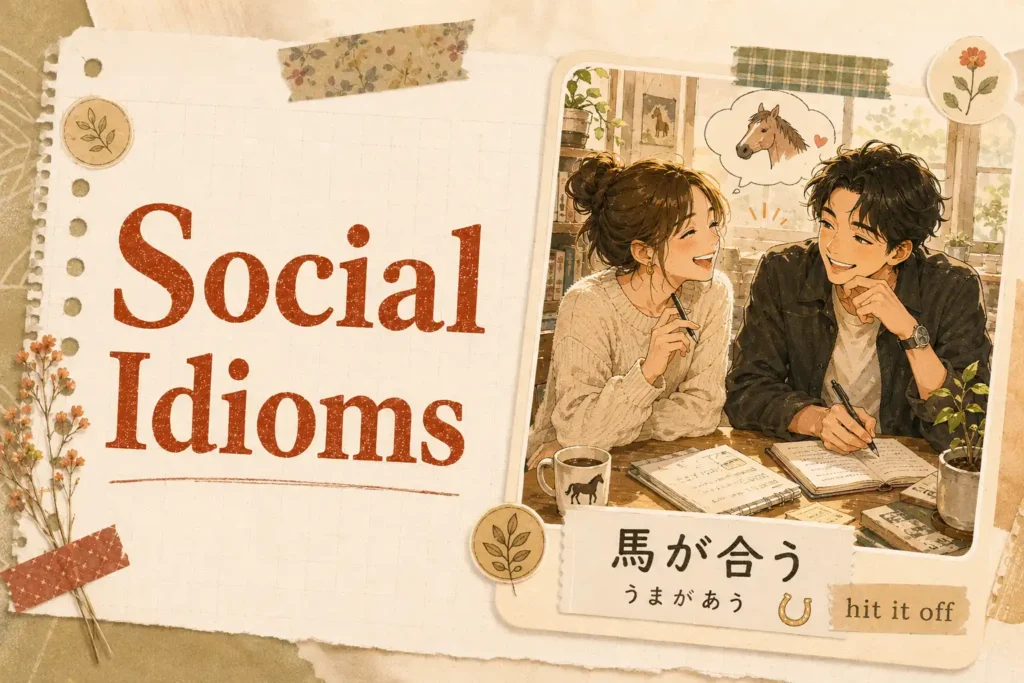
These expressions are useful when people talk about trust, secrets, face, conflict, and social distance. They are especially helpful for understanding Japanese workplace and group dynamics.
13. 口が軽い
くちがかるい · 🧍 Body idiom · Can sound critical
Meaning: to have a loose tongue.
✍️ Example
彼は口が軽いから、秘密は話さないほうがいい。
かれは くちがかるいから、ひみつは はなさないほうがいい。
He has a loose tongue, so you should not tell him secrets.
🖼️ Literal image: a mouth so light it cannot hold anything in.
💡 Usage note: Common but negative. Avoid saying it directly to someone unless you are ready to sound critical.
14. 口が堅い
くちがかたい · 🧍 Body idiom · Trust and secrets
Meaning: to be good at keeping secrets.
✍️ Example
彼女は口が堅いから、安心して話せる。
かのじょは くちがかたいから、あんしんして はなせる。
She knows how to keep a secret, so I can talk to her safely.
🖼️ Literal image: a mouth locked shut like a firm door.
💡 Usage note: Positive and safe. Use it when describing someone trustworthy.
15. 顔を立てる
かおをたてる · 🧍 Body idiom · Social nuance
Meaning: to save someone’s face or show respect.
✍️ Example
先輩の顔を立てて、その場では何も言わなかった。
せんぱいの かおをたてて、そのばでは なにも いわなかった。
I said nothing there to save my senior’s face.
🖼️ Literal image: keeping someone’s face standing upright.
💡 Usage note: Important for hierarchy and group harmony. It appears in workplace, family, and group situations.
16. 顔をつぶす
かおをつぶす · 🧍 Body idiom · Social mistake
Meaning: to make someone lose face.
✍️ Example
みんなの前で注意して、彼の顔をつぶしてしまった。
みんなの まえで ちゅういして、かれの かおをつぶしてしまった。
I embarrassed him by correcting him in front of everyone.
🖼️ Literal image: crushing someone’s face in public.
💡 Usage note: Strong and sensitive. Use it carefully, especially in work or family contexts.
17. 馬が合う
うまがあう · 🐴 Animal idiom · Chemistry with people
Meaning: to get along well.
✍️ Example
初めて会ったのに、彼とは馬が合った。
はじめて あったのに、かれとは うまがあった。
Even though we had just met, we really hit it off.
🖼️ Literal image: two horses move at the same pace.
💡 Usage note: Natural for friends, coworkers, classmates, and people with easy chemistry.
18. 水に流す
みずにながす · 💬 Conversational phrase · Conflict repair
Meaning: to let bygones be bygones.
✍️ Example
昔のことは水に流そう。
むかしのことは みずにながそう。
Let’s put the past behind us.
🖼️ Literal image: old trouble floats away with the water.
💡 Usage note: Useful after conflict. It sounds forgiving, but only use it when both sides are ready to move on.
19. 足を引っ張る
あしをひっぱる · 🧍 Body idiom · Team pressure
Meaning: to hold someone back.
✍️ Example
チームの足を引っ張りたくない。
チームの あしをひっぱりたくない。
I do not want to hold the team back.
🖼️ Literal image: someone pulls another person’s leg so they cannot move forward.
💡 Usage note: Safe when used about yourself. It can sound harsh when used to criticize another person.
20. 頭が上がらない
あたまがあがらない · 🧍 Body idiom · Gratitude and indebtedness
Meaning: to feel unable to oppose someone because you owe them so much.
✍️ Example
先生には昔からお世話になっていて、頭が上がらない。
せんせいには むかしから おせわになっていて、あたまがあがらない。
My teacher has helped me for years, so I feel deeply indebted to them.
🖼️ Literal image: you cannot raise your head in front of someone.
💡 Usage note: This often carries gratitude, respect, or a sense of obligation. It is not just fear.
Mini Check: Can You Use These Social Idioms?
Choose the best idiom for each situation.
- You want to describe someone who cannot keep secrets.
A. 口が軽い
B. 馬が合う
C. 水に流す - You do not want to slow down your team.
A. 顔を立てる
B. 足を引っ張る
C. 頭が上がらない
Answers: 1-A, 2-B
Work, Study, and Effort Idioms
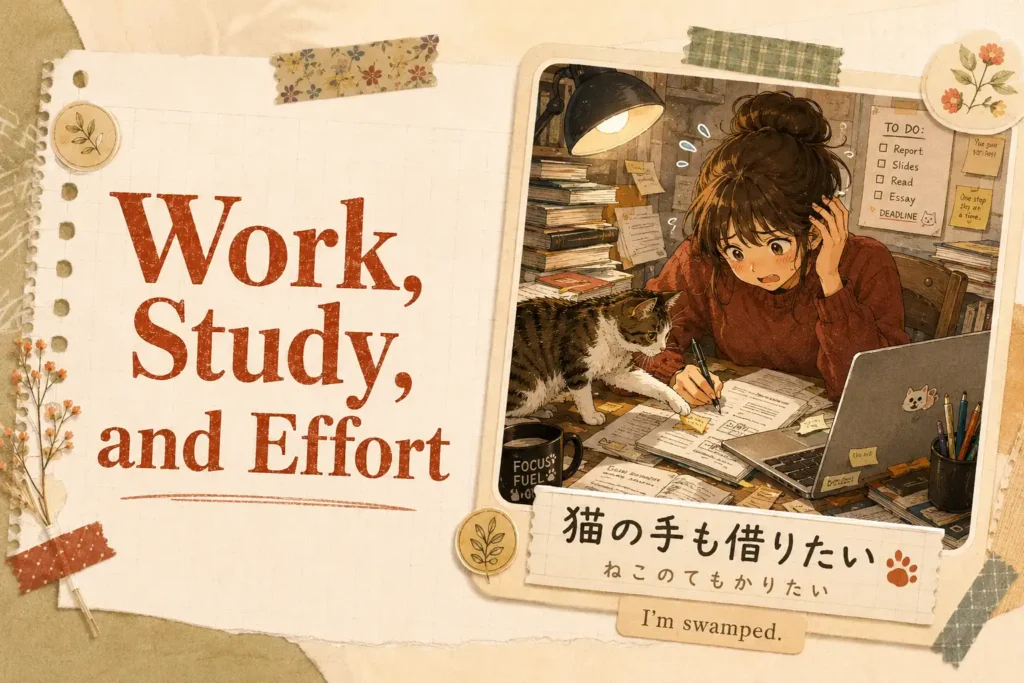
These idioms are useful for daily life, language learning, work pressure, and self-discipline. They are also easy to reuse in your own Japanese sentences.
21. 猫の手も借りたい
ねこのてもかりたい · 🐱 Animal idiom · Daily conversation
Meaning: to be completely swamped.
✍️ Example
今日は忙しくて、猫の手も借りたい。
きょうは いそがしくて、ねこのてもかりたい。
I’m completely swamped today.
🖼️ Literal image: even a cat’s tiny paw starts to look useful.
💡 Usage note: Natural for work, study, chores, or errands. For formal writing, use とても忙しい instead.
22. 手を焼く
てをやく · 🧍 Body idiom · Difficult situations
Meaning: to struggle with someone or something.
✍️ Example
新しいシステムに手を焼いている。
あたらしい システムに てをやいている。
I am having trouble with the new system.
🖼️ Literal image: your hands get burned while trying to handle it.
💡 Usage note: Safe for tasks or problems. Be careful when using it about people because it can sound like they are difficult.
23. 手を貸す
てをかす · 🧍 Body idiom · Asking for help
Meaning: to lend a hand.
✍️ Example
少し手を貸してくれる?
すこし てをかしてくれる?
Can you lend me a hand for a moment?
🖼️ Literal image: giving someone your hand so they can finish the task.
💡 Usage note: Common and useful. In polite speech, say 手を貸していただけますか.
24. 気が重い
きがおもい · 💬 Conversational phrase · Stress and pressure
Meaning: to feel weighed down.
✍️ Example
明日の会議のことを考えると気が重い。
あしたの かいぎのことを かんがえると きがおもい。
Thinking about tomorrow’s meeting makes me feel heavy.
🖼️ Literal image: your mood becomes physically heavy.
💡 Usage note: Natural for stressful events, awkward meetings, difficult calls, or tasks you do not want to face.
25. 気を使う
きをつかう · 💬 Conversational phrase · Social awareness
Meaning: to be considerate or worry about others’ feelings.
✍️ Example
そんなに気を使わなくていいよ。
そんなに きをつかわなくていいよ。
You do not have to be so considerate.
🖼️ Literal image: using your inner energy to care about others.
💡 Usage note: Very common in Japanese social life. It can mean kindness, pressure, or emotional labor depending on context.
26. 気を抜く
きをぬく · 💬 Conversational phrase · Focus and effort
Meaning: to let your guard down.
✍️ Example
最後まで気を抜かないで。
さいごまで きをぬかないで。
Do not let your guard down until the end.
🖼️ Literal image: pulling the energy out of yourself too early.
💡 Usage note: Useful in sports, exams, work, and any situation that needs focus.
27. 骨が折れる
ほねがおれる · 🧍 Body idiom · Hard work
Meaning: to be hard work.
✍️ Example
この資料を全部直すのは骨が折れる。
この しりょうを ぜんぶ なおすのは ほねがおれる。
Fixing all these documents is hard work.
🖼️ Literal image: the task is so hard it could break your bones.
💡 Usage note: Natural for difficult tasks. It sounds more expressive than 大変です.
28. 腕を上げる
うでをあげる · 🧍 Body idiom · Skill improvement
Meaning: to improve your skill.
✍️ Example
最近、料理の腕を上げたね。
さいきん、りょうりの うでをあげたね。
Your cooking skills have really improved lately.
🖼️ Literal image: your arm rises higher as your skill grows.
💡 Usage note: Positive and safe. It works well for cooking, sports, art, language, and work skills.
Mini Check: Can You Use These Work Idioms?
Choose the best idiom for each situation.
- You are so busy that even a small amount of help would be useful.
A. 猫の手も借りたい
B. 腕を上げる
C. 気を抜く - Your cooking has improved a lot recently.
A. 骨が折れる
B. 腕を上げる
C. 気が重い
Answers: 1-A, 2-B
Funny Literal Idioms with Animals, Food, and Luck
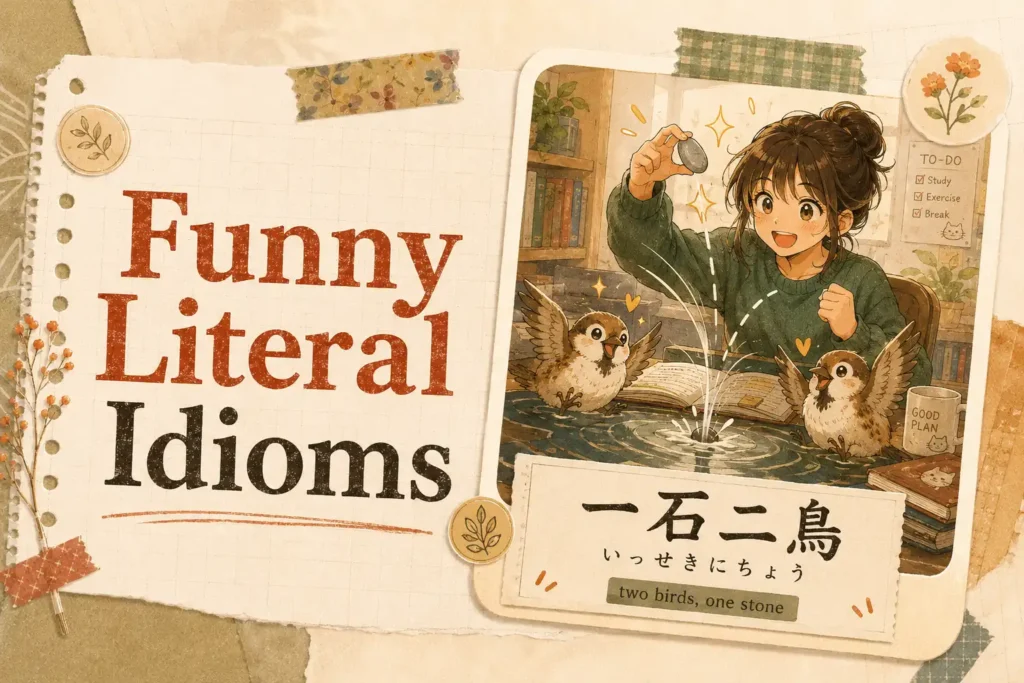
These are the expressions that make Japanese idioms fun to remember. The literal images are strange, cute, or funny, but the meanings are practical.
29. 鯖を読む
さばをよむ · 🐟 Animal idiom · Use with care
Meaning: to fudge the numbers.
✍️ Example
彼は年齢を少し鯖読んでいるらしい。
かれは ねんれいを すこし さばよんでいるらしい。
Apparently, he is fudging his age a little.
🖼️ Literal image: counting mackerel so quickly that the numbers get blurry.
💡 Usage note: Common, but it implies someone is not being honest. Avoid using it about bosses, clients, or serious money matters.
30. 棚から牡丹餅
たなからぼたもち · 📜 Proverb · Lucky moments
Meaning: an unexpected stroke of luck.
✍️ Example
無料でチケットをもらえるなんて、棚から牡丹餅だね。
むりょうで チケットをもらえるなんて、たなから ぼたもちだね。
Getting free tickets like that is such a lucky break.
🖼️ Literal image: a sweet rice cake falls from the shelf into your hands.
💡 Usage note: Cute and memorable. Use it when good luck appears without much effort.
31. 花より団子
はなよりだんご · 📜 Proverb · Food and practicality
Meaning: practical things matter more than pretty things.
✍️ Example
景色より食べ物が楽しみなんて、花より団子だね。
けしきより たべものが たのしみなんて、はなより だんごだね。
You care more about the food than the view. That is very substance over style.
🖼️ Literal image: choosing rice dumplings over flowers.
💡 Usage note: Often playful. It is good for food, travel, shopping, and people who prefer comfort over aesthetics.
32. 猿も木から落ちる
さるもきからおちる · 🐵 Animal proverb · Encouragement
Meaning: even experts make mistakes.
✍️ Example
プロでも失敗するよ。猿も木から落ちる。
プロでも しっぱいするよ。さるも きから おちる。
Even pros make mistakes.
🖼️ Literal image: even a monkey falls from a tree.
💡 Usage note: Encouraging and easy to remember. Use it to comfort someone after a mistake.
33. 二兎を追う者は一兎をも得ず
にとをおうものはいっとをもえず · 🐇 Animal proverb · Focus and priorities
Meaning: chase two things at once, and you may lose both.
✍️ Example
仕事も試験も完璧にしようとして、結局どちらもうまくいかなかった。
しごとも しけんも かんぺきにしようとして、けっきょく どちらも うまくいかなかった。
I tried to perfect both work and exams, and ended up doing well in neither.
🖼️ Literal image: running after two rabbits and catching neither.
💡 Usage note: Clear and close to English. It is useful when talking about focus, goals, and priorities.
34. 泣き面に蜂
なきつらにはち · 🐝 Animal proverb · Bad luck
Meaning: one bad thing happens after another.
✍️ Example
財布をなくした上に、雨まで降ってきた。泣き面に蜂だ。
さいふをなくした うえに、あめまで ふってきた。なきつらに はちだ。
I lost my wallet, and then it started raining. One thing after another.
🖼️ Literal image: a bee stings you while you are already crying.
💡 Usage note: Similar to “when it rains, it pours.” It is vivid but not rude.
35. 鬼に金棒
おににかなぼう · 📜 Proverb-like phrase · Extra advantage
Meaning: something strong becomes even stronger.
✍️ Example
彼に新しいパソコンを持たせたら、鬼に金棒だ。
かれに あたらしい パソコンを もたせたら、おににかなぼうだ。
Give him a new computer, and he will be unstoppable.
🖼️ Literal image: a demon holding an iron club.
💡 Usage note: Positive and slightly dramatic. Use it when a capable person gets an extra advantage.
36. 知らぬが仏
しらぬがほとけ · 📜 Proverb · Ironic comfort
Meaning: ignorance can be bliss.
✍️ Example
本当の値段を知らないほうが幸せかも。知らぬが仏だね。
ほんとうの ねだんを しらないほうが しあわせかも。しらぬがほとけだね。
Maybe it is better not to know the real price. Ignorance is bliss.
🖼️ Literal image: not knowing lets you stay as calm as a Buddha.
💡 Usage note: Often used with humor. It can also carry a slightly cynical tone.
Mini Check: Can You Use These Funny Literal Idioms?
Choose the best idiom for each situation.
- You get free tickets without expecting anything.
A. 棚から牡丹餅
B. 泣き面に蜂
C. 鯖を読む - Even a professional makes a mistake.
A. 花より団子
B. 猿も木から落ちる
C. 知らぬが仏
Answers: 1-A, 2-B
Japanese Proverbs for Life Lessons and Culture
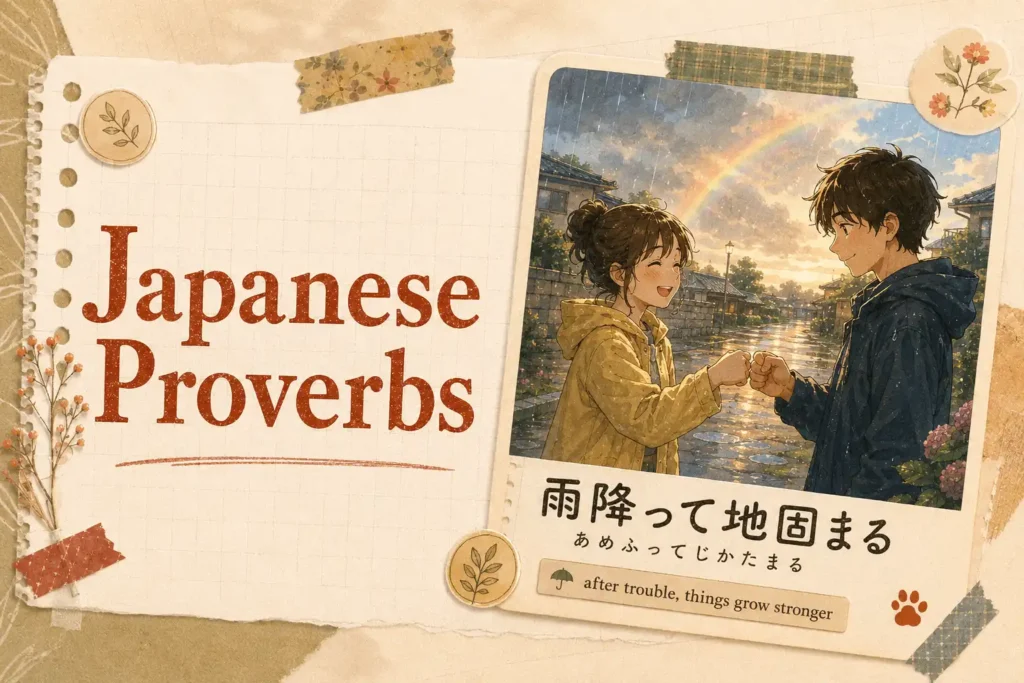
These phrases feel more like cultural wisdom than everyday slang. You may see them in essays, speeches, interviews, and reflective conversations.
37. 石の上にも三年
いしのうえにもさんねん · 📜 Proverb · Long-term effort
Meaning: patience and persistence pay off.
✍️ Example
語学はすぐに上達しない。石の上にも三年だ。
ごがくは すぐに じょうたつしない。いしのうえにも さんねんだ。
Language learning does not improve overnight. Persistence matters.
🖼️ Literal image: sitting on a cold stone until it finally becomes warm.
💡 Usage note: Common in study, work, and long-term goals. It sounds motivational rather than casual.
38. 七転び八起き
ななころびやおき · 📜 Proverb · Motivation
Meaning: keep getting back up.
✍️ Example
何度失敗しても、七転び八起きの気持ちで頑張ろう。
なんど しっぱいしても、ななころびやおきの きもちで がんばろう。
No matter how many times we fail, let’s keep getting back up.
🖼️ Literal image: falling seven times and standing up eight.
💡 Usage note: Positive and motivational. It works well in essays, speeches, and personal reflection.
39. 後の祭り
あとのまつり · 📜 Proverb-like phrase · Too late now
Meaning: it is too late now.
✍️ Example
今さら謝っても、後の祭りだ。
いまさら あやまっても、あとのまつりだ。
Apologizing now is too little, too late.
🖼️ Literal image: arriving after the festival is already over.
💡 Usage note: Common and useful. It can sound a bit cold, so soften it in sensitive situations.
40. 急がば回れ
いそがばまわれ · 📜 Proverb · Practical advice
Meaning: slow and steady can be faster in the end.
✍️ Example
近道より安全な道を行こう。急がば回れだ。
ちかみちより あんぜんな みちを いこう。いそがばまわれだ。
Let’s take the safer route instead of the shortcut.
🖼️ Literal image: taking the long way because rushing can backfire.
💡 Usage note: Useful for study, work, travel, and problem-solving. It sounds practical rather than emotional.
41. 出る杭は打たれる
でるくいはうたれる · 📜 Proverb · Cultural idea
Meaning: people who stand out may get criticized.
✍️ Example
日本では、出る杭は打たれると言われることがある。
にほんでは、でるくいは うたれると いわれることがある。
In Japan, people sometimes say that the nail that sticks out gets hammered down.
🖼️ Literal image: a raised stake gets hit with a hammer.
💡 Usage note: Useful for cultural discussion, but do not use it as a simple explanation for all Japanese behavior.
42. 住めば都
すめばみやこ · 📜 Proverb · Adjusting to change
Meaning: any place can start to feel like home.
✍️ Example
最初は不便だったけど、住めば都だね。
さいしょは ふべんだったけど、すめばみやこだね。
It was inconvenient at first, but now it feels like home.
🖼️ Literal image: wherever you live can become the capital.
💡 Usage note: Warm and useful for moving, travel, study abroad, or adjusting to a new job.
43. 雨降って地固まる
あめふってじかたまる · 📜 Proverb · Conflict repair
Meaning: after trouble, things can become stronger.
✍️ Example
喧嘩したけど、前より仲良くなった。雨降って地固まるだね。
けんかしたけど、まえより なかよくなった。あめふって じかたまるだね。
We fought, but now we are closer than before.
🖼️ Literal image: after rain, the ground becomes firm.
💡 Usage note: Often used after conflict, tension, or a difficult event that leads to a better relationship.
44. 口は災いの元
くちはわざわいのもと · 📜 Proverb · Careful speech
Meaning: careless words cause trouble.
✍️ Example
余計なことを言ってしまった。口は災いの元だね。
よけいなことを いってしまった。くちは わざわいのもとだね。
I said something unnecessary. Words really can cause trouble.
🖼️ Literal image: disaster begins at the mouth.
💡 Usage note: Good for self-reflection. It can sound preachy if you say it to someone else.
Mini Check: Can You Use These Proverbs?
Choose the best idiom for each situation.
- You want to say persistence matters in language learning.
A. 石の上にも三年
B. 後の祭り
C. 住めば都 - Two people fought, but the relationship became stronger afterward.
A. 出る杭は打たれる
B. 雨降って地固まる
C. 口は災いの元
Answers: 1-A, 2-B
Yojijukugo That English Speakers Can Actually Remember
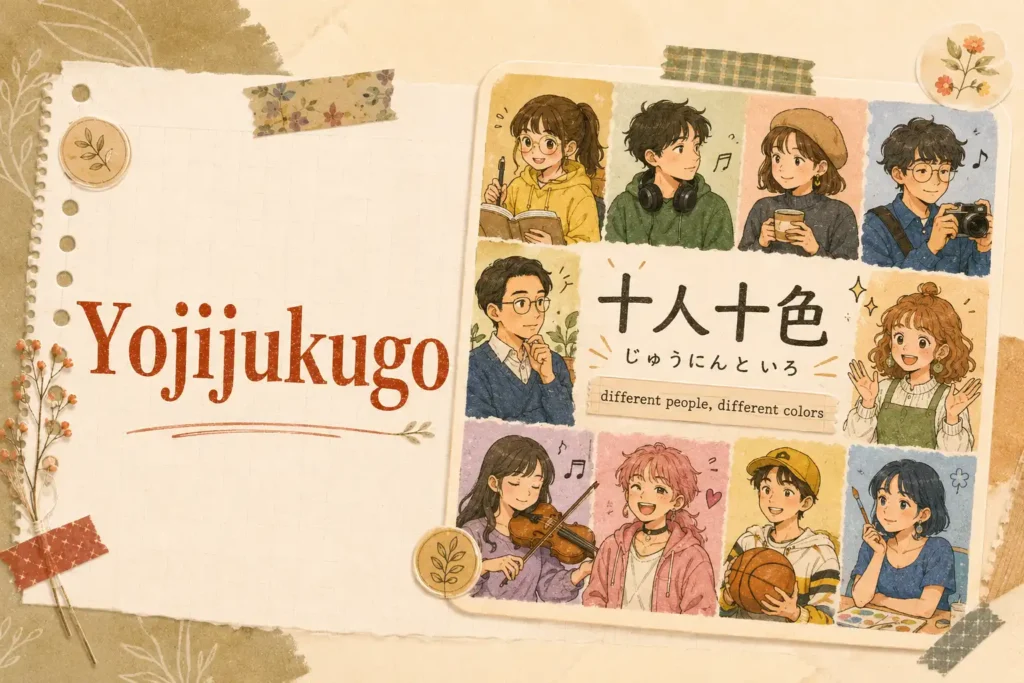
These four-character idioms are useful because many of them have a clear English match or a memorable idea.
45. 一石二鳥
いっせきにちょう · 🈶 Yojijukugo · Easy English match
Meaning: to kill two birds with one stone.
✍️ Example
通勤中に日本語を聞けば、勉強にもなるし時間も無駄にならない。一石二鳥だ。
つうきんちゅうに にほんごをきけば、べんきょうにもなるし じかんも むだにならない。いっせきにちょうだ。
Listening to Japanese during your commute is a two-for-one win.
🖼️ Literal image: one stone brings down two birds.
💡 Usage note: Very easy for English speakers to remember because the idea matches English closely.
46. 十人十色
じゅうにんといろ · 🈶 Yojijukugo · Opinions and tastes
Meaning: everyone is different.
✍️ Example
好きな勉強法は人によって違う。十人十色だ。
すきな べんきょうほうは ひとによって ちがう。じゅうにんといろだ。
Everyone has a different study method.
🖼️ Literal image: ten people, ten colors.
💡 Usage note: Positive and safe. Use it for tastes, personalities, opinions, and learning styles.
47. 三日坊主
みっかぼうず · 🈶 Yojijukugo · Teasing phrase
Meaning: someone who gives up quickly.
✍️ Example
また日記をやめたの?三日坊主だね。
また にっきを やめたの?みっかぼうずだね。
You quit journaling again? You never stick with it, do you?
🖼️ Literal image: a monk for only three days.
💡 Usage note: Common and funny, but it can sound teasing. Use it carefully when talking about someone else.
48. 一期一会
いちごいちえ · 🈶 Yojijukugo · Cultural phrase
Meaning: a once-in-a-lifetime encounter.
✍️ Example
この出会いを大切にしたい。一期一会だから。
この であいを たいせつにしたい。いちごいちえだから。
I want to treasure this meeting because it may only happen once.
🖼️ Literal image: one time, one meeting.
💡 Usage note: Beautiful and cultural. It is common in speeches, travel writing, tea ceremony contexts, and reflective posts. You may also see it explained through the tea ceremony idea of treasuring an unrepeatable meeting, often described as ichi-go ichi-e.
49. 自業自得
じごうじとく · 🈶 Yojijukugo · Can sound harsh
Meaning: you reap what you sow.
✍️ Example
勉強しなかったから落ちたんだよ。自業自得だ。
べんきょうしなかったから おちたんだよ。じごうじとくだ。
You failed because you did not study. You brought it on yourself.
🖼️ Literal image: your own actions return to you as your own result.
💡 Usage note: Very direct. It is safe for self-reflection, but harsh when said to someone who is already upset.
50. 温故知新
おんこちしん · 🈶 Yojijukugo · Writing and speeches
Meaning: to learn something new by studying the past.
✍️ Example
古い記事を読み返すと、新しい発見がある。まさに温故知新だ。
ふるい きじを よみかえすと、あたらしい はっけんがある。まさに おんこちしんだ。
When I reread old articles, I discover something new. That is learning from the past.
🖼️ Literal image: warming up old knowledge until it reveals something new.
💡 Usage note: More formal and reflective. It works well in essays, speeches, learning posts, and cultural topics.
Mini Check: Can You Use These Yojijukugo?
Choose the best idiom for each situation.
- You listen to Japanese while commuting, so you save time and study at the same time.
A. 一石二鳥
B. 三日坊主
C. 自業自得 - You want to say everyone has different tastes and learning styles.
A. 温故知新
B. 十人十色
C. 一期一会
Answers: 1-A, 2-B
Japanese Idioms Similar to English Idioms
Some Japanese idioms are easier to remember because they have a similar feeling in English.
| Japanese | Kana | Natural English |
|---|---|---|
| 一石二鳥 | いっせきにちょう | kill two birds with one stone |
| 後の祭り | あとのまつり | too little, too late |
| 知らぬが仏 | しらぬがほとけ | ignorance is bliss |
| 顔を立てる | かおをたてる | to save face |
| 水に流す | みずにながす | let bygones be bygones |
| 猿も木から落ちる | さるもきからおちる | even experts make mistakes |
This does not mean the Japanese and English phrases are always used in exactly the same way. But these matches can help you remember the core image faster.
How to Learn Japanese Idioms Without Memorizing a Long List
Do not start by trying to memorize 100 idioms at once. That is the fastest way to forget them.
Start with the expressions you keep noticing in real input. For me, that means Japanese variety shows, subtitles, dramas, interviews, songs, and reading notes.
First, save the Japanese phrase with kana. Do not rely only on romaji. Kana helps your eyes get used to real Japanese.
Second, write the literal image. This is the fun part. If the phrase says a cat’s paw, a falling monkey, or a hand coming out of a throat, keep that image. Weird images are easier to remember.
Third, write the natural English meaning. Do not translate word by word. Ask yourself what an English speaker would actually say in the same situation.
Fourth, add one usage note. Is it safe for daily conversation? Is it too direct? Is it more common in writing? Would it sound rude if you said it to a boss?
Finally, make one sentence from your own life. The sentence does not need to be fancy. It just needs to be yours. Once you have a few idioms with real sentences attached, a free Quizlet alternative can help you review them with spaced repetition so they actually stick.
Practice Japanese Idioms with AI
A list of Japanese idioms is useful, but it is not enough. If you only memorize the English meaning, you may still freeze when the phrase appears in a drama, subtitle, interview, or real conversation.
This is where AI can help.
The goal is not to let AI replace your Japanese input. The goal is to make your input easier to notice. When you find a phrase in a show, song, article, or textbook, you can use AI to check what kind of expression it is, how natural it sounds, and whether you should actively use it. If you use AI frequently for language learning, you might want to look into the ChatGPT Plus subscription price in Turkey to get premium features at a lower cost.
Practice 1: Check if the phrase is really an idiom
Not every beautiful Japanese phrase is an idiom. Songs and dramas often use poetic language, emotional collocations, and normal phrases that feel idiom-like.
Use this prompt when you are not sure.
I found this Japanese expression: [paste expression]

Can you tell me if it is:
1. a common idiom,
2. a proverb,
3. a yojijukugo,
4. a fixed expression,
5. or just a poetic phrase?

Please explain the difference in simple English.
Then give me one natural example sentence with kana and English translation.
Also tell me whether I should actively use it or just recognize it.
This is useful when you notice phrases in J-pop lyrics. For example, expressions like 胸を張る, 耳を澄ます, and 心を込める can be reused outside music. But many beautiful lyric lines are poetic, not fixed idioms.
Practice 2: Turn one idiom into natural dialogues
Idioms become easier to remember when you see them used between two people in a realistic situation.
I am learning the Japanese idiom [paste idiom].

Create three short Japanese dialogues where this phrase sounds natural.
Add kana under each Japanese sentence.
Give a natural English translation.
Then explain when this idiom sounds natural and when it might sound too strong.
For example, if you are learning 猫の手も借りたい, you can ask for dialogues about work, school, housework, or preparing for an event. The idiom sticks because it is connected to a scene, not just a definition.
Practice 3: Add idioms to your own Japanese diary
If you write a Japanese diary, even one or two sentences a day, AI can help you turn your own writing into an idiom lesson.
Here is my Japanese diary entry:[paste your entry]
Can you suggest 2 or 3 Japanese idioms that could naturally fit somewhere in this text? For each idiom: – show me where it could go, – explain the meaning, – add kana, – give a natural English translation, – and tell me if it sounds natural for my level.
This works better than memorizing random examples because the sentence comes from your own life.
Practice 4: Make a review table
Once you have collected several idioms, ask AI to turn them into a review table.
Turn these Japanese idioms into a review table:[paste idiom list]
Include: – Japanese idiom – kana – type: idiom, proverb, yojijukugo, or fixed expression – natural English meaning – one short Japanese example sentence – kana sentence – English translation – one usage note Make the examples sound natural for daily conversation.
You can paste the table into Notion, print it, or turn it into flashcards.
Download the Free Japanese Idioms PDF
If you want to keep all the idioms in one place, I also made a free PDF version.
It includes 100 Japanese idiom study cards with kana, meanings, literal images, usage notes, and review pages. You can save it to your phone, print it, or use it for weekly review.
FAQ About Japanese Idioms
What are Japanese idioms?
Japanese idioms are fixed expressions whose meaning cannot always be understood from the individual words. Many Japanese idioms use body parts, animals, food, nature, or four-kanji compounds to express feelings, social situations, and life lessons.
What is the difference between Japanese idioms, proverbs, and yojijukugo?
Japanese idioms, or 慣用句, are often used in daily sentences. Proverbs, or ことわざ, usually teach a lesson or cultural idea. Yojijukugo, or 四字熟語, are four-character expressions made of kanji. Some yojijukugo are common and idiomatic, while others sound more formal or literary.
Are Japanese idioms used in everyday conversation?
Yes, many Japanese idioms are used in everyday conversation. Expressions like 頭に来る, 気を使う, 手を貸す, and 馬が合う can appear naturally in casual speech, shows, subtitles, and social conversations.
Are all Japanese idioms casual?
No, Japanese idioms are not all casual. Some are conversational, some are safe for work, some sound formal or literary, and some can sound harsh if used at the wrong moment. That is why usage notes matter.
Why do Japanese idioms use so many body parts?
Japanese body idioms often turn emotions and social reactions into physical images. Anger can go to the head, feelings can fill the chest, and secrets can be held by the mouth. These images make abstract feelings easier to picture.
Are yojijukugo common in daily Japanese?
Some yojijukugo are common in daily Japanese, such as 一石二鳥, 十人十色, 三日坊主, and 半信半疑. Others sound more formal, literary, or academic, so it is better to learn them with example sentences and usage notes.
Can I learn Japanese idioms from songs?
Yes, Japanese songs can help you notice idioms and fixed expressions, but not every lyric phrase is an idiom. Songs often use poetic language, so it is better to save expressions that also appear in shows, interviews, articles, or daily conversation. Good examples include 胸を張る, 耳を澄ます, 心を込める, and 頭の中が真っ白になる.
How do I know if a Japanese idiom is outdated?
The safest way is to check whether you hear it in modern shows, conversations, subtitles, podcasts, or recent learning materials. If an idiom only appears in old proverb lists and never in real examples, treat it as cultural knowledge rather than a phrase to use actively.
What is the best way to memorize Japanese idioms?
The best way to memorize Japanese idioms is to connect three things: the literal image, the natural English meaning, and one real-life sentence. A strange image like a cat’s paw or a monkey falling from a tree becomes much easier to remember when you attach it to a situation you actually understand.
Should I learn 50 or 100 Japanese idioms?
Start with 50 if you want to recognize common idioms in shows, subtitles, and daily examples. Use a 100-idiom PDF as a longer review resource, not as something you need to memorize in one sitting.
Final Thoughts
Japanese idioms can feel strange at first. Someone’s stomach stands up. A cat’s paw becomes useful. A monkey falls from a tree. A rice cake drops from a shelf.
But once you stop treating these expressions as random vocabulary and start seeing them as little scenes, they become much easier to remember.
You do not need to memorize every Japanese idiom at once. Start with the ones you keep seeing in shows, subtitles, manga, conversations, songs, and study notes. Learn the meaning, notice the image, and pay attention to the situation.
That is how Japanese idioms move from “weird phrases in a list” to expressions you can actually understand and use.