You learn 大きい and 寒い first. The pattern feels clear: i adjectives change their own endings.
Then you meet 静か, きれい, and 好き. They describe things just like i adjectives do, but the grammar works completely differently.
That is usually the moment na adjectives start to feel confusing.
In this guide, you will learn what Japanese na adjectives are, how they conjugate, when to add or drop な, and how to practice them with AI prompts and a Notion flashcard system. This way, the pattern does not stay as another grammar rule you forget tomorrow.
Quick Answer: What Are Japanese Na Adjectives?
Japanese na adjectives are descriptive words that need な when placed before a noun. Unlike i adjectives, they do not change their own endings. Instead, they use だ or です to express tense and politeness.
For example:
| Word | Reading | English |
|---|---|---|
| 静か | しずか | quiet |
| きれい | きれい | pretty / clean |
| 好き | すき | liked / favorite |
| 有名 | ゆうめい | famous |
| 元気 | げんき | healthy / energetic |
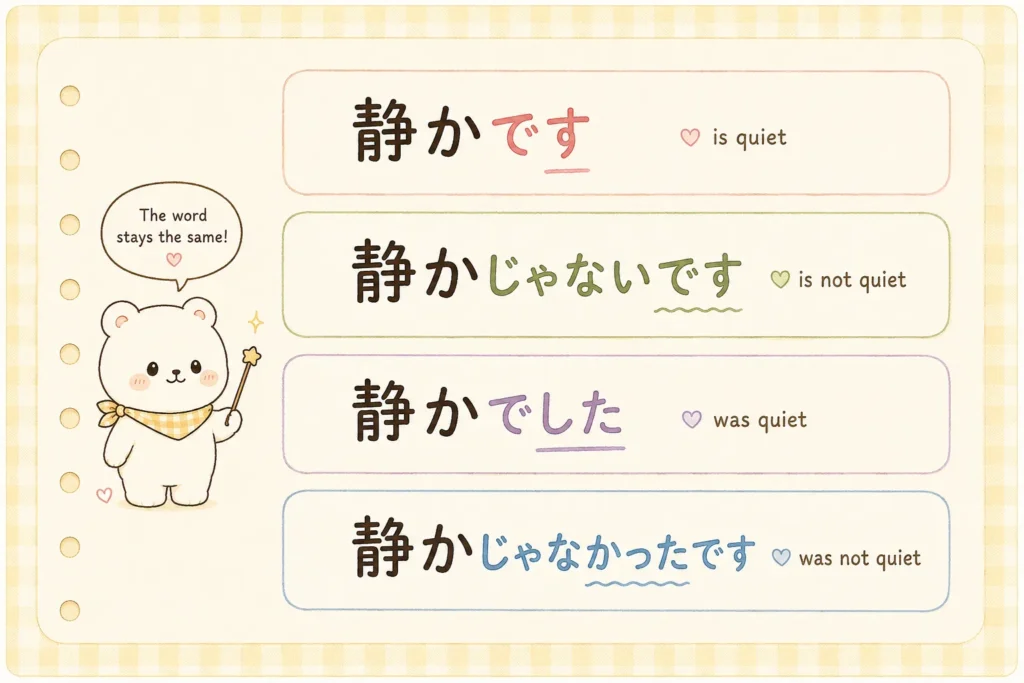
That means 静か can become:
| Form | Japanese | English |
|---|---|---|
| Present | 静かです | is quiet |
| Negative | 静かじゃないです | is not quiet |
| Past | 静かでした | was quiet |
| Past Negative | 静かじゃなかったです | was not quiet |
Once you understand that pattern, every na adjective you encounter becomes easier to use.
Japanese Na Adjective Cheat Sheet
Here is the pattern you need most often:
| Meaning | Rule | Example |
|---|---|---|
| is not | na adjective + じゃない | 静か → 静かじゃない |
| was | na adjective + だった | 静か → 静かだった |
| was not | na adjective + じゃなかった | 静か → 静かじゃなかった |
| and / so | na adjective + で | 静か → 静かで |
Use this table whenever a na adjective needs to change form.
What Are Japanese Na Adjectives?
Japanese has two main adjective types:
| Type | Example | Reading | Basic Meaning |
|---|---|---|---|
| I adjective | おいしい | おいしい | delicious |
| Na adjective | 静か | しずか | quiet |
Na adjectives are called na adjectives because they need な when placed directly before a noun.
Examples:
| Word | Reading | English |
|---|---|---|
| 静か | しずか | quiet |
| きれい | きれい | pretty / clean |
| 有名 | ゆうめい | famous |
| 親切 | しんせつ | kind |
| 便利 | べんり | convenient |
They can do two things.
First, they can describe a noun directly. When they do, な goes between the adjective and the noun:
| Japanese | Reading | English |
|---|---|---|
| 静かな部屋 | しずかなへや | a quiet room |
| きれいな花 | きれいなはな | a pretty flower |
| 有名な人 | ゆうめいなひと | a famous person |
| 便利なアプリ | べんりなあぷり | a convenient app |
Second, they can finish a sentence. When they do, な is dropped:
この部屋は静かです。
This room is quiet.

彼女はきれいです。
She is pretty.

この店は有名です。
This shop is famous.
This is where na adjectives feel different from i adjectives.
I adjectives carry tense inside the word itself. 寒い becomes 寒かった on its own.
Na adjectives do not change their own form. 静か stays as 静か. The word after it handles tense and politeness.
静か + です = 静かです (is quiet) 静か + でした = 静かでした (was quiet)
This is why na adjectives are sometimes described as noun-like. They behave more like nouns than like verbs.
How to Recognize Na Adjectives
There is no single ending that marks every na adjective. The best approach is to learn the type together with the word.
That said, many common na adjectives follow recognizable patterns:
| Word | Reading | English |
|---|---|---|
| 静か | しずか | quiet |
| 元気 | げんき | healthy / energetic |
| 親切 | しんせつ | kind |
| 便利 | べんり | convenient |
| 有名 | ゆうめい | famous |
| 大切 | たいせつ | important / precious |
| 大丈夫 | だいじょうぶ | okay / fine |
| 上手 | じょうず | good at |
| 下手 | へた | bad at |
| 暇 | ひま | free (not busy) |
If you are not sure whether a word is a na adjective or an i adjective, the Japanese i adjectives guide covers the full conjugation pattern for comparison.
A helpful test: try adding とても (very) before the word. If it sounds natural, the word is likely an adjective.
とても静か → natural ✅ (very quiet)
とても犬 → unnatural ❌ (very dog)
One important note: some words end with an い sound but are still na adjectives. きれい and 嫌い look like i adjectives, but they are not. We will look at this trap later in detail.
Japanese Na Adjective Conjugation
Na adjectives do not change their own form. Instead, the copula (だ or です) changes to express tense and politeness.
The stem stays the same. Everything else attaches after.
Present Form
The present form uses だ in casual speech or です in polite speech.
| Plain | Polite | English |
|---|---|---|
| 静かだ | 静かです | is quiet |
| きれいだ | きれいです | is pretty |
| 有名だ | 有名です | is famous |
この部屋は静かです。
This room is quiet.

彼女はきれいです。
She is pretty.
Negative Form
To make a na adjective negative, add じゃない (casual) or じゃないです (polite).
静か → 静かじゃない
きれい → きれいじゃない
有名 → 有名じゃない
| Word | Negative | Reading | English |
|---|---|---|---|
| 静か | 静かじゃない | しずかじゃない | is not quiet |
| きれい | きれいじゃない | きれいじゃない | is not pretty |
| 有名 | 有名じゃない | ゆうめいじゃない | is not famous |
| 元気 | 元気じゃない | げんきじゃない | is not well |
この部屋は静かじゃないです。
This room is not quiet.

今日は元気じゃないです。
I am not feeling well today.
じゃない vs ではない
Both mean “is not.” じゃない is casual and natural in everyday speech. ではない is more formal and used in writing or formal situations.
静かじゃない  (casual, everyday)
静かではない  (formal, written)
静かじゃありません  (polite, spoken)
静かではありません  (formal polite)
For most learners and daily conversations, じゃない and じゃないです are enough.
Past Form
To make a na adjective past tense, add だった (casual) or でした (polite).
静か → 静かだった
きれい → きれいだった
有名 → 有名だった
| Word | Past Form | Reading | English |
|---|---|---|---|
| 静か | 静かだった | しずかだった | was quiet |
| きれい | きれいだった | きれいだった | was pretty |
| 有名 | 有名だった | ゆうめいだった | was famous |
| 元気 | 元気だった | げんきだった | was well |
昨日は静かでした。
Yesterday was quiet.

子どもの頃、彼女はきれいでした。
When she was young, she was pretty.
Past Negative Form
To make a na adjective past negative, add じゃなかった (casual) or じゃなかったです (polite).
静か → 静かじゃなかった
きれい → きれいじゃなかった
有名 → 有名じゃなかった
| Word | Past Negative | Reading | English |
|---|---|---|---|
| 静か | 静かじゃなかった | しずかじゃなかった | was not quiet |
| きれい | きれいじゃなかった | きれいじゃなかった | was not pretty |
| 有名 | 有名じゃなかった | ゆうめいじゃなかった | was not famous |
| 元気 | 元気じゃなかった | げんきじゃなかった | was not well |
昨日は元気じゃなかったです。
I was not feeling well yesterday.

その映画はそんなに有名じゃなかったです。
That movie was not that famous.
Complete Na Adjective Conjugation Table
Three common na adjectives side by side.
| Form | 静か | きれい | 元気 |
|---|---|---|---|
| Present (plain) | 静かだ | きれいだ | 元気だ |
| Present (polite) | 静かです | きれいです | 元気です |
| Negative (plain) | 静かじゃない | きれいじゃない | 元気じゃない |
| Negative (polite) | 静かじゃないです | きれいじゃないです | 元気じゃないです |
| Past (plain) | 静かだった | きれいだった | 元気だった |
| Past (polite) | 静かでした | きれいでした | 元気でした |
| Past Negative (plain) | 静かじゃなかった | きれいじゃなかった | 元気じゃなかった |
| Past Negative (polite) | 静かじゃなかったです | きれいじゃなかったです | 元気じゃなかったです |
To see the pattern clearly:
静か
静かじゃない
静かだった
静かじゃなかった
The word 静か never changes. Only the ending changes.
The な Rule: When to Add It and When to Drop It
This is the single most common mistake beginners make with na adjectives.
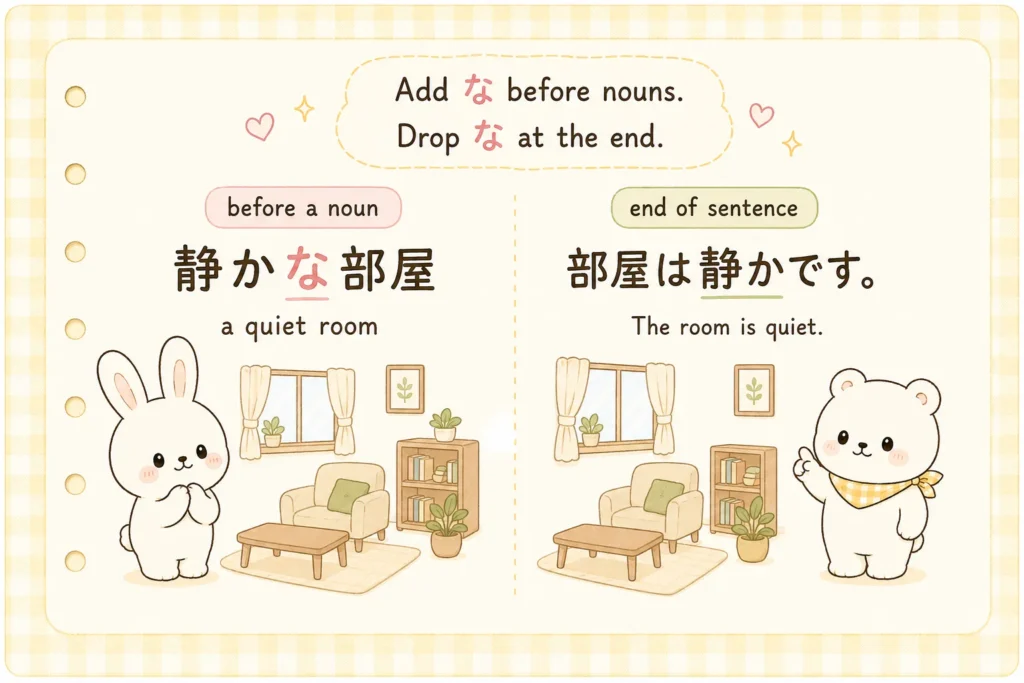
The rule is simple:
Add な when the na adjective directly describes a noun. Drop な when the na adjective ends the sentence.
Before a noun → add な
静かな部屋  ✅
a quiet room

きれいな花  ✅
a pretty flower

有名な人  ✅
a famous person
End of sentence → no な
この部屋は静かです。  ✅
This room is quiet.

彼女はきれいです。  ✅
She is pretty.
Common mistake: adding な before です
この部屋は静かなです。  ❌
この部屋は静かです。  ✅
な only connects the adjective to a noun. It does not connect the adjective to です or だ.
Another common mistake: forgetting な before a noun.
静か部屋  ❌
静かな部屋  ✅

きれい花  ❌
きれいな花  ✅
One more example to make it clear:
静かな部屋が好きです。
I like quiet rooms.
Here 静かな modifies 部屋 (room), so な is needed. The adjective 好き at the end does not need な because it ends the predicate.
Na Adjective Te Form: How to Connect Descriptions
To connect two descriptions using na adjectives, use the て form: add で after the na adjective.
静か → 静かで
きれい → きれいで
有名 → 有名で
| Word | Te Form | Reading | English |
|---|---|---|---|
| 静か | 静かで | しずかで | quiet and |
| きれい | きれいで | きれいで | pretty and |
| 有名 | 有名で | ゆうめいで | famous and |
この部屋は静かできれいです。
This room is quiet and pretty.

彼は有名で親切です。
He is famous and kind.
The で form can also show a reason:
暇で、映画を見ました。
I was free, so I watched a movie.
Na Adjectives as Adverbs
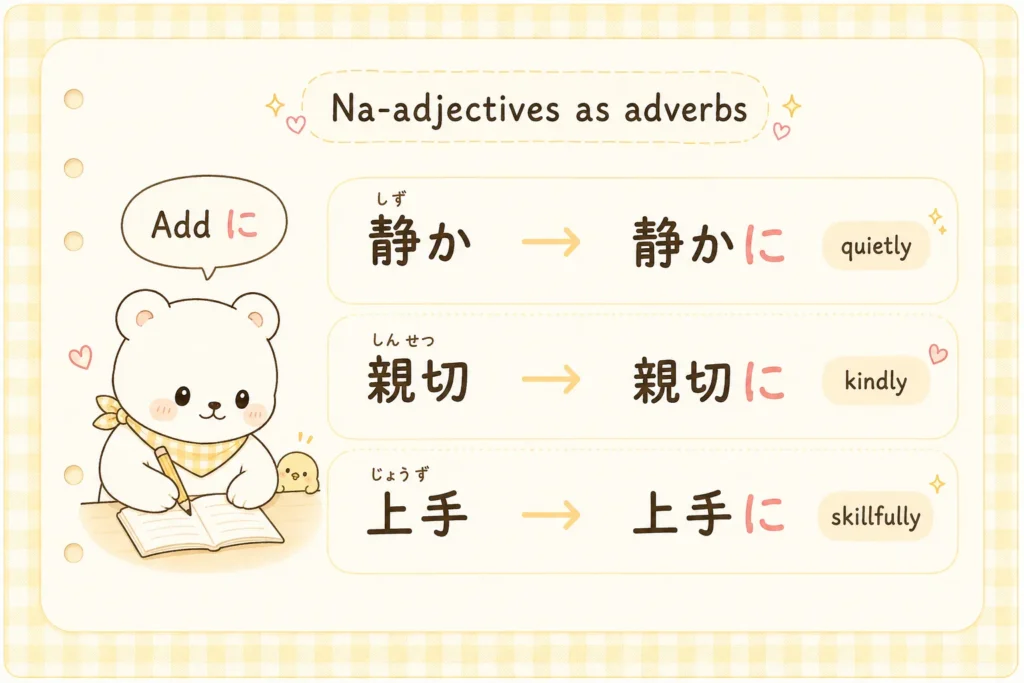
To turn a na adjective into an adverb, add に after the word.
静か → 静かに (quietly)
きれい → きれいに (prettily / cleanly)
上手 → 上手に (skillfully)
親切 → 親切に (kindly)
| Word | Adverb Form | Reading | English |
|---|---|---|---|
| 静か | 静かに | しずかに | quietly |
| きれい | きれいに | きれいに | prettily / cleanly |
| 上手 | 上手に | じょうずに | skillfully |
| 親切 | 親切に | しんせつに | kindly |
静かに話してください。
Please speak quietly.

きれいに書いてください。
Please write neatly.

上手に弾けました。
I was able to play skillfully.
Tricky Exceptions
きれい and 嫌い: Not I Adjectives
きれい (pretty / clean) and 嫌い (disliked) end with an い sound. Many beginners assume they are i adjectives.
They are not. Both are na adjectives.
きれいな部屋  ✅  (not きれい部屋)
嫌いな食べ物  ✅  (not 嫌い食べ物)
And they conjugate like na adjectives, not like i adjectives.
きれいじゃない  ✅
きれいくない   ❌

きれいだった  ✅
きれいかった  ❌
The reliable way to tell: for true i adjectives, the final い is written outside the kanji as okurigana. For きれい (綺麗), the い sound is fused into the kanji reading and cannot be removed for conjugation.
好き and 嫌い: Adjectives, Not Verbs
In English, “like” and “dislike” are verbs. In Japanese, 好き (liked) and 嫌い (disliked) are na adjectives.
This changes the particle you use.
寿司が好きです。  ✅
I like sushi. (literally: sushi is liked)

寿司を好きです。  ❌
Use が with 好き and 嫌い, not を.
猫が好きです。
I like cats.

納豆が嫌いです。
I dislike natto.
同じ: The Na Adjective That Skips な
同じ (おなじ) means “same.” It is a na adjective, but it does not take な before a noun.
同じ本  ✅  (not 同じな本)
the same book

同じ学校  ✅
the same school
At the end of a sentence, it works normally:
これは同じです。
This is the same.
Just remember: 同じ goes directly before the noun without な.
| Exception | Rule | Example |
|---|---|---|
| きれい | na adjective, conjugates with じゃない/だった | きれいじゃない / きれいだった |
| 嫌い | na adjective, use が not を | 猫が嫌いです |
| 好き | na adjective, use が not を | 寿司が好きです |
| 同じ | na adjective, no な before noun | 同じ本 |
For a reliable reference on any adjective’s classification, Jisho is a trusted Japanese dictionary used by learners worldwide.
A note on の-adjectives
Some words can also take の instead of な before a noun, like 本当の話 (a true story, ほんとうのはなし). You will notice these more as you read more Japanese. For now, focus on mastering the na adjective pattern first.
Common Na Adjectives Japanese List
Here are common Japanese na adjectives grouped by real use case.
🧠 Personality and Character
| Word | Reading | English | Example |
|---|---|---|---|
| 親切 | しんせつ | kind | 彼は親切です。 |
| 真面目 | まじめ | serious / hardworking | 彼女は真面目です。 |
| 元気 | げんき | energetic / healthy | 子どもたちは元気です。 |
| 素直 | すなお | honest / obedient | 彼は素直です。 |
| 丁寧 | ていねい | polite / careful | 彼女は丁寧です。 |
❤️ Feelings and States
| Word | Reading | English | Example |
|---|---|---|---|
| 好き | すき | liked / favorite | 音楽が好きです。 |
| 嫌い | きらい | disliked | 納豆が嫌いです。 |
| 大丈夫 | だいじょうぶ | okay / fine | 大丈夫ですか? |
| 暇 | ひま | free / not busy | 今日は暇です。 |
| 大変 | たいへん | tough / difficult | 仕事が大変です。 |
🏙️ Places and Situations
| Word | Reading | English | Example |
|---|---|---|---|
| 静か | しずか | quiet | 図書館は静かです。 |
| にぎやか | にぎやか | lively / busy | 渋谷はにぎやかです。 |
| きれい | きれい | pretty / clean | 部屋はきれいです。 |
| 便利 | べんり | convenient | この駅は便利です。 |
| 安全 | あんぜん | safe | この道は安全です。 |
| 危険 | きけん | dangerous | その場所は危険です。 |
📚 Ability and Skills
| Word | Reading | English | Example |
|---|---|---|---|
| 上手 | じょうず | good at | 彼はギターが上手です。 |
| 下手 | へた | bad at | 料理が下手です。 |
| 得意 | とくい | good at / confident | 数学が得意です。 |
| 苦手 | にがて | not good at | 英語が苦手です。 |
| 簡単 | かんたん | easy | この問題は簡単です。 |
⭐ Other Common Words
| Word | Reading | English | Example |
|---|---|---|---|
| 有名 | ゆうめい | famous | この映画は有名です。 |
| 大切 | たいせつ | important / precious | 家族は大切です。 |
| 特別 | とくべつ | special | 今日は特別です。 |
| 同じ | おなじ | same | 同じ学校です。 |
| 素敵 | すてき | lovely / wonderful | 素敵な場所です。 |
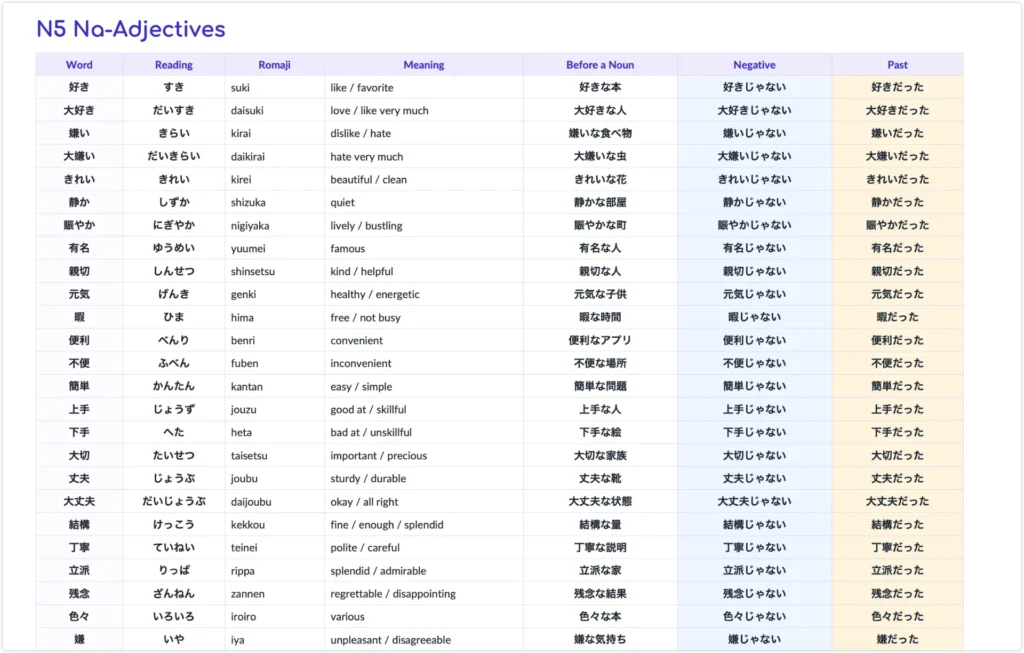
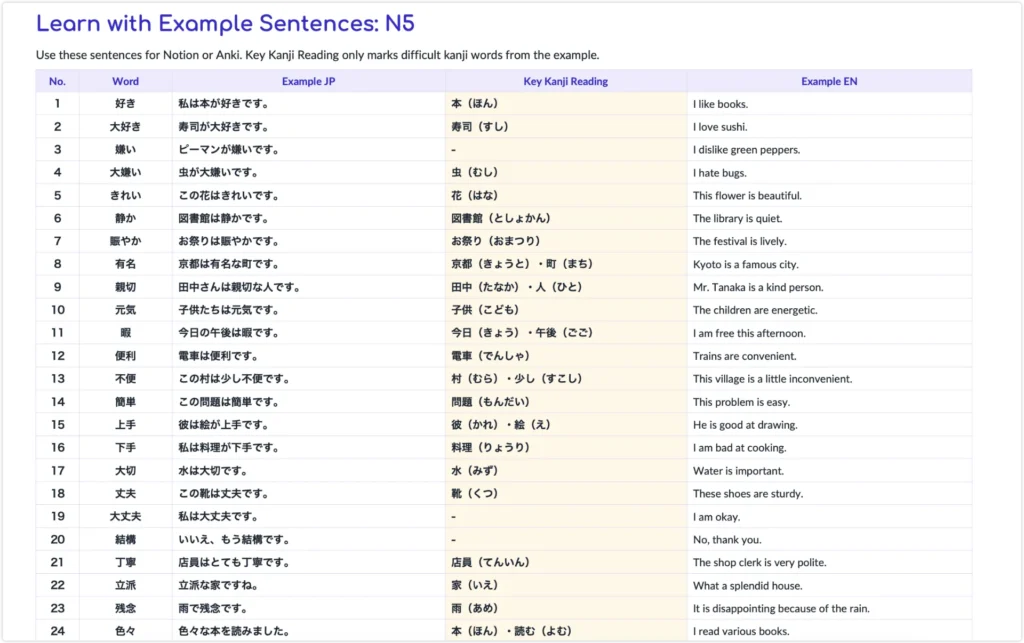
For a printable study table covering common な-adjectives from N5 to N1 — with readings, conjugation forms, and example sentences — download the free PDF here.
Na Adjectives as Nouns
Some na adjectives can also work as nouns on their own. These words refer to abstract concepts like safety, peace, or freedom. When used as nouns, they do not need な or です attached to them.
| Word | Reading | English | Example as Noun |
|---|---|---|---|
| 安全 | あんぜん | safety | 安全が第一だ。Safety comes first. |
| 平和 | へいわ | peace | 平和を願っています。We hope for peace. |
| 自由 | じゆう | freedom | 自由を守りましょう。Let’s protect our freedom. |
| 健康 | けんこう | health | 健康が大切です。Health is important. |
When you see these words without な or です after them, they are being used as nouns, not adjectives. This is one reason why na adjectives are sometimes called “adjectival nouns” in linguistics.
Practice Na Adjectives with AI
Copy these prompts into the latest version of ChatGPT, Claude, or any AI language tutor and use them as study drills.
💬 Prompt 1: Conjugation Drill
Act as a Japanese teacher. Give me one Japanese na-adjective at a time. Ask me to change it into negative, past, and past negative forms. Correct my answer gently and explain the rule in simple English.
💬 Prompt 2: Sentence Correction
Act as a Japanese tutor. I will write Japanese sentences using na-adjectives. Correct my grammar, explain the mistake, and give me a more natural version. Please include English translation.
💬 Prompt 3: Na vs I Adjective Quiz
Quiz me on Japanese i-adjectives and na-adjectives. Give me one adjective at a time and ask whether it is an i-adjective or a na-adjective. Include tricky words like きれい, 嫌い, 好き, 同じ, おいしい, 高い, and 静か. Explain the rule after each answer.
💬 Prompt 4: Diary Sentence Practice
Give me five simple diary prompts using Japanese na-adjectives. Help me write one sentence about a place, a person, a feeling, an ability, and something important. Correct my sentences and explain each correction.
💬 Prompt 5: Describe a Person in Japanese
Help me describe a friend in Japanese using na-adjectives. Use words like 親切, 真面目, 元気, 上手, and 好き. Show me the correct particle for each adjective and give one natural example sentence for each word.
Repeat these prompts every few days with new adjectives. The goal is not to memorize one table. The goal is to train your brain to see the pattern quickly.
Build a Notion Flashcard System for Japanese Na Adjectives
A grammar chart is useful when you are reading. A flashcard system is useful when you want to remember the pattern next week.
| Field | Example |
|---|---|
| Word | 静か |
| Reading | しずか |
| Meaning | quiet |
| Type | na adjective |
| Before a noun | 静かな部屋 |
| Negative | 静かじゃない |
| Past | 静かだった |
| Past Negative | 静かじゃなかった |
| Te Form | 静かで |
| Adverb Form | 静かに |
| Example Sentence | この図書館は静かです。 |
| My Sentence | 昨日の夜は静かでした。 |
| Review Status | New / Learning / Mastered |
| Review Date | Friday |
Simple study workflow:
- Add five new na adjectives.
- Fill in the reading, negative, past, and past negative forms.
- Write one personal sentence for each word.
- Ask AI to correct your sentences.
- Review the same cards again in three days.
The personal sentence is the most important part.
この図書館は静かです。
This library is quiet.

昨日の夜は静かでした。
Last night was quiet.
Grammar becomes easier when it lives inside a sentence from your own life.
Quick Practice Quiz
Questions
- Change 静か into the negative form.
- Change きれい into the past form.
- Change 元気 into the past negative form.
- Is きれい an i adjective or a na adjective?
- Is 好き an i adjective or a na adjective?
- Fill in the blank: 静か___部屋が好きです。
- Correct the mistake: この部屋は静かなです。
- Correct the mistake: 寿司を好きです。
- Translate: That place was not safe.
- Translate: She is kind and famous.
- Change 有名 into the adverb form.
- Does 同じ need な before a noun?
Answers
- 静かじゃない
- きれいだった
- 元気じゃなかった
- きれい is a na adjective.
- 好き is a na adjective.
- 静かな部屋が好きです。
- この部屋は静かです。(drop な before です)
- 寿司が好きです。(use が, not を)
- その場所は安全じゃなかったです。
- 彼女は親切で有名です。
- 有名に
- No. 同じ goes directly before the noun: 同じ本。
If you got the な rule wrong, go back to the な section and try writing three sentences: one before a noun, one at the end of a sentence.
FAQ About Japanese Na Adjectives
What is a na adjective in Japanese?
A na adjective is a type of Japanese adjective that needs な when placed directly before a noun. Unlike i adjectives, na adjectives do not change their own form. They use だ or です to express tense and politeness. Examples include 静か, きれい, 元気, 有名, and 好き.
How do you conjugate na adjectives?
Na adjectives do not change form. The copula after them changes instead.
静か → 静かです / 静かじゃない / 静かだった / 静かじゃなかった
Use じゃない for negative, だった for past, and じゃなかった for past negative.
Is きれい a na adjective?
Yes. Even though きれい ends with an い sound, it is a na adjective. It conjugates with じゃない and だった, not with くない and かった.
きれいじゃない  ✅
きれいくない   ❌
Is 好き a na adjective?
Yes. 好き means “liked” or “favorite” and is a na adjective in Japanese. Because it is an adjective, use が to mark what you like, not を.
寿司が好きです。  ✅
寿司を好きです。  ❌
When do you drop the な?
Drop な when the na adjective appears at the end of a sentence. Keep な when the na adjective directly describes a noun.
静かな部屋  (before a noun → keep な)
部屋は静かです。  (end of sentence → no な)
What is the difference between じゃない and ではない?
Both mean “is not.” じゃない is casual and used in everyday speech. ではない is more formal and used in writing or formal situations. For most beginners, じゃない is enough.
How do you use na adjectives as adverbs?
Add に after the na adjective.
静か → 静かに (quietly)
上手 → 上手に (skillfully)
きれい → きれいに (neatly)
Does 同じ take な before a noun?
No. 同じ is a na adjective but goes directly before the noun without な.
同じ本  ✅  (not 同じな本)
the same book
Final Takeaway
Japanese na adjectives become easier once you remember one core rule: the word itself never changes. Only the ending after it changes.
静か
静かじゃない
静かだった
静かじゃなかった
Start with the な rule:
静かな部屋  (before a noun → な)
部屋は静かです。  (end of sentence → no な)
Then remember the common traps:
きれい → na adjective (not i adjective)
好き → use が, not を
同じ → no な before a noun
Practice in real sentences. Copy one AI prompt, add five na adjectives to your Notion flashcard table, and review them this week.
Once the pattern clicks, Japanese descriptions start to feel much more natural.
Ready to keep going? Now that you know both adjective types, the next step is understanding exactly how Japanese i adjectives and na adjectives work differently — and how to tell them apart every time.